





Travel Expense Fraud: How Expense Management Can Reduce It



Mekari Insight
- Travel expense fraud can involve fictitious trips, unused tickets, inflated expenses, duplicate reimbursements, or personal expenses claimed as business costs.
- Expense management helps Finance teams reduce these risks by connecting travel requests, approvals, receipts, reimbursements, and transaction checks in one workflow.
- Key controls include expense policy enforcement, duplicate detection, receipt verification, approval controls, and a clear audit trail.
- Mekari Expense Business Trip brings these controls together with digital trip requests, multi-level approvals, automated travel policies, OCR receipt capture, duplicate transaction detection, and Fraud AI Checker.
Business travel is supposed to support operations, not become a source of spending leakage in the budget. Yet travel fraud remains a persistent problem across companies and government institutions alike.
According to detik.com, Indonesia’s Supreme Audit Agency (BPK) uncovered Rp39.26 billion in irregular business travel expenditures across 46 ministries and government agencies in its 2023 audit report alone. The schemes are growing more varied — from forged tickets and duplicate claims to trips that were never taken in the first place.
Left unchecked, these practices don’t just drain finances. They erode the transparency and credibility of an organization’s financial management as a whole.

What is travel expense fraud?
Travel expense fraud refers to any act of misconduct aimed at obtaining personal gain from a company’s or institution’s travel budget.
It can take many forms: forged documents, inflated expenses, or claims submitted for trips that never actually happened.
Broadly speaking, travel expense fraud falls into several categories:
- Fictitious business trip: Travel that never took place, yet full documentation and reimbursement claims are submitted anyway.
- Inflated expenses: The trip did happen, but the claimed costs are deliberately marked up to secure a larger reimbursement.
- Duplicate claims: The same expense is submitted more than once to receive multiple payouts.
The ACFE (Association of Certified Fraud Examiners) classifies travel reimbursement fraud into four primary types:
- Fictitious expenses: Costs claimed for things that never occurred.
- Mischaracterized expenses: Personal expenses disguised as business travel costs.
- Overstated expenses: Real costs that have been deliberately inflated.
- Multiple reimbursements: The same claim submitted more than once.
It’s also worth noting that travel expense fraud isn’t confined to the public sector. It’s widespread in private companies too — particularly those where approval and reimbursement processes are still handled manually.
Read more: Business Travel Expenses Guide: How to Manage & Tracking
Travel Expense Fraud Data and Cases
Travel expense fraud is not a rare or isolated occurrence. Audit findings over recent years show that it continues to happen repeatedly, with increasingly varied methods.
Cases in Indonesia
Here are some notable findings that illustrate the ongoing nature of the problem:
- 2026 – Bank DKI case: BPK identified suspected irregularities in travel reimbursements with potential overpayments reaching Rp389 million. Among the findings: 163 plane tickets with a “Not Used” status had still been claimed for reimbursement.
- 2021 – BPK findings across ministries and agencies: In its First Semester Audit Summary for 2021, BPK found fictitious travel expenses totaling Rp2.54 billion and duplicate or above-standard travel claims totaling Rp13.16 billion
- 2022 – KPK special focus: Indonesia’s Corruption Eradication Commission (KPK) identified fictitious business trip as one of the most frequently occurring fraud schemes at the regional government level — including budget disbursements for activities that simply never took place.
During the same period, BPK recorded approximately 15,000 state financial management issues, with total potential losses reaching Rp18.37 trillion.
Global data: expense fraud remains rampant
The problem extends well beyond Indonesia. According to the ACFE 2024 Report to the Nations:
- The average loss per reimbursement fraud case is USD 251,000
- Fraud goes undetected for an average of 18 months before being caught
- 20% of small businesses and 12% of large companies have experienced expense fraud
Perhaps most telling, the leading reason fraud goes undetected isn’t that the schemes are too sophisticated — it’s that internal controls are too weak:
- 32% of cases slipped through due to insufficient internal controls
- 19% succeeded because existing controls were bypassed
- 18% went unnoticed due to weak management review
Weak controls can allow travel expense fraud to continue without detection. Without proper approval systems, verification processes, and ongoing monitoring, organizations can hemorrhage budget slowly — and silently.
The most common travel expense fraud schemes
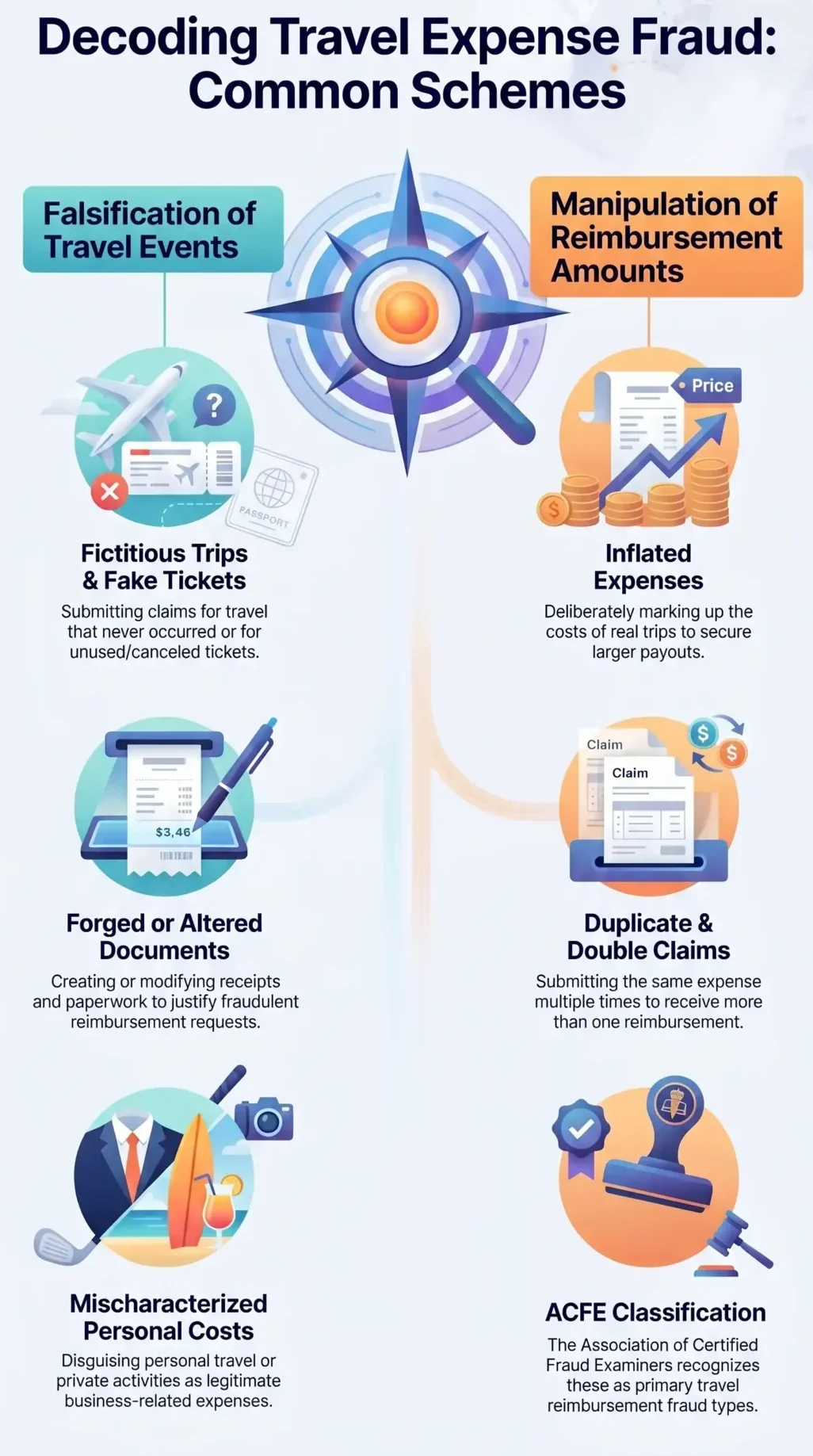
Travel fraud can be carried out in many ways, from document manipulation to fabricated claims that are nearly impossible to spot through manual review. Here are the schemes that come up most often:
- Fictitious trips: The perpetrator creates official travel documents for a trip that never actually happened.
- Fake or unused tickets: A ticket is purchased and then cancelled, but the cost is still claimed as a travel expense.
- Forged or altered documents: Receipts or invoices are modified — amounts are changed, dates are adjusted — to support a fraudulent claim.
- Inflated expenses (overstated): The trip was real, but the amounts claimed are deliberately exaggerated.
- Duplicate claims (multiple reimbursements): A single expense is submitted more than once across different reporting periods or reimbursement channels.
- Personal expenses claimed as business costs (mischaracterized): Non-work-related spending is folded into travel expense reports to get company reimbursement.
- Double-claimed travel: The same travel costs are claimed by more than one person, or claimed even when expenses were already covered by another party.
Read More: Visa Fraud Claim: Risks and How Companies Prevent Them
Warning signs and red flags of business travel fraud
Travel fraud is often hard to detect precisely because the people doing it understand how the company’s approval and reimbursement workflows operate.
That said, there are patterns worth watching. Finance teams, HR, and internal auditors can look out for the following red flags before losses spiral out of control.
Document-level red flags
Some warning signs show up directly in the paperwork:
- Receipts or invoices appear edited: Inconsistencies in font, formatting, or transaction dates compared to the rest of the document.
- Invalid ticket or booking codes: Reference numbers that can’t be verified with the airline or travel platform.
- Incomplete travel authorizations: Missing signatures, unmatched dates, or approvals that don’t appear to have been properly authorized.
- No evidence of actual travel: Boarding passes, hotel check-in confirmations, or trip reports are nowhere to be found.
- Suspiciously round figures: Claimed amounts consistently land exactly at the per diem ceiling with no natural variation.
Read More: Credit Card Fraud Detection: How It Works and Best Practices
Pattern-level red flags
Beyond individual documents, unusual claiming patterns can also signal trouble:
- Frequent trips to the same location with no clear business justification
- A sudden sharp increase in travel frequency compared to previous periods
- Long-distance travel claims with no supporting transportation records (e.g., flight or train tickets)
- Hotel charges appearing on weekends or public holidays without official travel authorization
- Claimed amounts that consistently hover just below review thresholds — a common tactic to avoid scrutiny
Behavioral red flags
In many cases, employee behavior itself can point to manipulation:
- Refusing to provide original documents, only submitting photos or photocopies
- Consistently late submission of travel expense reports
- Inability to explain trip details when asked to verify
- A noticeable lifestyle upgrade that doesn’t match official income
When several of these red flags appear together, organizations should initiate a closer review or internal audit as quickly as possible to prevent further financial damage.
Why business travel fraud is so hard to catch
In many cases, travel fraud succeeds not because the scheme was particularly clever, but because the process itself was full of gaps. When approvals, reimbursements, and document verification are all handled manually, the risk of manipulation becomes extremely difficult to manage.
Several factors contribute to why this type of fraud so often slips through:
- Manual processes still dominate: Submissions and approvals handled via email, WhatsApp, or spreadsheets have no built-in mechanism to flag transaction duplicates or validate travel bookings.
- Reviewers are overloaded: Finance teams and approvers often have to process dozens of claims at once, making it easy to miss details. ACFE found that 18% of fraud cases succeeded specifically because of weak management review.
- Documents are increasingly easy to falsify: AI tools and editing software now make it possible to produce forged receipts and invoices that look entirely legitimate.
- No digital audit trail: When the entire process is scattered across multiple channels, it becomes nearly impossible to track who changed, approved, or modified a document.
- Third-party bookings lack transparency: Booking travel through personal contacts or external vendors — without a structured validation system — creates significant room for manipulation.
Manual vs. Digital Travel Expense Management
Expense management can help reduce travel expense fraud by moving key checks earlier in the process, before reimbursement is completed.
| Aspect | Manual system | Digital / automated system |
|---|---|---|
| Trip submission | Via email, WhatsApp, or paper forms; easy to manipulate | Standardized digital forms with required fields and automatic validation |
| Document verification | Manual and dependent on reviewer diligence | System flags anomalies and validates documents automatically |
| Duplicate claim detection | Difficult to check across periods | Duplicate claims detected automatically based on date, vendor, and amount |
| Approval workflow | Relies on email or physical signatures | Real-time approvals with timestamps and approver identity |
| Audit trail | Documents scattered and easy to alter | All changes logged automatically in an audit trail |
| Third-party verification | Manual confirmation, time-consuming | Direct integration with vendor data or travel platforms |
| Budget visibility | Actuals only visible at period end | Real-time dashboard with automatic fraud alerts as budget limits approach |
| Suspicious pattern detection | Difficult without manual cross-checking | System detects anomalous patterns automatically |
| Per diem and cost limits | Dependent on user compliance | Cost limits enforced automatically by the system |
| Fraud risk | High — many gaps, minimal monitoring | Lower — processes are more controlled and fully documented |
How to Prevent Business Travel Fraud: 8 Key Controls
Travel fraud can be reduced with clear policies, strong approval controls, and regular monitoring. Here are eight practical steps Finance teams can take to reduce the risk of fraudulent travel claims:
1. Establish a Clear Travel Expense Policy
Set written rules covering expense limits, submission procedures, required documentation, and reporting deadlines. Clear policies give employees and approvers a consistent standard for deciding which travel expenses can be reimbursed.
2. Require Multi-Level Approvals
Implement multiple approval levels for business travel, particularly for higher-value trips or travel outside the employee’s usual location.
3. Require Verifiable Digital Proof
Require boarding passes, hotel booking confirmations, and transaction receipts that can be verified against the underlying booking or transaction.
4. Connect Travel, Expense, and Approval Workflows
Use an integrated expense management system to connect travel requests, approvals, documentation, and reimbursement records in one workflow.
5. Use Fraud Detection Software
Use automated checks to identify duplicate transactions, unusual amounts, and other patterns that may require further review before reimbursement.
6. Conduct Regular Audits and Spot Checks
Verify selected claims against hotels, airlines, travel providers, or other supporting records to identify discrepancies that routine processing may miss.
7. Provide a Whistleblower Channel
Give employees a safe and confidential way to report suspected fraud or policy violations.
8. Enforce Consequences Consistently
Apply disciplinary and recovery procedures consistently when fraudulent claims are confirmed.
Read more: 7 Tips on How to Choose Corporate Travel Solutions
How Mekari Expense helps prevent business travel fraud
As a spend management platform with dedicated Business Trip functionality, Mekari Expense gives companies end-to-end control over the entire travel process — from trip requests and approvals to cash advances, reimbursements, and final expense reports, all within a single integrated system.
To help detect fraud earlier in the process, Mekari Expense includes a Fraud AI Checker that automatically assigns a risk score to every transaction based on several indicators:
- Unusual amount detection: Flags transaction amounts that deviate from historical spending patterns
- Unusual vendor detection: Checks for mismatches between vendors, expense categories, and associated accounts
- Duplicate transaction detection: Identifies duplicate claims or similar transactions submitted within the same period
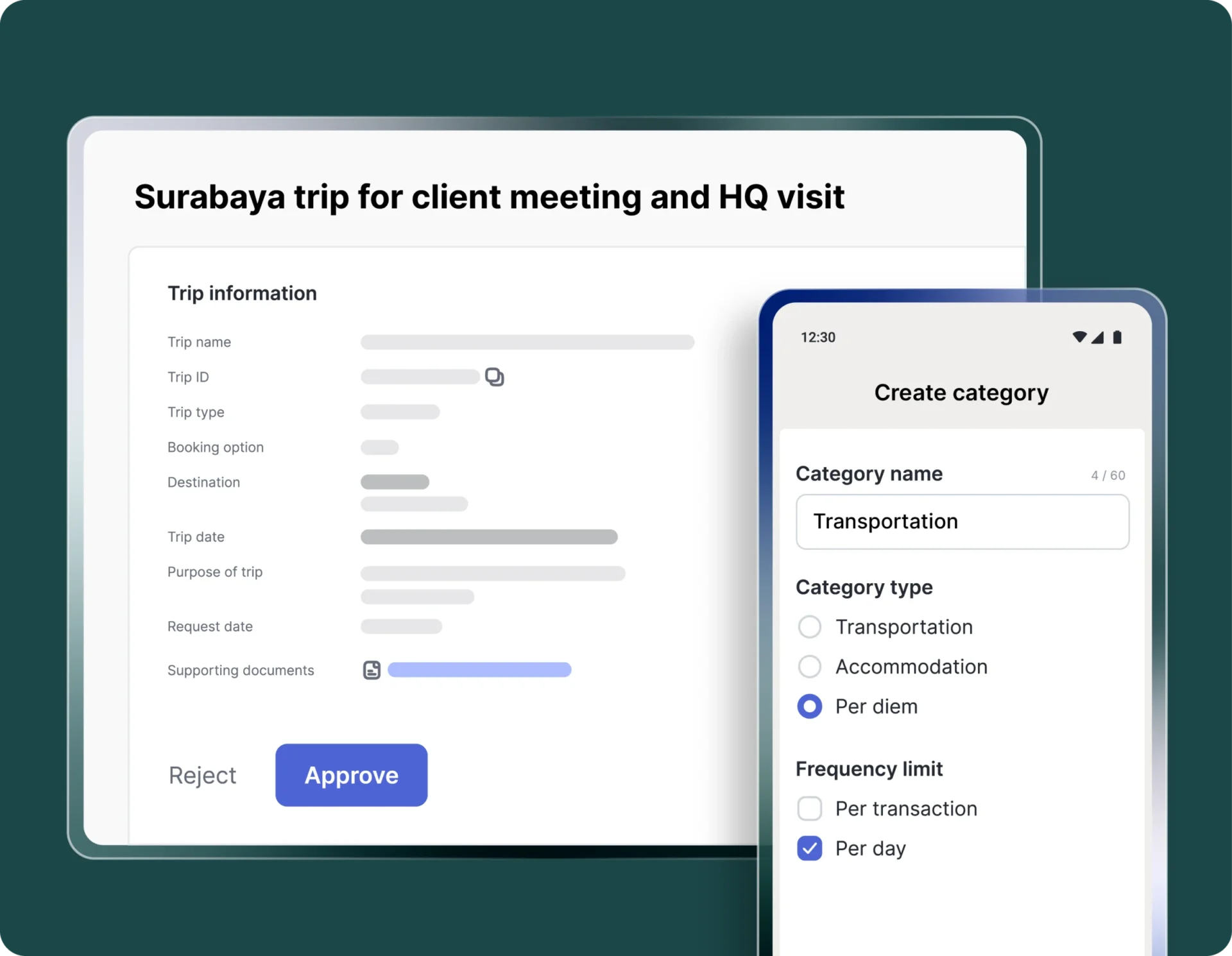
Additional features that help reduce the risk of fictitious business trip and expense fraud include:
- Digital trip request forms with required fields and full documentation
- Multi-level approval with real-time notifications and a complete approval trail
- OCR scanning for receipts and invoices to minimize manual manipulation
- Automated travel policies configured by job level, team, or destination
- Automatic duplicate claim detection to prevent double billing
- A complete digital audit trail to support investigations and internal audits
- A real-time dashboard for monitoring travel expenditures by team or individual
- Integration with Mekari Jurnal for more accurate financial records and reduced risk of manipulation
Use Mekari Expense Business Trip features to prevent fictitious business trip through digital approval workflows, automated fraud detection, and real-time spending monitoring — all in one integrated system.
References and methodology
Methodology
Methodology
Articles published by Mekari Expense are developed using trusted sources, including official data, company reports, academic research, and insights from industry practitioners. Whenever possible, we refer directly to primary sources before drawing conclusions. Our editorial team reviews and verifies the information to ensure accuracy and relevance. All references are listed so readers can trace each piece of information back to its original source.
Our editorial standards
Our editorial standards
- Primary source first: We consult official product documentation and pricing pages directly, not secondhand summaries or aggregator sites.
- Fact-checking: All product features, pricing, and claims are cross-verified against each platform’s official website at the time of writing.
- No paid placement: Tools are selected based on relevance and fit for Indonesian businesses, not commercial arrangements. Mekari Expense is included as a first-party product and is transparently labeled as such.
- Regular review: Articles are periodically updated to reflect product changes or shifts in market relevance.
References
References
Detik.com. ’’MAKI: Uang Perjalanan Dinas Fiktif Meski Sudah Balik, Bisa Diproses Hukum’’
FAQ
1. How do you detect business travel fraud that has been going on for a long time?
1. How do you detect business travel fraud that has been going on for a long time?
The starting point is data matching — cross-referencing travel reports against verifiable third-party records. This includes confirming ticket status directly with airlines (similar to how BPK uses its e-audit system connected to Garuda Indonesia), verifying hotel stays with the properties themselves, and checking for duplicate claims across reporting periods. An integrated digital system allows this process to run automatically and continuously, rather than relying on periodic manual checks.
2. What should a company do when it finds signs of travel fraud?
2. What should a company do when it finds signs of travel fraud?
First and foremost: do not confront the suspected individual before sufficient evidence has been gathered — doing so risks evidence being destroyed. Collect all relevant documentation, verify claims with third parties, and bring in the internal audit team or an independent forensic consultant. Once the evidence is solid, proceed through the company’s internal disciplinary process and consider legal action where the financial losses are material.
3. How long does business travel fraud typically go undetected?
3. How long does business travel fraud typically go undetected?
According to the ACFE 2024, reimbursement fraud schemes run for an average of 18 months before being caught in systems that rely on passive, manual review. With automated systems and active auditing in place, that detection window can be brought down to six months or less.
4. Are there laws or regulations governing business travel in Indonesia?
4. Are there laws or regulations governing business travel in Indonesia?
For government institutions, business travel is regulated by Ministry of Finance regulations (PMK) covering both domestic and international official travel, as well as relevant government decrees. Violations can be prosecuted under the Corruption Crime Law (UU Tipikor). In the private sector, travel fraud can be pursued under the fraud provisions of the Criminal Code (KUHP) or under labor law provisions relating to workplace disciplinary violations.
5. How specifically does Mekari Expense help prevent fictitious trips?
5. How specifically does Mekari Expense help prevent fictitious trips?
Mekari Expense prevents fictitious trips through multiple layers of control: digital submission forms with mandatory fields that cannot be left blank, automated policies that validate claims before they even reach an approver, multi-level approval requiring sign-off from more than one party, OCR for document extraction and validation, and a complete audit trail with full edit history that logs every change made. All data is available in real time to Finance, HR, and management — no waiting until the end-of-month report.