





Employee Business Expense Guide: Prevent 47% Reimbursement Delays


Mekari Insight
- Employee business expense is an essential process in business operations because every employee expense for work purposes needs to be managed systematically to remain transparent, well-documented, and aligned with company policies.
- Manual management creates risks of inefficiency and cost leakage when reimbursement processes are slow, documentation is lacking, and approvals are unstructured, increasing the likelihood of fraud, policy non-compliance, and budget waste.
- Mekari Expense helps simplify the end-to-end reimbursement process through its Reimbursement feature, enabling companies to manage claim submissions, automated approvals, and fund disbursement within a single integrated system that is faster, more transparent, and more accurate.
Every time an employee pays for transportation during a business trip, submits a meal receipt with a client, or files a reimbursement for work-related needs, they are participating in the employee business expense management process.
Managing these expenses is important because it ensures employees are reimbursed fairly while also helping companies meet tax and audit requirements with complete documentation. However, if not managed properly, this process can lead to cost leakage, compliance risks, and operational inefficiencies that directly impact business finances.
This guide will discuss what employee business expenses are, how they are categorized, and best practices for managing expenses more effectively.

What is employee business expenses?

Employee business expenses are costs incurred by employees in carrying out their job responsibilities, whether paid using personal funds or through company-provided facilities such as corporate cards or cash advances, which are then recorded, categorized, and reimbursed by the company or reconciled in accounting records.
In general, an expense can be categorized as a business expense if it is used entirely for work purposes and can be supported with valid documentation. This means every cost must have a clear business purpose and be backed by verifiable transaction evidence.
One of the simplest ways to understand this is by distinguishing between business and personal expenses. Daily commuting from home to the main office is considered a personal expense and therefore cannot be claimed as a business expense.
On the other hand, travel from the office to a client location, business events, or temporary work sites is considered a legitimate business expense and can be reimbursed by the company.
Read more: Employee Expense Reporting Guide to Reduce Cost up to 43%
Types of employee business expenses
Secara umum, employee business expenses terbagi ke dalam dua jenis utama yang menentukan bagaimana biaya tersebut diproses, dicatat, dan jika diperlukan dapat diganti oleh perusahaan.
1. Reimbursable employee expenses
Reimbursable expenses are costs incurred by employees using personal funds for business purposes, with the expectation that they will be reimbursed by the company. The reimbursement process is usually carried out after the employee submits a claim supported by transaction evidence.
To ensure proper control, most companies implement multi-level approval processes. Each claim is verified to confirm that it is truly related to business needs, complies with company policies, and is supported by adequate documentation. This step helps prevent misuse while ensuring employees receive legitimate reimbursements.
2. Non-reimbursable expenses
Non-reimbursable expenses are costs paid directly using company funds, such as through corporate cards, prepaid cards, or cash advances. Since personal funds are not used, employees do not need to submit reimbursement claims.
However, these expenses still need to be managed strictly. Every transaction must be recorded, categorized, reviewed, and reconciled within the company’s financial system. Documentation requirements still apply to ensure transparency and compliance with existing policies.
Read more: Best 10 Employee Expense Reimbursement Software
Common categories of employee business expenses

Employee business expenses cover various types of spending, each with different rules, documentation requirements, and tax treatments. Below are the eight most common categories:
1. Travel expenses
Travel expenses include all transportation costs used for business purposes, such as flights, trains, taxis, ride-sharing, and vehicle rentals. It is important to distinguish that commuting from home to the main office is not considered a business expense, but a personal expense.
2. Accommodation expenses
If a business trip requires an overnight stay, accommodation costs such as hotels or serviced apartments can be claimed. Companies usually set daily accommodation limits based on employee level, location, or trip duration.
3. Per diem dan subsistence allowances
Per diem refers to a daily allowance to cover meals and minor expenses during business trips. This scheme is widely used to simplify the process, as it does not require itemized receipts, as long as it stays within company or regulatory limits.
4. Mileage expenses
When employees use personal vehicles for work purposes, costs can be reimbursed based on distance traveled (per kilometer or mile). To qualify for reimbursement, this category requires travel records that include the date, route, distance, and business purpose.
5. Meals and entertainment
This category includes client meals, informal meetings, or team events. To be valid, the expense must have a clear business purpose and be supported by details such as the number of participants and the context of the activity.
6. Office supplies and equipment
Purchases of work-related supplies such as stationery, printers, or other supporting equipment fall under this category. For high-value items like laptops or office furniture, additional rules typically apply regarding approvals and asset recording.
7. Subscriptions and software fees
Subscriptions to software, work tools, or professional platforms are increasingly common, especially in remote and hybrid work setups. These expenses can be claimed as long as the tools genuinely support job responsibilities and are not already provided by the company.
8. Professional development
Costs for training, certifications, workshops, and conferences fall into this category. The main requirement is that the activity is relevant to the employee’s current role and contributes to improving their professional skills.
Read more: Employee Expense Management Guide & Top Software
Best practices for managing employee business expenses

To ensure employee business expense management runs effectively and goes beyond merely fulfilling administrative requirements, companies need to implement structured and consistent practices.
1. Establish clear expense policies
Well-documented policies help eliminate uncertainty for employees. Companies should clearly define expense categories, spending limits, documentation requirements, approval workflows, and reimbursement timelines so they are understood by all employees.
2. Require documentation for every claim
Every expense must be supported by valid transaction evidence. Standards such as “no receipt, no reimbursement” are essential to maintain compliance, minimize fraud risk, and ensure audit readiness.
Studies show that fraud causes companies to lose around 5% of revenue annually. – ACFE
3. Implement automated multi-level approvals
Approval workflows should be automated based on transaction value and requirements. Multi-level approval systems also make it easier for companies and employees to manage reimbursement processes faster and more efficiently.
As many as 47% of employees report reimbursement delays due to outdated approval processes. – ExpenseOut.
4. Define reimbursement SLAs
Delayed reimbursements can financially burden employees and reduce job satisfaction. Therefore, companies need to establish clear SLAs and ensure processes run quickly, ideally integrated with payroll processing in Indonesia.
5. Categorize expense types
Differentiate between reimbursable and non-reimbursable expenses. Employees need to understand that using corporate cards or company funds does not eliminate the requirement for documentation. All transactions must still be recorded and accounted for according to policy.
6. Align policies with tax regulations
Each country has different tax rules regarding business expenses. Companies must ensure that their policies align with applicable tax regulations in Indonesia to avoid compliance risks.
7. Use expense management software
Manual processes tend to be inefficient and prone to recording errors. With an automated system, companies can accelerate approval processes, improve data accuracy, strengthen policy control, and simplify reconciliation and reporting.
Studies show that companies that automate expense management processes can gain significant benefits, such as reducing processing costs by up to 30%, decreasing expense report errors by 65%, and speeding up approval times by up to 50%. – Aberdeen Group via Expend.
Simplify employee business expense flow with Mekari Expense
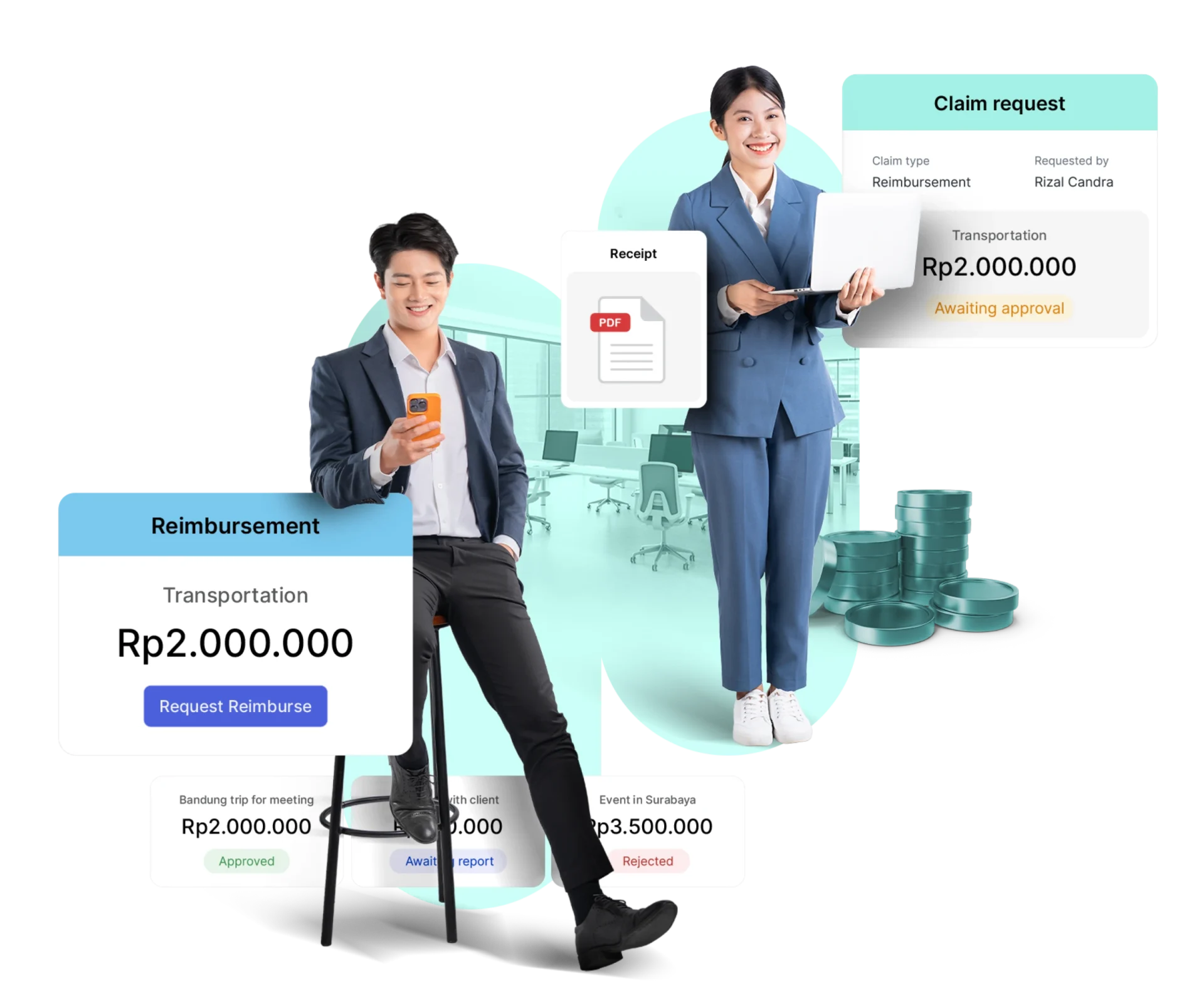
For businesses in Indonesia, managing employee business expenses can quickly become complex when handled manually starting from collecting receipts, lengthy approval processes, to delayed reimbursements.
Mekari Expense is a spend management platform designed to simplify the entire employee business expense process, particularly through its Reimbursement feature, which is integrated end-to-end within a single application.
Through the Reimbursement feature, Mekari Expense streamlines the employee business expense process by enabling:
- Submit claims: Enter expense details and upload transaction receipts directly from the application.
- Approval process: Claims are automatically routed through multi-level approval workflows based on the company structure.
- Track status: Monitor claim status in real-time, from submission to approval.
- Fund disbursement: Once approved, reimbursement funds are automatically transferred to the employee’s account.
Why Mekari Expense?
- Claim accuracy: Employees simply capture and upload receipts directly to the app without manual input, making the process faster and reducing errors.
- Transparent process: Claim statuses can be tracked in real-time by both employees and finance teams, ensuring a clearer and more reliable process.
- Accurate reporting: All claim data is automatically recorded in the system, ensuring financial reports remain organized, precise, and audit-ready.
- Time efficiency: Workflow automation speeds up reimbursement processes by up to 2x compared to manual methods.
- Cash flow control: Every claim follows predefined company policies, helping maintain healthy cash flow and better expense control.
- Improved productivity: Manual administrative tasks are eliminated, allowing teams to focus on more strategic work.
Learn more about how to manage employee business expenses faster, more accurately, and with real-time control using Mekari Expense.
References
ACFE. “Occupational Fraud 2024: A Report to The Nations”
Expenseout. “20+ Business Expense Reimbursement & Management Statistics and Trends for 2025”
Expend. “Expense Management Statistics Every Business Owner Should Know”
FAQ
What is employee business expense?
What is employee business expense?
Employee business expense refers to costs incurred by employees for work-related purposes that are reimbursed or managed by the company based on its policies.
What is the difference between reimbursable and non-reimbursable expenses?
What is the difference between reimbursable and non-reimbursable expenses?
Reimbursable expenses are paid using employees’ personal funds and later reimbursed, while non-reimbursable expenses are paid directly using company funds or facilities.
What are examples of employee business expenses?
What are examples of employee business expenses?
Examples include business travel, accommodation, client meals, mileage, and work-related software subscriptions.
How does Mekari Expense help with reimbursement processes?
How does Mekari Expense help with reimbursement processes?
Mekari Expense simplifies reimbursement through an integrated feature that covers expense submission, automated approval workflows, real-time tracking, and faster, more accurate payouts.