





Credit Card Fraud Detection: How It Works and Best Practices

Mekari Insight
- Credit card fraud detection combines authentication, behavioral analysis, and machine learning to confirm that every transaction is genuinely authorized by the cardholder, ranging from basic CVV and AVS checks to real-time anomaly scoring that flags suspicious patterns before a payment is processed.
- As digital and card-not-present transactions continue to rise, businesses face growing exposure not only from external card fraud but also from fraud risks hidden inside their own expense and procurement processes, such as inflated reimbursement claims, duplicate submissions, and mismatched vendor invoices that often go undetected until a manual audit.
- Mekari Expense addresses this internal blind spot as a spend management platform with built-in fraud detection capabilities through its Fraud AI Checker powered by Mekari Airene, automatically flagging unusual amounts, vendor mismatches, and duplicate submissions across claims, purchases, and business trips before they reach the approval stage.
Credit card fraud continues to be one of the most persistent challenges in modern payment systems.
According to the Nilson Report, global card-fraud losses reached $28.65 billion in 2021 alone. – Stripe.
For both consumers and businesses, understanding how fraud detection works is no longer optional, it is now a critical operational requirement.
In simple terms, credit card fraud is the unauthorized use of a credit card or its associated information to make purchases or access funds without the cardholder’s consent. It comes in many forms, constantly evolves, and affects every layer of the payment ecosystem.
This article explores the fundamentals of credit card fraud detection, the most common types of fraud, and the technologies used to identify and prevent them. It also highlights the types of businesses that face the greatest exposure to fraud risks.

What is credit card fraud detection?

Credit card fraud detection refers to the combination of tools, technologies, and processes designed to prevent unauthorized transactions across both online and in-person payment environments.
At its core, the objective is straightforward: ensure that the individual initiating a transaction is the legitimate cardholder and that the transaction itself is valid.
Detection approaches range from basic verification methods to advanced, machine learning–driven systems.
Common techniques include multi-factor authentication (MFA), which confirms identity through multiple layers such as SMS codes or app-based approvals, and 3-D Secure (3DS), which introduces an additional verification step before a transaction is authorized.
Other methods include biometric authentication, such as fingerprint, facial recognition, or voice verification and one-time passwords (OTP) for single-use access.
In more advanced setups, modern fraud detection systems continuously monitor transaction patterns in real time, identifying anomalies such as purchases made from high-risk IP addresses or unfamiliar devices.
Read more: Business Trip Fraud: How to Prevent 5% Revenue Losses
Common types of credit card fraud
Fraud tactics are typically designed to exploit specific vulnerabilities across the payment chain. Below are some of the most common types:
- Lost or stolen cards: This occurs when a fraudster physically obtains someone else’s card through theft or loss, then uses it to make unauthorized purchases before the card is reported and blocked.
- Card-not-present (CNP) fraud: CNP fraud happens when a criminal gains access to card details such as the card number, expiration date, or CVV, and uses them for transactions where the physical card is not required, including online, phone, or mail orders.
- Account takeover fraud: A fraudster gains unauthorized access to an existing account, often through phishing or identity theft. They may then change account details, add themselves as an authorized user, or request a replacement card to carry out fraudulent transactions.
- Application fraud: This involves applying for a new credit card using stolen or fabricated personal information. Once approved, the fraudster uses the card while the victim deals with the financial and legal consequences.
- Skimming: Skimming uses small electronic devices to capture card data from the magnetic stripe during legitimate transactions, typically at ATMs or payment terminals. The stolen data is then used to create counterfeit cards or conduct unauthorized transactions.
- Phishing and vishing: These scams rely on deception to obtain sensitive card information. Fraudsters impersonate trusted entities such as banks or retailers through emails, phone calls, or text messages to trick victims into revealing their card details.
How does credit card fraud detection work?
Credit card fraud detection combines data analysis with automated decision-making. Financial institutions and merchants rely on multiple overlapping methods that work together to identify and prevent suspicious transactions.
- Machine learning models analyze transaction patterns to detect unusual activity, such as large overseas purchases or repeated small test transactions. These models continuously improve as they learn from new fraud behaviors.
- Rule-based systems operate on predefined conditions set by merchants. For example, transactions above a certain value can be blocked, or payments may be flagged when billing and shipping details do not match.
- Behavioral analytics examines how users interact with a website or app, including typing speed and navigation patterns. Any deviation from typical behavior may indicate a potential account takeover.
- Authentication layers such as tokenization, biometric verification, and 3-D Secure (3DS) provide additional protection by verifying user identity before a transaction is approved.
By combining these approaches, businesses can detect and prevent fraudulent activity early while maintaining a smooth experience for legitimate customers.
Read more: 7 Best Automated Fraud Alert Platforms for Expenses 2026
Key techniques used to detect credit card fraud
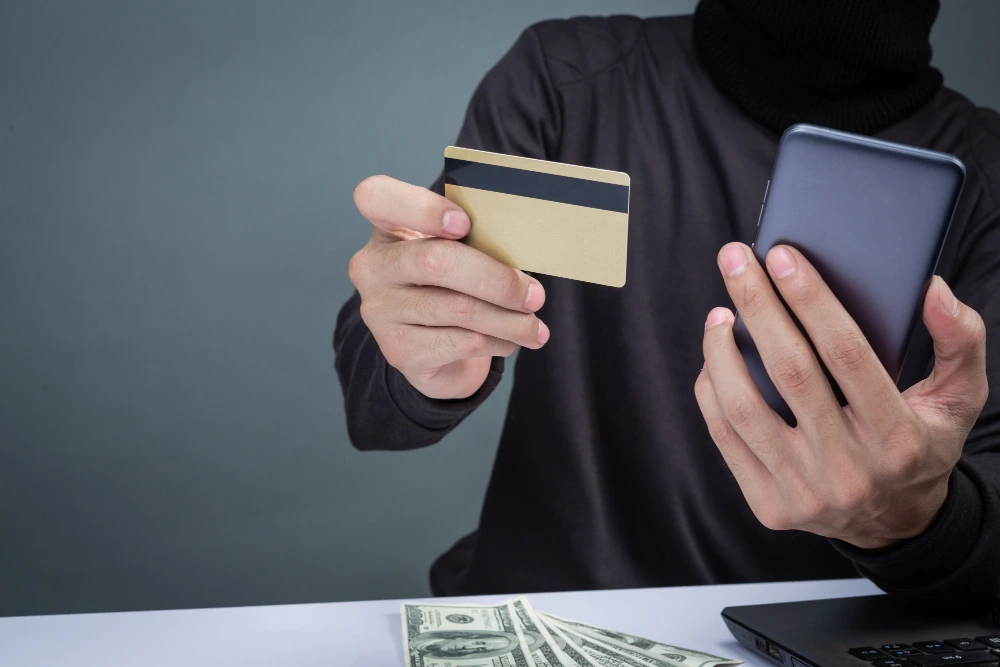
To better understand how fraud is prevented in practice, it is important to look at the key techniques used to detect credit card fraud.
1. Card security features
Card networks have developed built-in security measures to prevent unauthorized transactions. The Address Verification Service (AVS) checks the cardholder’s billing address against the bank’s records.
3-D Secure (3DS), often branded as Visa Secure or Mastercard SecureCode, requires users to complete an additional verification step before a transaction is approved, preventing Mastercard or Visa fraud claims. The CVV, a three-digit code on the card, helps confirm that the buyer has physical access to the card.
While these features strengthen security, they can introduce friction during checkout. Some large retailers choose to skip certain checks, such as CVV verification, to create a smoother user experience and instead rely on other layers of protection.
2. Risk scoring
Risk scoring, also known as fraud scoring, evaluates how risky a transaction is based on a set of rules or models. Businesses use this score to decide whether to approve, flag, or block a payment. For example, a transaction may receive a higher risk score if the IP address does not match the shipping location.
Velocity rules are another common approach. These rules monitor activity within a defined time period, such as blocking an account after multiple failed payment attempts in a short timeframe.
Risk scoring systems can be either whitebox, where rules are transparent and customizable, or blackbox, where decisions rely on predefined algorithms. Larger organizations often prefer whitebox systems for greater control, while smaller businesses may choose ready-to-use solutions.
3. Digital footprint analysis
Digital footprint analysis provides an additional layer of verification without adding friction for users. It collects signals such as digital and social data checks, IP analysis to detect VPNs or suspicious proxies, BIN lookups to validate card type and origin, and device intelligence to recognize whether a device has been used on the platform before.
These signals feed into risk scoring systems and help build a clearer picture of normal user behavior. They can also support investigations in chargeback disputes or cases of friendly fraud.
Which businesses are most vulnerable to credit card fraud?
Some types of businesses face disproportionately higher fraud exposure due to the nature of their transactions, industry, or security maturity.
With losses projected to reach $38.5 billion by 2027 (Nilson Report), the stakes for businesses that lack robust fraud prevention have never been higher. – Seon.
- Ecommerce and online retailers: These businesses rely heavily on card-not-present transactions, which are more difficult to verify and more susceptible to data breaches, phishing, and malware.
- Small businesses: Limited resources often make it harder to implement advanced fraud prevention systems or maintain strong security practices.
- High-risk industries: Sectors such as gambling, travel, and adult entertainment tend to experience higher fraud and chargeback rates. This is often driven by higher transaction values and greater levels of customer anonymity.
- Businesses with high employee turnover: Frequent staff changes can lead to inconsistent enforcement of security policies. In some cases, internal fraud may also become a risk.
- Companies with weak security measures: Organizations that lack encryption, tokenization, or secure payment processing are more vulnerable to data breaches and unauthorized access.
- Brick-and-mortar retailers with outdated systems: Retailers that still rely on older point-of-sale technology face higher exposure to skimming attacks, as these systems may not support modern security features such as EMV chip authentication.
Read more: 11 Cara Deteksi Fraud Pengeluaran Perusahaan dan Solusinya
Best practices for credit card fraud prevention
Businesses can combine several measures to build a comprehensive fraud prevention strategy:
- Secure payment processing: Use tokenization and encryption to protect sensitive card data during transactions.
- Adopt EMV technology: Implement EMV chip cards and compatible terminals to reduce fraud in physical locations, since chip cards are harder to counterfeit than magnetic stripe cards.
- Use AVS and CVV checks: These help verify the authenticity of card-not-present transactions and reduce the risk of unauthorized use.
- Leverage fraud detection tools: Apply machine learning and behavioral analytics to identify and flag suspicious transactions before they are processed.
- Train employees regularly: Ensure staff understand fraud risks and prevention procedures, especially in retail environments where they act as a frontline defense.
- Monitor transactions continuously: Regular tracking of transactions and account activity helps detect unusual patterns early.
- Establish a chargeback management process: Maintain a structured approach to track, analyze, and respond to disputes that may indicate fraudulent activity.
Continuous monitoring is also important for identifying spending leakages caused by duplicate charges, invoice fraud, unauthorized purchases, and policy non-compliance before they create significant financial losses.
Detecting fraud in business spend using Mekari Expense
Much of the conversation around credit card fraud detection focuses on protecting customers and merchants during a sale. But businesses face a parallel and often less visible risk on the other side of the ledger: fraud within their own spending processes.
Inflated reimbursement claims, duplicate expense submissions, mismatched vendor invoices, and fictitious purchase requests can drain a company’s finances just as steadily as external card fraud, yet they are frequently caught only during manual audits, if at all.
As a spend management platform, Mekari Expense brings the same principles that power consumer-facing fraud detection pattern analysis, anomaly scoring, and automated flagging directly into the business expense and procurement workflow. Through its Fraud AI Checker. Every transaction is automatically analyzed the moment it is submitted, covering three core spend categories:
Why Mekari Expense?
- Faster processing: Reimbursements and settlements are completed faster with clear rules and limits from the start, without revisions or stalled claims.
- Accurate budgeting: Budget allocation per category ensures funds are spent as planned, keeping cash flow healthy and predictable.
- Full transparency: All policies, approvals, and violations are recorded in the system, enabling expense trend analysis and audit-ready reporting.
- Audit-ready reports: Each transaction is clearly logged, including approval times and rejection reasons, speeding up audits and reducing fraud risk.
- Cross-branch control: Customize rules by team, role, or location while maintaining consistency across the company from one centralized dashboard.
- Fraud prevention: Company policies are automatically enforced during claim submission, eliminating off-policy expenses and minimizing risks from the start.
Explore how Mekari Expense Fraud AI Checker and customizable spend policies help finance teams catch irregularities before they become losses.
References and methodology
Methodology
Methodology
Articles published by Mekari Expense are developed using trusted sources, including official data, company reports, academic research, and insights from industry practitioners. Whenever possible, we refer directly to primary sources before drawing conclusions. Our editorial team reviews and verifies the information to ensure accuracy and relevance. All references are listed so readers can trace each piece of information back to its original source.
Our editorial standards
Our editorial standards
- Primary source first: We consult official product documentation and pricing pages directly, not secondhand summaries or aggregator sites.
- Fact-checking: All product features, pricing, and claims are cross-verified against each platform’s official website at the time of writing.
- No paid placement: Tools are selected based on relevance and fit for Indonesian businesses, not commercial arrangements. Mekari Expense is included as a first-party product and is transparently labeled as such.
- Regular review: Articles are periodically updated to reflect product changes or shifts in market relevance.
References
References
Seon. “Credit Card Fraud Detection: What is It, How It Works and Its Importance”
FAQ
What is credit card fraud detection?
What is credit card fraud detection?
Credit card fraud detection is the combination of tools, technologies, and processes used to confirm a cardholder’s identity and verify that a transaction is legitimate — ranging from basic checks like CVV verification to advanced machine-learning analytics.
When does a business need fraud detection systems?
When does a business need fraud detection systems?
Fraud detection becomes essential as soon as a business processes card-not-present transactions, operates across multiple channels, or handles a growing volume of transactions where manual review is no longer practical. Businesses in high-risk industries or with outdated payment systems should prioritize it even earlier.
What's the difference between fraud detection and fraud prevention?
What's the difference between fraud detection and fraud prevention?
Fraud detection focuses on identifying suspicious or unauthorized activity — often after a transaction has been initiated — while fraud prevention focuses on the measures put in place beforehand, such as EMV chip technology or employee training, to reduce the likelihood of fraud occurring at all. The two work together as part of a broader fraud management strategy.
How does Mekari Expense help prevent fraud in business spending?
How does Mekari Expense help prevent fraud in business spending?
Mekari Expense’s Fraud AI Checker, powered by Mekari Airene, automatically analyzes claims, purchases, and trip submissions for unusual amounts, vendor mismatches, and duplicate transactions — flagging irregularities before they reach approval.