





Purchase Order Management: How to Control Committed Spend From Approval to Payment

Mekari Insight
- A purchase order turns an approved buying decision into a documented spending commitment.
- Procurement can use the PO to keep supplier, quantity, price, and delivery terms aligned with the approved purchase.
- Finance gets visibility into spending that has already been committed, even before the invoice arrives.
- Comparing the PO, receipt, and invoice helps identify discrepancies before payment.
- Mekari Expense’s purchase order feature connects purchase requests, approvals, purchase orders, budgets, and payment workflows.
Procurement approves a $100,000 order. The supplier receives the PO. Two weeks later, finance sees a $112,000 invoice.
The extra $12,000 could come from a higher quantity, additional freight, a revised scope, or an agreement made after the PO was issued. Someone still has to trace the change.
The same thing happens when one order arrives in two batches, a supplier changes the delivery schedule, or a completed PO stays open in the system.
The PO may have started as a purchasing document. Once the supplier accepts it, the company also has a financial commitment to manage.
Purchase order management keeps that commitment accurate as the order moves from approval to fulfillment, receiving, invoicing, and payment.

What Does Purchase Order Management Control?
A purchase order records the commercial terms behind an approved purchase: the supplier, item or service, quantity, price, delivery terms, payment terms, and approval.
The difficult part starts after the PO is issued.
A negotiated price can change before invoicing. A partial delivery can leave part of the order outstanding. A completed PO can remain open and inflate the company’s apparent commitments.
That makes the PO a shared reference for procurement, finance, the requesting team, receiving, and accounts payable.
Committed spend deserves a place beside actual spend
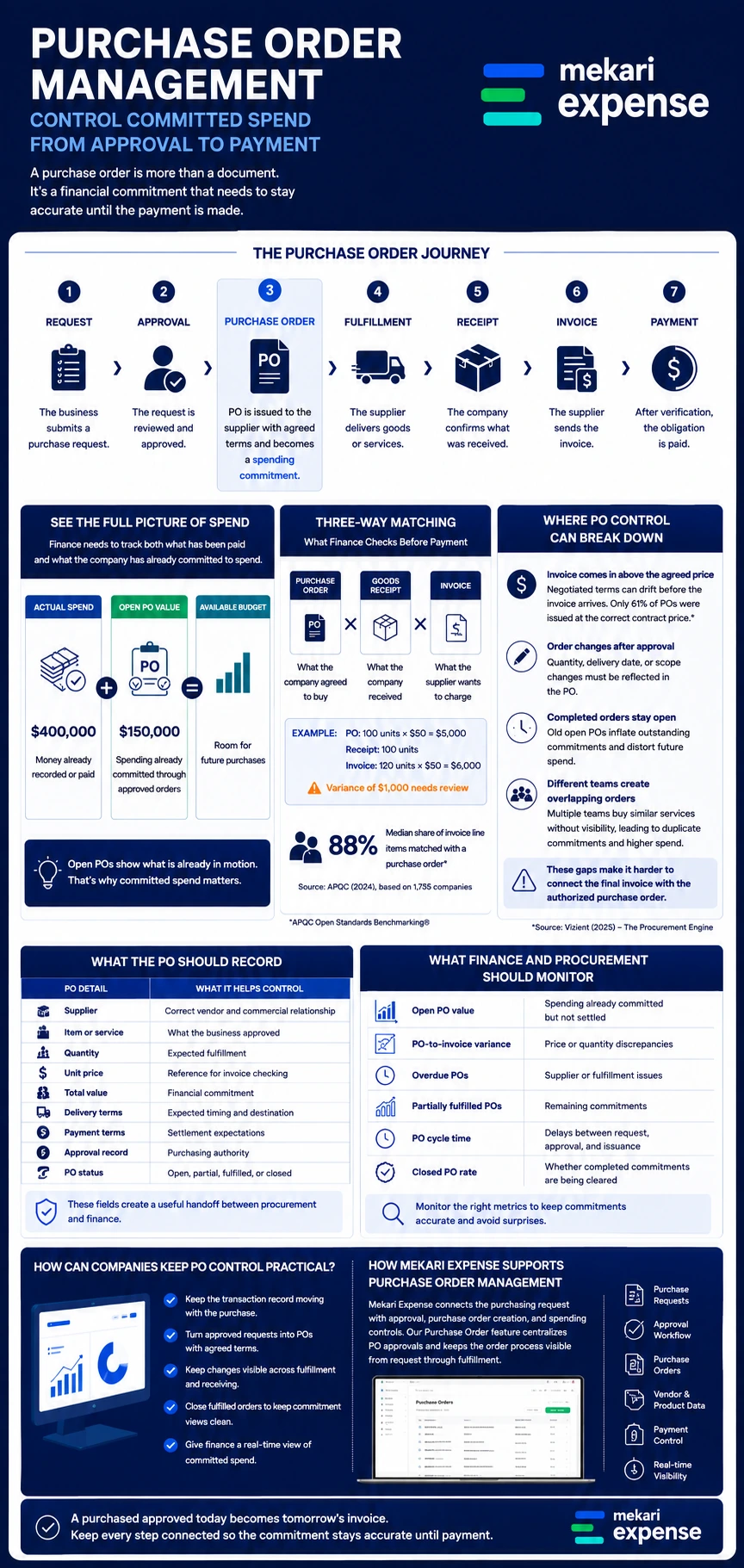
Finance may see $400,000 of invoices already recorded and another $150,000 sitting in approved purchase orders.
The second figure matters because the company has already committed to that spending.
| Financial view | What it shows |
|---|---|
| Actual spend | Money already recorded or paid |
| Open PO value | Spending already committed through approved orders |
| Available budget | Room for future purchases |
Actual spending tells finance what has happened. Open POs show what is already in motion.
That is why consistent spend data management matters when procurement and finance need to see commitments across multiple teams and categories.
Where Can PO Control Break Down?
The most expensive problems usually start when the PO stops matching the transaction around it.
The invoice comes in above the agreed price
Procurement negotiates a supplier rate, but the PO carries a different number. The invoice then arrives using yet another price.
A 2025 Vizient analysis found that only 61% of purchase orders were issued at the correct contract price across the health systems it studied. The figure is specific to healthcare procurement, but it shows how easily negotiated terms can drift before they reach the PO.
The fix starts before AP sees the invoice: keep the approved commercial terms visible in the purchase order.
The order changes after approval
The supplier may confirm a different quantity, split the delivery, or change the expected delivery date.
Those changes can be legitimate. The PO still needs to reflect them.
Otherwise, procurement works from one version, receiving works from another, and finance has to reconcile the difference later.
Completed orders stay open
An order can be fully delivered while its PO remains active.
That matters when finance uses open POs to understand upcoming commitments. An old PO can make the business appear to have more outstanding spending than it actually does.
Closing fulfilled orders keeps the commitment view cleaner.
Different teams create overlapping orders
A company with several business units can have multiple teams buying similar services without seeing each other’s open commitments.
One department raises a PO for software. Another signs a separate order for a similar requirement. Both transactions can look reasonable on their own.
The problem appears when finance sees the combined spend.
This is also where maverick spending becomes relevant. Purchases outside the approved process make it harder to connect the final transaction with an authorized purchase order.
Baca Juga: Vendor Risk Management: Checklist and Implementation
What Should the PO Record?
The purchase order should contain enough detail for the next team to understand the commitment without reopening the original negotiation.
| PO detail | What it helps control |
|---|---|
| Supplier | Correct vendor and commercial relationship |
| Item or service | What the business approved |
| Quantity | Expected fulfillment |
| Unit price | Reference for invoice checking |
| Total value | Financial commitment |
| Delivery terms | Expected timing and destination |
| Payment terms | Settlement expectations |
| Approval record | Purchasing authority |
| PO status | Open, partial, fulfilled, or closed |
These fields also create a useful handoff between procurement and finance.
Procurement can manage the order against the agreed terms. Finance has a record of what the business has committed to pay.
Where those approvals and purchasing rules need stronger controls, procurement compliance and governance provides the wider framework around purchasing authority and policy.
From Approval to Payment
Request → Approval → PO → Fulfillment → Receipt → Invoice → Payment
The stages serve different purposes.
- Request records the business need.
- Approval gives the purchase the required authorization.
- PO records the supplier, commercial terms, and spending commitment.
- Fulfillment shows how the supplier carries out the order.
- Receipt confirms what the company actually received.
- Invoice shows what the supplier expects to be paid.
- Payment settles the obligation.
The value comes from keeping those records connected. A PO sitting in one system while receiving and invoice data live elsewhere leaves more room for discrepancies and manual follow-up.
For businesses with high PO volumes, purchase order automation can reduce manual handoffs across the process. The management problem, though, comes first: the workflow needs clear approval, ownership, and status rules before automation can improve it.
Three-Way Matching: What Finance Checks Before Payment
Three-way matching compares three records:
- Purchase order -> what the company agreed to buy
- Goods receipt -> what the company received
- Invoice -> what the supplier wants to charge
Take a PO for 100 units at $50 each. Receiving confirms 100 units. The invoice also shows 100 units at $50.
The records agree. An invoice for 120 units creates a variance that needs to be resolved before payment.
APQC’s current benchmark puts the median share of invoice line items matched with a purchase order at 88%. The remaining gap shows why AP needs a reliable PO record when an invoice reaches the payment process.
The PO defines the original commitment. Accounts payable uses it, together with the receipt, to determine whether the invoice is ready for payment.
What Should Finance and Procurement Monitor?
Once a company has hundreds or thousands of POs, individual order status becomes financial information.
| Metric | What it can reveal |
|---|---|
| Open PO value | Spending already committed but not settled |
| PO-to-invoice variance | Price or quantity discrepancies |
| Overdue POs | Supplier or fulfillment issues |
| Partially fulfilled POs | Remaining commitments |
| PO cycle time | Delays between request, approval, and issuance |
| Closed PO rate | Whether completed commitments are being cleared |
The right emphasis depends on the buying environment.
A project-based business may care most about open commitments and partial deliveries. A high-volume operational business may focus on cycle time, duplicate orders, and overdue POs.
The important part is knowing which numbers can distort the company’s picture of future spending.
Baca Juga: Spend Visibility: Why Blind Spots Cost You Millions
How Can Companies Keep PO Control Practical?
Managing PO status through email threads and separate spreadsheets becomes harder as transaction volume grows.
Procurement has to track approvals and supplier responses. Receiving needs the latest order details. Finance needs the committed amount. AP needs the PO when the invoice arrives.
A disconnected process creates more reconciliation work.
The better setup keeps the transaction record moving with the purchase. An approved request becomes a PO with the agreed supplier and commercial terms. Changes remain visible. Fulfilled orders move out of the open commitment view.
That also gives finance a more current spending picture without asking teams to reconstruct each transaction at month-end.
How Mekari Expense Supports Purchase Order Management
Mekari Expense connects the purchasing request with approval, purchase order creation, and spending controls. Our Purchase Order feature centralizes PO approvals and keeps the order process visible from request through fulfillment.
A request can move through the required approval flow before becoming a PO, keeping the original business need attached to the transaction. The procurement workflow also keeps vendor and payment information available alongside the order.
For finance, that creates a clearer view of the spending commitment before the supplier invoice arrives.
For procurement, the same record remains available when the team follows up on an order, checks supplier fulfillment, or reviews open commitments.
A Purchase Order Should Still Make Sense When the Invoice Arrives
A PO starts as an approved buying decision. After the supplier accepts it, the company has something more important to manage: a commitment.
Price changes, quantity changes, partial delivery, and duplicate orders can all affect that commitment before payment happens.
Keeping the PO connected to approval, fulfillment, receiving, and invoicing gives procurement a reliable order record and gives finance a clearer view of what the business has already committed to spend.
That is the job of purchase order management: keeping the financial and operational details of a purchase aligned until the commitment is fulfilled and paid.