





Maverick Spending: How It Costs Up to 16% Expense Savings


Mekari Insight
- Maverick spending is any purchase made outside a company’s established procurement processes, approved vendor agreements, or negotiated contract terms — and it is more prevalent than most organizations realize.
- The most effective way to reduce maverick spending is to make the compliant path the easiest path — through streamlined approval workflows, accessible preferred vendor lists, a “No PO, No Pay” policy, and a spend management system that enforces compliance automatically at the point of purchase.
- Mekari Expense Procurement helps companies control maverick spending through a procurement management system with purchase requests, purchase orders, automated approval workflows, vendor management, and real-time spend visibility.
Most companies have procurement policies in place. The problem is that not everyone follows them.
APQC’s benchmarking data shows that organizations with over $500 million in revenue typically see 2.5% or more of their purchases made outside approved procurement processes — a figure that compounds quickly at scale.
For a company spending $1 billion annually on procurement, that 2.5% alone translates to $25 million flowing outside any contract or approval process.
Maverick spending, or rogue spend, is the term for these off-contract purchases, and it is one of the most persistent drains on procurement savings.
This article explains what maverick spending is, what causes it, what it costs, and what procurement teams can do to get it under control.

What is maverick spending?
Maverick spending refers to any purchase made outside a company’s established procurement processes — buying from unapproved suppliers, bypassing required approval workflows, or transacting on terms that fall outside negotiated contracts.
These off-contract purchases occur when employees, whether deliberately or unknowingly, circumvent the official purchasing process to get what they need faster or more conveniently.
Unlike large unauthorized transactions that are easy to flag, maverick spending most often surfaces as small, repeated purchases — individually minor, but significant in aggregate and difficult to detect until the cost has already accumulated.
Maverick Spend vs. Tail Spend
These two terms are often used interchangeably, but they refer to different problems. The table below breaks down the key differences:
| Aspects | Maverick Spend | Tail Spend |
|---|---|---|
| Definition | Purchases that violate procurement policy | High-volume, low-value purchases that are hard to manage centrally |
| Vendor | Often unapproved or non-contracted | Can include approved vendors |
| Policy compliance | By definition non-compliant | Can be fully compliant |
| Transaction value | Any value | Typically low |
| Visibility | Often untracked and undetected | Low visibility, but not necessarily hidden |
| Relationship to each other | Most commonly occurs within tail spend categories | Not all tail spend is maverick spend |
The key distinction between maverick and tail spend is policy compliance. Tail spend can be legitimate; maverick spend by definition is not.
Read More: 10 Tail Spend Management Software to Control Small Spend
Types of Maverick Spending
Maverick spending manifests in several distinct forms, each with a different level of spend visibility and control:
- Uncontrolled and unknown: The procurement team receives an invoice from a vendor the company has no prior relationship or contract with. This carries the highest risk, as the purchase is only discovered after the fact.
- Semi-controlled and semi-known: The vendor is familiar, but the transaction lacks proper documentation — no purchase order, incomplete contract terms, or missing approval.
- Semi-controlled and known: An approved vendor is used, but the purchase falls outside negotiated terms — different pricing, quantities that exceed authorized volumes, or a process that bypassed the standard approval workflow.
- Spot buying: A one-off purchase from a non-preferred supplier, typically driven by urgency or convenience rather than deliberate non-compliance.
- Non-PO spend: Any purchase processed without a purchase order, removing it from the standard approval and tracking process entirely.
Common Examples of Maverick Spending in Procurement
Maverick spending shows up in more places than most companies expect. It occurs across industries — from manufacturing and retail to F&B, professional services, and beyond — and in more spend categories than procurement teams typically account for.
Here is what maverick spending looks like in practice:
- Office supplies: An employee needs printer ink urgently and buys it from a nearby retail store using a personal card, unaware that the company has a contracted supplier offering bulk discounts on the same item
- Freelance and professional services: A brand manager hires a freelance designer for a rebranding project without notifying procurement, missing the opportunity to work with pre-approved contractors at negotiated rates
- SaaS and software: A marketing team signs up for a new tool directly without going through IT or finance, creating an untracked subscription that sits outside any approved budget line
- Preferred vendor bypass: An office manager reorders supplies from a personally familiar vendor rather than the contracted supplier, forfeiting volume discounts without realizing it
In each of these cases, the employee was most likely trying to solve a real problem. Therefore, the purchase felt justified in the moment — and in isolation, it probably was.
The issue, however, is that these decisions accumulate silently across departments, eroding the savings procurement worked hard to negotiate before anyone notices the pattern.
That is what makes maverick spending particularly difficult to manage: it does not announce itself. It builds quietly, across teams, categories, and transactions that each seem too small to matter — until they do.
What Causes Maverick Spending?
Most instances of maverick purchasing share common roots. Process complexity, organizational structure, and knowledge gaps account for the majority of cases are some of the main causes, with a few additional factors rounding out the picture.
1. Overly Complex or Slow Procurement Processes
When procure-to-pay workflows are too slow or complex, employees facing deadlines will find faster alternatives.
According to The Hackett Group’s 2019 User Experience and Maverick Spend Study, 75% of procurement professionals cite a lack of self-service or guided buying tools as one of the biggest causes of maverick purchases.
APQC’s benchmarking data further shows that organizations with higher maverick purchasing rates need a median of 16 hours more to issue a purchase order than those with lower rates.
What feels like a shortcut for one employee creates downstream friction for everyone else instead.
2. Decentralized Spending Structures
Certain spend categories frequently fall outside procurement’s direct oversight, making off-contract purchasing the default rather than the exception.
According to APQC’s 2023 survey of 1,181 global procurement professionals, 55% of organizations rely on a decentralized structure for indirect materials and services. It is precisely in these categories where maverick spending is hardest to detect and most likely to accumulate.
3. Knowledge and Visibility Gaps
Many employees engage in maverick spending simply because they do not know what contracts exist or how the preferred purchasing process works.
According to The Hackett Group’s 2019 study, 69% of organizations report a non-compliant mentality among employees as a significant driver.
In most cases, this is not deliberate defiance but a simple lack of awareness about existing contracts and procurement policies.
4. Personal Supplier Relationships
Employees sometimes have existing working relationships with vendors outside the approved list and route purchases through them out of familiarity or trust.
This is not always driven by bad intent. In many cases, the employee genuinely believes they are getting a good deal or working with a reliable partner.
The problem is that these purchases bypass the vetting, pricing, and compliance controls that preferred vendor agreements are designed to provide.
5. Urgency and Time Pressure
When deadlines are real and approval workflows are slow, employees will prioritize speed over compliance.
69% of organizations report employees resisting behavioral change despite clearly stated policies, a pattern that urgency consistently reinforces.
What Does Maverick Spending Cost Your Business?
Maverick spending is often called a silent budget killer — and the label fits. The impact of this rogue spending does not announce itself through a single large transaction that triggers an audit.
Instead, it accumulates quietly across departments, categories, and vendors until the damage is already done. The consequences fall into several distinct areas.
1. Lost Savings
Every purchase made outside a negotiated contract forfeits the pricing, discounts, and terms that procurement worked to secure.
According to The Hackett Group’s 2019 User Experience and Maverick Spend Study, organizations lose up to 16% of their negotiated savings due to maverick purchasing.
McKinsey’s analysis of indirect procurement further shows that compliance with strategic supplier contracts can preserve between 10 to 50% in value that would otherwise leak through unmanaged purchasing.
Read More: Direct Spend Procurement: Definition, Strategies & Best Practices
2. Breach of Contract and Weakened Supplier Relationships
Supplier contracts often include minimum purchase volume commitments, and maverick spending puts those thresholds at risk.
Beyond the financial penalties, repeated off-contract purchases signal to preferred suppliers that the organization is an unreliable partner.
The Hackett Group found that 63% of organizations report decreased sourcing leverage from fragmented spend as a direct consequence of maverick purchasing.
3. Budget Inaccuracy and Finance Overhead
Untracked spend makes accurate budget planning impossible and creates downstream reconciliation work for finance teams.
44% of organizations report increased purchasing process costs as a result of maverick spending. This reflects the additional time and resources spent chasing down transactions that should never have been untracked in the first place.
4. Quality Control Risk
Goods and services purchased outside strategic sourcing are not subject to the same vetting process as those from preferred vendors.
Without the procurement team’s involvement, there are no controls to ensure that what is delivered meets the organization’s quality or safety standards.
5. ESG and Reputational Risk
Purchasing from non-approved suppliers introduces compliance risks that go beyond cost.
41% of organizations report increased supply-base risk as a consequence of maverick spending. Vendors outside the approved list may not have been vetted against the organization’s environmental, social, and governance standards.
If a rogue supplier fails to meet those standards, the reputational damage extends well beyond the procurement function. In regulated industries, this can carry legal consequences as well.
6. A Note on Nuance
Not all maverick spend is harmful. Employees occasionally identify suppliers with better pricing or specifications than those on the approved list, surfacing opportunities for contract renegotiation.
The problem is not the individual instance but the absence of a system to evaluate and act on it.
How to measure maverick spending?
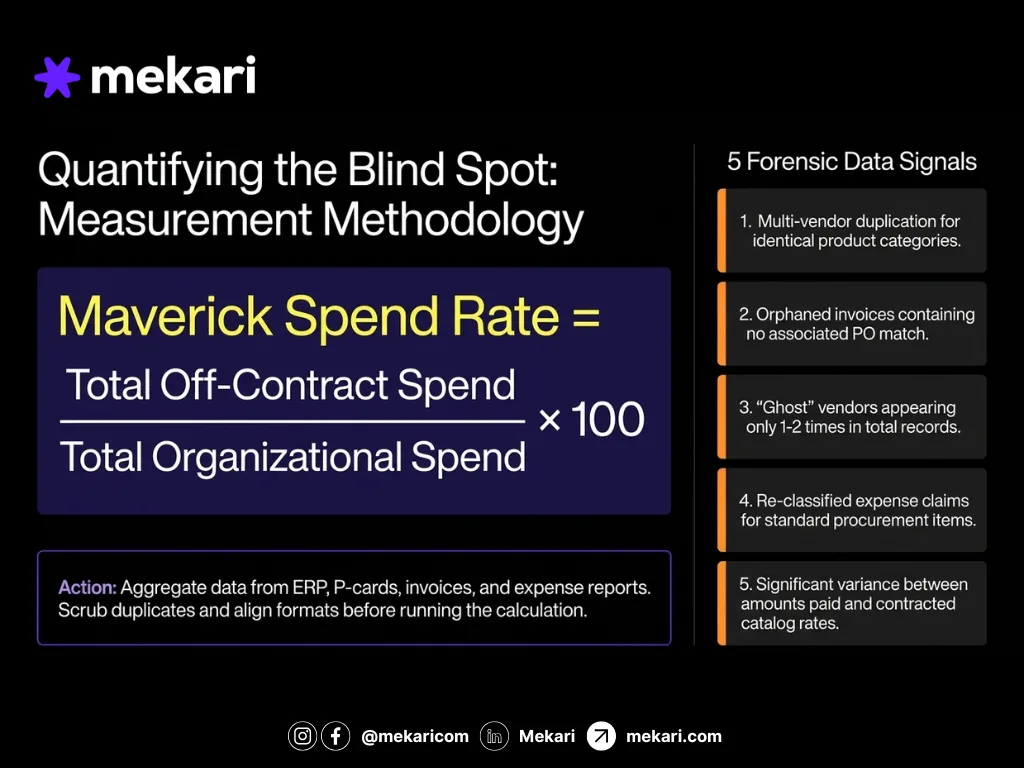
Controlling maverick spending starts with knowing how much of it exists in the first place. That means moving beyond assumptions and looking at the actual data — specifically, calculating what share of total organizational spend is flowing outside approved procurement channels.
To quantify this, procurement teams typically start with the maverick spend rate.
Maverick spend rate = (total off-contract spend / total organizational spend) × 100
For example, if an organization spends $50 million annually and $7.5 million bypasses approved channels, the maverick spend rate is 15%.
To calculate this accurately, pull spend data from invoices, purchase orders, corporate credit card statements, ERP records, and employee expense reports. Then, standardize the data by removing duplicates and aligning formats before analysis.
From there, look for these signals in the data:
- Multiple vendors supplying the same product or category
- Invoices with no associated purchase order
- Vendors that appear only once or twice in the records
- Expense claims for items that should have gone through procurement
- Significant variance between amounts paid and contracted rates
Once the signals are found, categorize them by department, vendor, and spend category to identify where maverick spending is most concentrated.
High-frequency, low-value categories — office supplies, IT software, marketing services — are typically the highest-risk zones.
This analysis becomes the baseline that procurement uses to set targets, prioritize action, and track improvement over time.
How to Reduce Maverick Spending
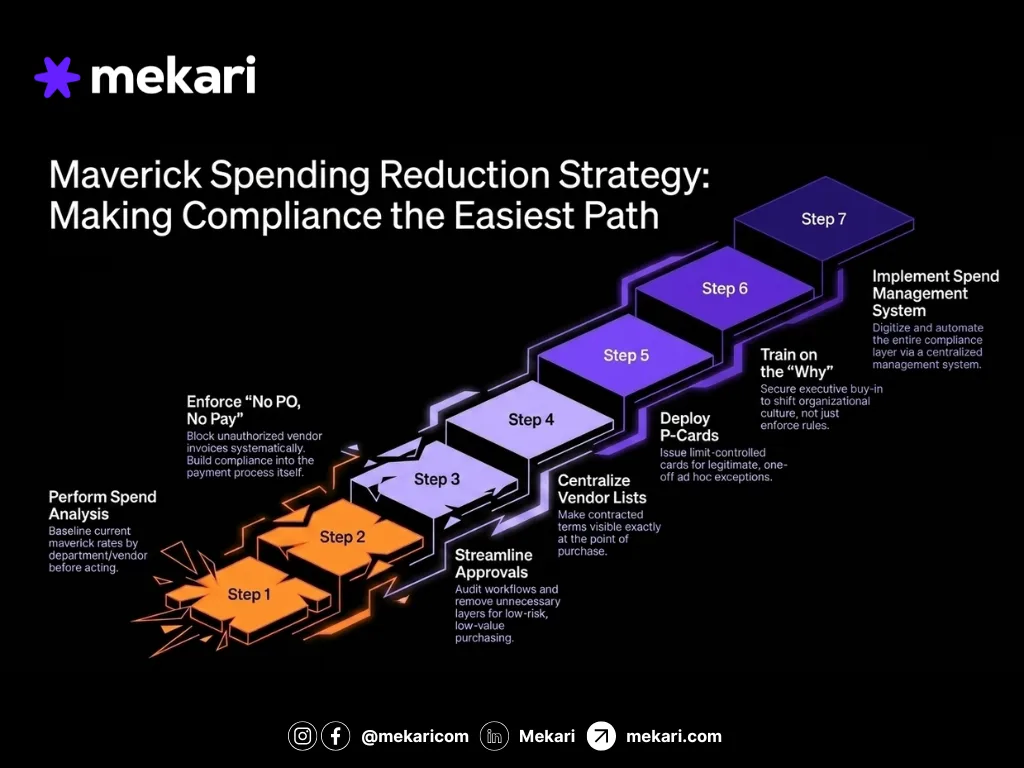
The central principle behind every effective maverick spend reduction strategy is simple: make the compliant path the easiest path.
If buying through approved channels is faster and less friction than going rogue, most employees will naturally comply. The following strategies work together toward that goal.
1. Start with spend analysis
Before implementing any solution, procurement teams need visibility into where the maverick spending is occurring.
Spend analysis reveals which departments are most affected, which categories are most vulnerable, and which vendors are receiving the most off-contract purchases.
Without this foundation, reduction efforts tend to be reactive rather than targeted.
2. Enforce a “No PO, No Pay” Policy
Requiring a purchase order for every transaction creates a documented, auditable trail for all spend and removes the ability to process invoices from unauthorized vendors without scrutiny.
This policy is one of the most direct levers available to procurement teams. It builds compliance into the payment process itself, not as a cultural expectation, but as a system requirement.
The practical effect is significant. When employees know that invoices without a matching PO will not be processed, the incentive to bypass procurement largely disappears.
3. Streamline Approval Workflows
Procurement bottlenecks are one of the leading drivers of rogue spending. When approval processes take days or weeks, employees with genuine urgency will find ways around them.
Auditing existing requisition and approval steps to identify where delays accumulate, and eliminating unnecessary layers for low-risk, low-value purchases, removes one of the most common motivations for going off-contract.
The goal is not to eliminate oversight but to make compliant purchasing fast enough that it is no longer perceived as an obstacle.
4. Maintain and Communicate Preferred Vendor Lists
Employees cannot buy from preferred vendors they do not know exist.
Maintaining an accessible, up-to-date list of approved suppliers, complete with current pricing, volume discount thresholds, and contract terms, closes one of the most common knowledge gaps that leads to maverick purchasing.
The list needs to be visible at the point of purchase, not buried in a shared drive that employees have to actively seek out. When the right supplier is the easiest supplier to find, compliance becomes the path of least resistance.
5. Invest in People and Secure Executive Buy-In
Training employees on procurement policy is most effective when it focuses on the “why” rather than just the rules.
When senior leaders actively support and enforce procurement policies, compliance becomes an organizational standard rather than a procurement department concern.
6. Issue procurement cards for legitimate one-off purchases
Not every ad hoc purchase can be routed through a full procure-to-pay workflow.
Companies can issue procurement cards to authorized employees with defined spending criteria and limits to give procurement visibility into one-off transactions without creating a compliance burden for every small, legitimate exception.
7. Implement a Spend Management System
Technology is the layer that makes all of the above strategies scalable and enforceable.
A spend management system centralizes purchasing activity, automates compliance, and gives finance and procurement teams real-time visibility into where money is going across the organization.
Key capabilities of spend management systems that directly address maverick spending include:
- Purchase request and purchase order automation: Digitize and standardize the end-to-end purchasing process, ensuring every transaction is initiated, tracked, and approved through a single system.
- Approval workflow: Automate multi-level approval routing so purchase requests reach the right approvers without delays that push employees to bypass the process.
- Custom policy: Encode procurement rules directly into the system, automatically blocking or flagging purchases that fall outside defined parameters.
- Budget allocation: Set and monitor budgets by department, category, or cost center in real time, making overspending visible before it happens.
- Corporate card: Issue virtual and physical cards to authorized employees with built-in spending limits and category restrictions, replacing untracked personal card usage.
- Vendor portal: Centralize approved vendor information so employees always have access to the right suppliers at the right terms.
- Purchase invoice and OCR: Automate invoice processing and match documents to purchase orders, reducing the manual reconciliation burden that maverick spend creates.
When the compliant purchasing experience is as simple and intuitive as a consumer shopping platform, employees have little reason to look elsewhere and maverick spending can be reduced significantly.
Bring maverick spending under control with a spend management system
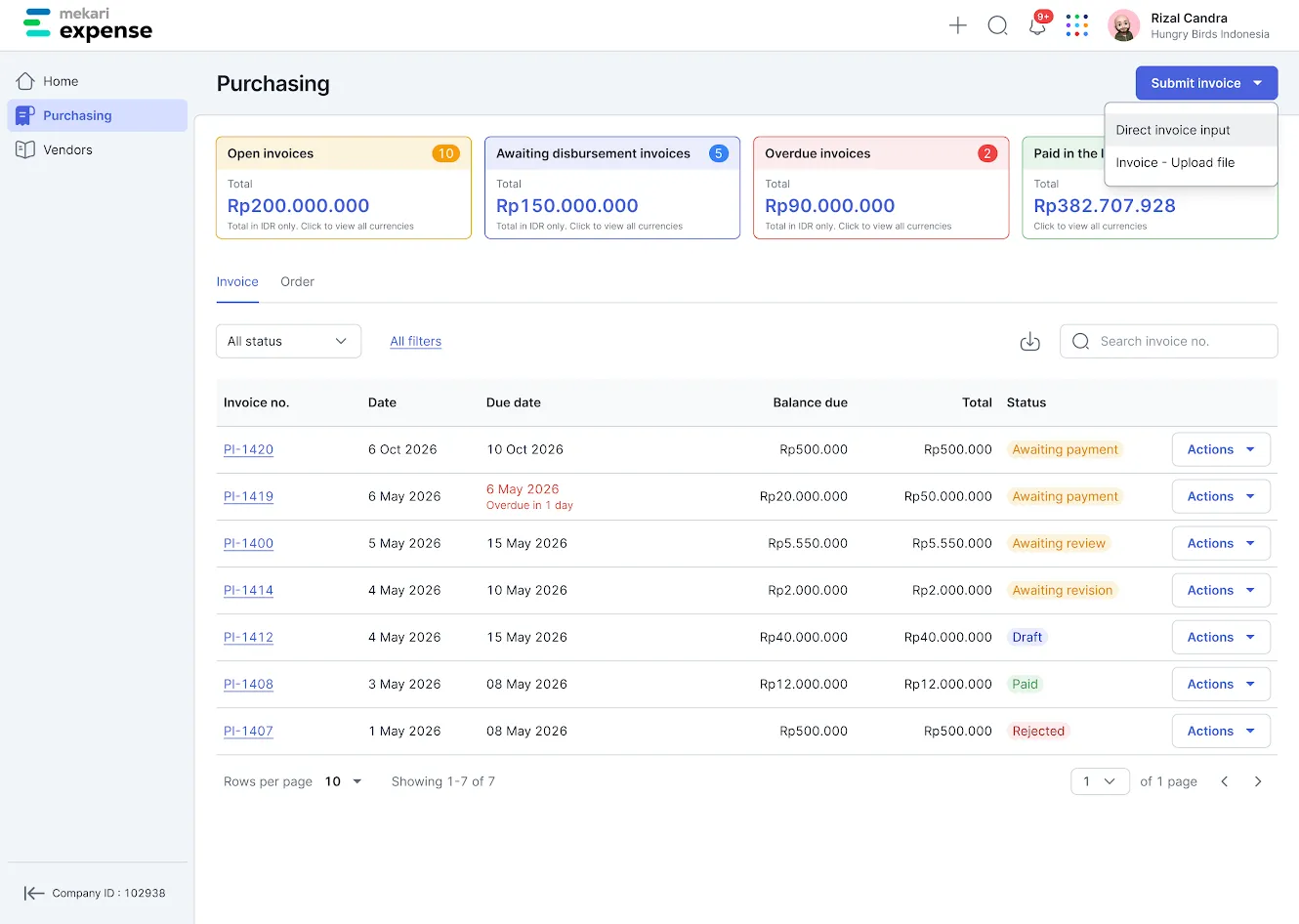
Controlling maverick spending at scale requires more than policy and training alone. It requires a system that enforces compliance at the point of purchase.
Mekari Expense is a spend management system built to function as a procurement software, putting compliance controls directly into the purchasing process and making it easier for employees to buy the right way and harder to go off-contract.
Here are some features and reasons that sets Mekari Expense Procurement apart:
- Purchase request with automated approval: Create and submit purchase requests based on department, project, or vendor needs, with multi-level approval flows that follow company authorization automatically.
- Purchase order creation: Digitize PO creation with complete vendor, product, and price details, ensuring every purchase is documented and tracked from submission to approval.
- Vendor management: Maintain a centralized, registered vendor database so only verified vendors can be used in POs and invoices, preventing purchases from unapproved suppliers at the system level.
- Custom policy: Set spending categories, limits, and rules that are applied automatically to every transaction, blocking non-compliant purchases before they happen.
- Approval workflow: Multi-level approval flows adjust based on transaction amount and department, maintaining oversight without creating the bottlenecks that drive employees off-contract.
- Centralized budget visibility: Monitor all procurement budgets from a single dashboard in real time, making overspending visible before it occurs.
- Mekari Limitless Card (Corporate card for purchasing): Issue virtual credit cards and physical debit cards to authorized employees with built-in spending limits and category restrictions, replacing untracked personal card usage with controlled, traceable transactions.
Eliminate maverick spending and bring all procurement activity throughout your company under control with Mekari Expense Procurement.
References and methodology
Methodology
Methodology
Articles published by Mekari Expense are developed using trusted sources, including official data, company reports, academic research, and insights from industry practitioners. Whenever possible, we refer directly to primary sources before drawing conclusions. Our editorial team reviews and verifies the information to ensure accuracy and relevance. All references are listed so readers can trace each piece of information back to its original source.
Our editorial standards
Our editorial standards
- Primary source first: We consult official product documentation and pricing pages directly, not secondhand summaries or aggregator sites.
- Fact-checking: All product features, pricing, and claims are cross-verified against each platform’s official website at the time of writing.
- No paid placement: Tools are selected based on relevance and fit for Indonesian businesses, not commercial arrangements. Mekari Expense is included as a first-party product and is transparently labeled as such.
- Regular review: Articles are periodically updated to reflect product changes or shifts in market relevance.
References
References
APQC. “Maverick Purchasing Means Slower, More Costly Purchases”
Tipalti. “Maverick Spend Explained: How to Identify and Prevent It”
FAQ
1. What is the difference between maverick spend and tail spend?
1. What is the difference between maverick spend and tail spend?
Tail spend refers to the high volume of low-value, irregular purchases that are difficult to manage centrally, and these can include purchases from approved vendors. Maverick spend specifically refers to purchases that violate procurement policy, regardless of value. Maverick spending most commonly occurs within tail spend categories, but not all tail spend is maverick spend.
2. What is the difference between maverick spend and rogue spend?
2. What is the difference between maverick spend and rogue spend?
Both terms refer to the same thing — purchases made outside a company’s approved procurement processes. Rogue spend is simply the more colloquial alias, while maverick spend is the more widely used term in procurement literature.
3. How does maverick spending affect the finance team specifically?
3. How does maverick spending affect the finance team specifically?
Finance teams bear the operational cost of maverick spending through increased reconciliation work, inaccurate budget forecasts, and difficulty closing books when purchases lack matching purchase orders. According to The Hackett Group, 44% of organizations report increased purchasing process costs as a direct consequence.
4. How does Mekari Expense help procurement teams prevent maverick spending?
4. How does Mekari Expense help procurement teams prevent maverick spending?
Mekari Expense is a spend management system and procurement software that enforces compliance directly at the point of purchase. With purchase requests, purchase orders, automated approval workflows, vendor management that restricts transactions to registered suppliers, and custom spending policies that block non-compliant purchases automatically, it gives procurement and finance teams full visibility and control over company spend. Explore how Mekari Expense can help bring maverick spending under control throughout your company.