





Spend Visibility: Why Blind Spots Cost You Millions



Mekari Insight
- Most companies operate with incomplete spend visibility, which leads to measurable financial losses, inefficient procurement decisions, and hidden risks across departments
- Achieving full spend visibility requires more than reporting. It depends on real-time data, standardized processes, centralized systems, and automated policy enforcement
- Spend management software Mekari Expense help businesses eliminate blind spots by centralizing all spend data, automating workflows, and providing real-time visibility without manual effort
Most companies believe they know where their money goes, but the data shows otherwise. According to the Veridion, 60% of finance executives admit they lack full visibility into their organization’s transactions. That gap comes at a real cost.
Gartner via Suplari estimates that poor spend visibility drains 3% to 11% of annual spend through duplicate suppliers, off-contract purchases, missed discounts, and hidden compliance issues. The fix is spend visibility: the ability to track and understand every purchase across the business in real time.
This article explores what it is, why it matters, what gets in the way, and how to achieve it without adding manual work.

What is spend visibility?

Spend visibility is an organization’s ability to track, analyze, and understand all purchasing and procurement activity across every department, supplier, and spending category in real time, enabling better decisions and cost control.
It answers critical questions such as:
- What the business is buying
- Who it is buying from
- How much is being spent
- Under what terms those purchases are made
Importantly, spend visibility goes beyond basic expense tracking. It provides a complete view of procurement, including: vendor contracts, departmental budgets, purchase orders, policy compliance, and payment timelines.
It is also different from spend reporting. Reporting looks backward at what has already happened, while visibility is continuous and real time, showing what is happening now.
With this level of insight, finance teams can improve cash flow forecasting by using accurate, up-to-date purchasing data to predict future spend with far greater precision.
Why spend visibility matters: the business case, in numbers
The impact of poor spend visibility is not just operational, it is measurable in risk, wasted budget, and missed savings. The data makes it clear that blind spots in spending come at a high cost, while organizations that fix them unlock significant financial gains.
1. The scale of the blind spot
- 60% of finance executives lack complete visibility into their organization’s transactions, based on an Economist Intelligence Unit survey of 507 CFOs and senior finance leaders (Veridion)
- 60% of finance and procurement leaders say poor spend visibility is a major source of organizational risk, according to a Harvard Business Review survey (Tropic App)
2. The financial cost of poor visibility
- Organizations lose 3% to 11% of total annual spend due to poor visibility, driven by duplicate suppliers, off-contract purchases, missed discounts, and compliance gaps (Gartner via Suplari)
- US SMBs alone waste $130 billion annually because finance teams cannot fully track and control spend (Glean.ai data cited by Tropic)
3. Maverick spend
- Companies lose 10% to 20% of targeted procurement savings بسبب maverick buying or unauthorized purchases (SDC Exec report cited by Sievo)
- 67% of procurement leaders say the main cause is employees not understanding or following procurement policies
4. The payoff of getting it right
- Organizations with strong spend transparency can save 11% to 20% in costs (Harvard Business Review)
- Companies that implement automated procurement solutions reduce processing costs by up to 30% (McKinsey & Co.)
- Spend analysis is now the fastest-growing procurement software category, with a 34% market share in 2024 and projected growth above 9% CAGR through 2034 (Global Market Insights)
Why most companies still struggle with spend visibility
Most organizations do not lack intent when it comes to controlling spend. The real issue lies in structural gaps, disconnected systems, and processes that were never designed for real-time visibility.
- Data is fragmented across systems: Spending data is scattered across accounting tools, spreadsheets, emails, procurement systems, and corporate cards, with no single source of truth
- Manual processes create delays and errors: Manual input and outdated record-keeping introduce time lags, making reports obsolete by the time they are reviewed
- Lack of standardization across departments: Different teams follow different formats, workflows, and vendor practices, making consolidation difficult
- Traditional payment methods limit traceability: Petty cash, physical cards, and manual payments are hard to track in real time and often only reconciled at month-end
- Silos between finance and procurement: When these teams operate separately, decisions are made with incomplete data and blind spots persist
- Spreadsheet tracking does not scale: As transaction volume grows, spreadsheets become error-prone and unsustainable, yet many companies rely on them for too long
The 5 core elements of effective spend visibility
Achieving true spend visibility requires more than better reporting. It depends on a set of core capabilities that work together to provide a complete and real-time view of spending.
- Spend categorization: Every transaction is tagged by category, vendor, department, or cost center to enable meaningful analysis
- Centralized data aggregation: All financial data from claims, cards, purchase orders, and invoices is unified in one system
- Real-time reporting and dashboards: Finance teams can monitor spend live and detect anomalies as they happen
- Policy compliance monitoring: Transactions are automatically checked against company policies, with violations flagged or blocked
- Audit trails and documentation: Each transaction includes a complete digital record of approvals, receipts, and actions
Read more: Spend Data Management Guide: Reduce Manual Work by 60%
Benefits of spend visibility for every function
When spend visibility is implemented effectively, its impact extends across the organization, improving both control and efficiency.
- CFOs and finance directors: Replace intuition-based budgeting with data-backed forecasts, identify deviations in real time, and improve cash flow accuracy
- Procurement teams: Consolidate vendors, negotiate better rates, and detect maverick spend earlier before it compounds
- Finance operations and AP teams: Reduce manual reconciliation, minimize time spent chasing approvals, and automatically flag discrepancies
- Department heads and budget owners: Track budget usage and remaining allocation without waiting for finance reports
- IT and operations: Reduce reliance on disconnected tools and minimize errors from manual data transfers
Manual vs. real-time spend visibility: a side-by-side comparison
To clearly understand the operational gap, the comparison below highlights how manual processes differ from real-time spend visibility across key areas.
| Aspect | Manual / low visibility | Real-time spend visibility |
|---|---|---|
| Data access | Collected at month-end from spreadsheets and email | Live dashboard updated with every transaction |
| Spend categorization | Manual tagging, inconsistent across departments | Automatic classification by category, vendor, cost center |
| Policy enforcement | Checked after the fact | Automated checks in real time, violations prevented |
| Maverick spend detection | Found during audits, often too late | Instantly flagged through system alerts |
| Budget tracking | Requires manual reconciliation | Live tracking with alerts at thresholds |
| Approval workflows | Email-based with limited visibility | Digital workflows with real-time status tracking |
| Vendor management | Fragmented, unapproved vendors common | Centralized and controlled vendor database |
| Audit readiness | Manual and time-consuming | Fully documented and instantly accessible |
| Forecasting accuracy | Based on outdated data | Based on real-time committed and actual spend |
| Reporting speed | Takes days or weeks | Instant and on-demand |
| Scalability | Breaks as volume increases | Scales without additional admin burden |
Read more: 10 Best Enterprise Budgeting Software for Cost Control
How to improve spend visibility: a step-by-approach
Improving spend visibility is not about adding more reports or tightening controls in isolation. It requires a structured approach that connects data, standardizes processes, and embeds visibility into daily operations.
The steps below outline how organizations can move from fragmented tracking to real-time, actionable insight.
1. Audit your current spend data sources
Start by mapping where your spending data currently lives. This typically includes accounts payable systems, procurement platforms, corporate cards, employee reimbursements, and petty cash.
The goal is to identify which systems are connected, which operate in silos, and where gaps or blind spots exist. This sets the foundation by showing how fragmented your current visibility really is.
2. Standardize spend categories
Before any meaningful analysis can happen, you need a consistent way to classify spend. Define a standardized taxonomy that applies across all departments, vendors, and transaction types.
Without this, comparing spend across teams or identifying patterns becomes unreliable and inconsistent.
3. Centralize all spending data onto one platform
Move away from scattered spreadsheets and disconnected tools into a centralized spend management system.
This platform should aggregate all transactions from different sources into a single, unified view. Centralization eliminates blind spots and ensures that finance teams are working with complete and up-to-date data.
4. Implement automated policy controls
Instead of relying on manual reviews, configure rules directly into the system. This includes approval workflows, spending limits, vendor restrictions, and category-based controls.
Automation ensures policies are enforced consistently and reduces the risk of non-compliant or unauthorized spend slipping through.
Read more: How to Prevent Spending Leakages & Recommended Software
5. Set up real-time dashboards and alerts
Define the key metrics that matter most to your organization, such as budget utilization by department, spend by vendor, or maverick spend rate. Build dashboards that update in real time and set alerts when thresholds are exceeded. This allows teams to act immediately, rather than reacting after month-end reports.
6. Connect procurement, AP, and accounting systems
Integration is critical to maintaining data accuracy and eliminating manual work. By connecting your spend management platform with ERP and accounting systems, you remove the need for duplicate data entry and ensure consistency across financial records.
7. Educate employees and enforce consistently
Even the best system will fail if employees do not use it properly. Provide training, clear guidelines, and ongoing communication about spending policies and processes. Consistent adoption across teams is what turns visibility from a tool into a company-wide capability.
8. Review and optimize continuously
Spend visibility is not a one-time project. Use the data and insights generated to continuously improve. Identify inefficiencies, renegotiate vendor contracts, consolidate suppliers, and refine budget allocations.
Over time, this creates a cycle of ongoing cost optimization and better financial control.
How Mekari Expense gives you full spend visibility without the manual work
Mekari Expense is Indonesia’s leading spend management platform, built to give finance and procurement teams real-time visibility and control over every transaction in one integrated system. From reimbursements and business trips to vendor payments and procurement, all spending data is captured and tracked automatically.
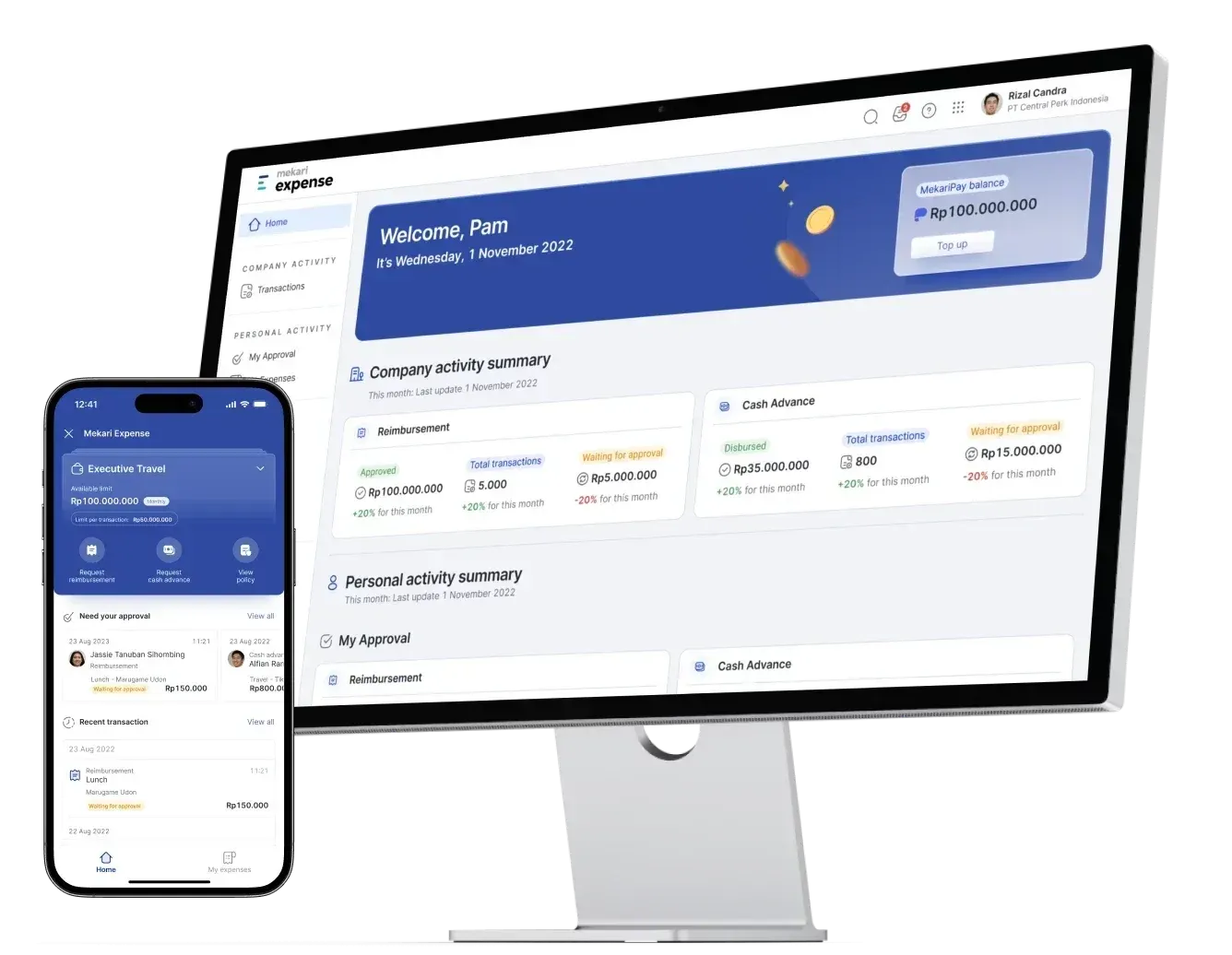
It addresses the core challenges of spend visibility by replacing disconnected tools, manual input, and delayed reporting with automated, real-time workflows. Trusted by 35,000+ companies and ISO 27001 certified, Mekari Expense helps businesses save up to 150 hours per month on expense management.
Key features that enable full spend visibility:
- Real-time transaction dashboard: Track all transactions from request to payment in one centralized view
- Budget allocation with live tracking: Monitor budgets across teams or projects with real-time balances and alerts
- Custom policy enforcement: Automatically block non-compliant spend before approval
- Multi-level approval workflows: Dynamic approvals with complete audit trails
- Mekari Limitless Card: Issue corporate cards with controlled limits and automatic transaction recording
- OCR receipt capture: Scan receipts and extract data instantly without manual entry
- On-demand reporting: Generate detailed reports by category, department, or vendor instantly
- Seamless integration with Mekari Jurnal: Sync all transactions automatically for accurate accounting
To see how your business can eliminate spend blind spots and gain full financial control, explore Mekari Expense.
References
Ivalua. ‘’What is Spend Management? A Comprehensive Guide’’
Suplari. ‘’Spend Analysis Explained’’
Veridion. ‘’10 Spend Management Statistics You Need to Know About’’
FAQ
1. What is the difference between spend visibility and expense tracking?
1. What is the difference between spend visibility and expense tracking?
Expense tracking focuses on recording past transactions, while spend visibility provides a real-time, complete view of all purchasing activities, including procurement, contracts, and budget usage.
2. Why do companies struggle with spend visibility?
2. Why do companies struggle with spend visibility?
The main challenges include fragmented systems, manual processes, lack of standardized categories, and limited integration between finance and procurement tools.
3. What is maverick spend and why does it matter?
3. What is maverick spend and why does it matter?
Maverick spend refers to purchases made outside approved vendors or processes. It reduces negotiated savings, increases risk, and makes spending harder to control.
4. How does real-time spend visibility improve financial planning?
4. How does real-time spend visibility improve financial planning?
It allows finance teams to track both committed and actual spend as it happens, leading to more accurate budgeting, forecasting, and cash flow management.
5. How can companies improve spend visibility without adding manual work?
5. How can companies improve spend visibility without adding manual work?
By adopting a centralized spend management platform that automates data capture, enforces policies, and provides real-time dashboards, companies can improve visibility while reducing administrative effort.