





Procurement Sourcing Strategy: Choosing the Right Approach for Each Category

Mekari Insight
- The right sourcing approach depends on the category, supplier market, spend, and supply risk.
- Two categories with similar spend can call for very different supplier setups.
- Procurement needs to understand the supply market before deciding how much competition or supplier coverage the category needs.
- Cost matters, but supplier capability, switching difficulty, and business impact can change the decision.
- Mekari Expense’s Spend Control feature helps finance and procurement keep sourcing decisions connected to budget and spending controls.
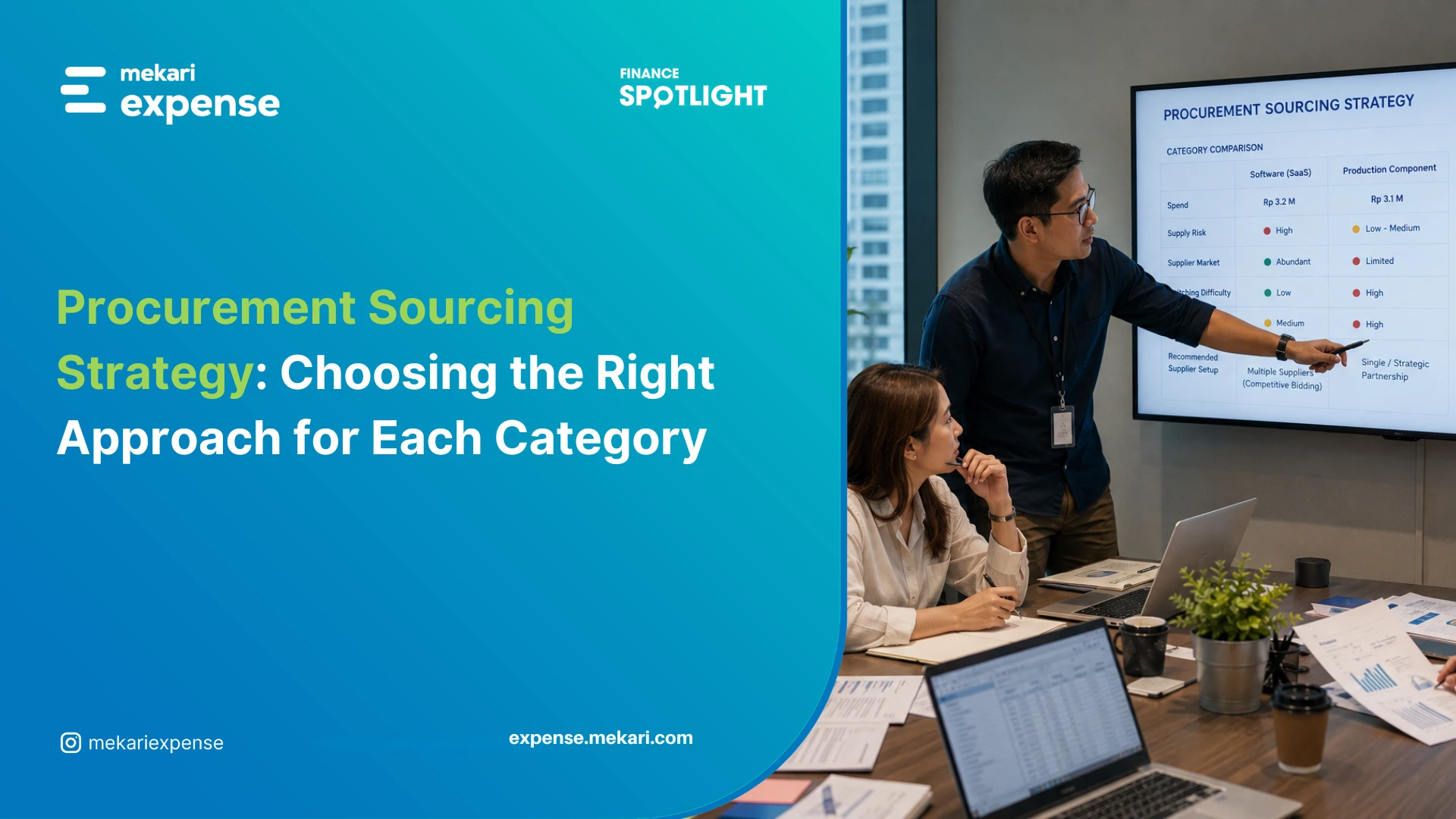
Procurement can spend the same amount on software and production components and still face completely different sourcing decisions.
Software may have dozens of qualified vendors. A production component may have three.
That difference changes the conversation. Procurement has more room to compare offers when suppliers can be replaced easily. When alternatives are scarce, capacity, qualification time, and supply continuity become part of the commercial decision.
That is the practical role of a procurement sourcing strategy: deciding how a category should be sourced before procurement starts comparing supplier proposals.
CIPS describes sourcing as a procurement activity that assesses the market, identifies viable suppliers, develops a sourcing strategy, and evaluates bids. Its strategic sourcing standard also covers market factors, supplier capabilities, supply and demand, supplier financial data, and cost structures.

What Is Procurement Sourcing Strategy?
Procurement sourcing strategy is the approach used to decide how a category should be brought to market and what supplier setup fits the business requirement.
That decision can shape the supplier pool, sourcing method, commercial terms, and level of supply dependence.
Consider a recurring software category. Procurement may have several vendors that meet the technical requirements, making competitive sourcing a realistic option. A specialized component can look very different when qualification takes months and only a few suppliers can meet the specification.
The sourcing strategy has to account for that difference before the bidding process starts.
Why Does the Category Come First?
Procurement often has more useful information than the supplier list alone. Spend data can show where purchases are fragmented. The supply market can reveal how many credible alternatives exist. The business requirement can show how much disruption the company could absorb if a supplier failed.
Those pieces belong together.
Start with the spend profile
Look at the category spend, buying frequency, business units involved, current suppliers, and recurring purchases.
A category split across several suppliers may point to a consolidation opportunity. A category with large recurring spend may justify a formal sourcing event.
Spend analysis can help procurement see supplier concentration and recurring buying patterns before the sourcing approach is chosen.
Read the supplier market
The number of suppliers in a directory says little on its own.
A category may have twenty suppliers on paper and only three that meet the required certification, volume, delivery window, or technical specification. Geography can change the picture as well. Local suppliers may offer shorter delivery routes, while overseas suppliers can widen the available supply base.
What matters is the number of suppliers that can actually compete for the business.
Check the cost of switching
Supplier choice becomes harder when replacement takes time.
Qualification work, technical integration, tooling, implementation, or internal approval can keep a company tied to a supplier long after the original contract was signed. A cheaper quote can lose its appeal when moving away from the supplier would take six months.
That makes switching difficulty part of the sourcing decision, not something to think about after supplier selection.
Look at the role the category plays
A supplier outage matters differently for office supplies and a production component.
Categories tied directly to production may need stronger continuity planning. Routine indirect spend can give procurement more room to prioritize price competition and simpler supplier management.
CIPS describes category management as grouping related products into categories and managing each category with its own strategy and goals. The approach also uses spend data and market factors when developing category plans.
71% of organizations say balancing cost and risk drives procurement strategy.
Procurement decisions increasingly weigh commercial value against supply disruption risk.
Source: Institute for Supply Management (ISM) & Amazon Business, 2026.
Read More: Direct Spend Procurement Best Practices
Which Sourcing Approach Fits the Category?
Once the category is clear, the sourcing model becomes easier to choose.
| Category signal | What it may mean | Sourcing approach to consider |
|---|---|---|
| Many qualified suppliers | Strong competition and easy supplier comparison | Competitive bidding |
| Few qualified suppliers | Limited alternatives and higher switching difficulty | Closer supplier relationship |
| Spend spread across many suppliers | Fragmented contracts or inconsistent pricing | Supplier consolidation |
| High business impact and supply risk | Disruption would hurt operations | Multiple sources or backup suppliers |
| Stable, routine demand | Easy-to-source requirement | Simple sourcing process with periodic review |
This is a decision guide, not a fixed formula.
A single supplier can make sense when technical consistency matters and the market is stable. Multiple suppliers can work better when continuity or competitive pressure matters more. CIPS also recognizes approaches such as global, local, outsourced, insourced, nearshore, and low-cost-country sourcing.
For MRO, the category often covers a broad range of recurring operational purchases, so its sourcing logic can differ from a strategic direct-material category.
Read More: MRO Sourcing Strategies That Cut Costs by up to 52%
How Should Procurement Compare Supplier Options?
A sourcing model can look attractive until the commercial and operational details are put side by side.
1. Compare the full cost
Unit price is only one part of the quote.
Freight, payment terms, minimum order quantities, discounts, warranties, and price-review clauses can change the economics of the deal. A supplier with the lowest unit price may end up costing more once those items are added.
2. Test supplier capability
A supplier can win on price and still struggle with volume.
Procurement can check production capacity, delivery coverage, technical capability, relevant certifications, and past performance with similar requirements. The right question is whether the supplier can deliver what the category actually requires.
3. Weigh supplier dependence
A second supplier has value when it gives the business a realistic alternative.
That option matters more when qualification takes months or when the category supports an important business function. For higher supplier exposure, vendor risk management can sit alongside the sourcing assessment.
Where Do Consolidation and Diversification Fit?
Supplier count often changes the economics of a category.
Three business units may buy similar software from three different vendors. Each contract looks reasonable on its own. Put the spend together and procurement may find duplicate contracts, different pricing, and several renewal dates for products that serve similar needs. That can create a case for consolidation.
Another category may need the opposite approach. A specialized product with only a handful of qualified suppliers becomes more exposed when one vendor holds most of the volume. Splitting the business can cost more to manage, but it may give the company a stronger fallback when supply changes.
The supplier structure has to fit the category.
43% of purchasing categories have proactive risk monitoring.
Supplier risk remains a reactive issue across many categories, making supplier visibility an important part of the sourcing decision.
Source: The Hackett Group, 2026 Procurement Executive Insight Report, via GEP.
How Does the Sourcing Event Shape the Decision?
The sourcing event should give suppliers enough room to respond to the question procurement is actually asking.
A clear specification and several capable suppliers can support an RFQ. A complex service may need an RFP so vendors can explain their delivery model, implementation plan, service levels, and commercial terms.
Lotting can change the result too. Procurement may award the full requirement to one supplier, split volume by geography, or separate the work by capability.
Those choices affect competition, supplier exposure, and the terms the company can negotiate.
CIPS places market analysis, sourcing strategy development, supplier assessment, and bid evaluation within strategic sourcing practice.
Baca Juga: Procurement Compliance & Governance Framework Guide
Where Does Negotiation Enter the Strategy?
The negotiation starts before the supplier meeting.
A category with several capable suppliers gives procurement more room to compare offers. In a tight supply market, the supplier may hold more leverage on capacity, lead time, or contract terms.
That changes what procurement should trade for.
Volume discounts can matter in one category. In another, payment terms, service levels, capacity commitments, warranties, or price-review mechanisms may have more commercial value.
The sourcing strategy sets that position. The detailed negotiation work can follow in the existing vendor negotiation strategy guide.
When Should Procurement Revisit the Sourcing Strategy?
A sourcing decision can stay sensible for years, or become outdated quickly.
Supplier capacity changes. Demand moves. New vendors enter the market. Prices shift. A contract may create more supplier dependency than procurement expected when the award was made.
Those changes give procurement a reason to review the category again.
A category that once worked well with one supplier may benefit from a second source later. A fragmented category may move toward consolidation after spending becomes easier to see.
CIPS also calls for ongoing assessment of market factors, supplier capabilities, supply and demand, and cost structures when developing sourcing plans.
65% of organizations still rely on manual reporting to gather supply-chain data.
Procurement and finance can spend valuable time piecing together information when spending or supplier conditions change.
Source: Institute for Supply Management (ISM) & Amazon Business, 2026.
Read More: Procurement Maturity Model: 4 Stages to Procurement Excellence
How Mekari Expense Supports the Spending Side of Sourcing
Sourcing decisions change spending plans. Finance needs to see the budget behind the decision while procurement works through supplier options.
Spend Control connects budget allocation, spending policy, approval, and spending visibility.
For example, a business unit may decide to change its supplier mix for a recurring category. Procurement works through the sourcing decision, while finance can keep the planned spend in view.
The sourcing strategy stays with procurement. Mekari Expense supports the financial controls around it.
The Category Sets the Direction
Procurement can use the same sourcing model across every category, but the results will differ.
One category may reward competition. Another may need a closer supplier relationship. A third may justify multiple sources because a disruption would affect the business too heavily.
Spend tells part of the story. The supply market, switching difficulty, business impact, and supplier dependency complete it.
That is why sourcing decisions work better when procurement starts with the category and builds the supplier approach from there.
References:
- Chartered Institute of Procurement & Supply (CIPS). Sourcing.
- Chartered Institute of Procurement & Supply (CIPS). Category Management.
- Chartered Institute of Procurement & Supply (CIPS). CIPS Global Standard — Segment 6.7: Strategic Sourcing.
- Chartered Institute of Procurement & Supply (CIPS). Global State of Procurement & Supply 2026.
- Institute for Supply Management (ISM) & Amazon Business. 2026 Supply Chain Research.
- The Hackett Group. 2026 Procurement Executive Insight Report.