





OCR Fraud Detection: Guide to Detect Business Fraud Early

Mekari Insight
- OCR fraud detection is a multi-stage pipeline image preprocessing, AI text recognition, layout parsing, and validation logic that transforms document images into verified, structured financial data.
- Inaccurate OCR in financial workflows creates compounding risks, identity fraud, regulatory breaches, disrupted operations, and data leaks particularly when deployed at scale without proper validation layers.
- Mekari Expense leverages AI-powered OCR to automate invoice data extraction, eliminate manual input risks, and sync vendor documents directly to the Purchase Invoice module, combined with a real-time Fraud AI Checker to ensure every transaction is validated and analyzed before payment is processed.
Every day, companies process thousands of financial documents, ranging from invoices to identity forms. The challenge arises when document volumes exceed the team’s ability to verify them, creating a gap between intake and verification that becomes an entry point for fraud.
According to PwC Global Economic Crime and Fraud Survey 2024, 51% of organizations worldwide experienced some form of fraud within the past two years, with document manipulation cited as one of the recurring methods.
As digital transformation advances, document manipulation has become increasingly sophisticated from altered invoices to counterfeit identity documents. Manual reviews can help, but at scale they tend to be slow, costly, and inconsistent.
OCR fraud detection addresses this challenge by combining automated text extraction with intelligent validation, enabling companies to process large volumes of documents accurately while detecting signs of manipulation at an earlier stage.

What is OCR fraud detection?
Optical Character Recognition (OCR) is a technology that converts images containing text, such as scanned PDFs, ID photos, or printed invoices, into structured, machine-readable data. With OCR, information from static documents can be processed, stored, and analyzed automatically by systems.
The global OCR market reflects this rapid adoption, valued at USD 13.95 billion in 2024 and forecast to surpass USD 46 billion by 2033. – Shufti.
As its use expands across business processes, OCR is no longer limited to simply reading documents, it also becomes the foundation for detecting potential fraud. This is where OCR fraud detection comes in, extracted text is not only read, but also validated to ensure internal consistency, format compliance, and to identify anomalies that may indicate manipulation.
In practice, OCR is often combined with systems like Data Loss Prevention (DLP) to identify sensitive data and prevent misuse. With this additional validation layer, OCR goes beyond automation to help detect suspicious patterns. Errors in this process can have serious consequences, ranging from undetected fraudulent documents to regulatory violations that lead to legal and financial risks.
Read More: How Purchase Invoice Fraud Works And How to Stop It
How does OCR fraud detection work in business?

OCR fraud detection generally consists of four sequential stages, namely:
1. Image acquisition
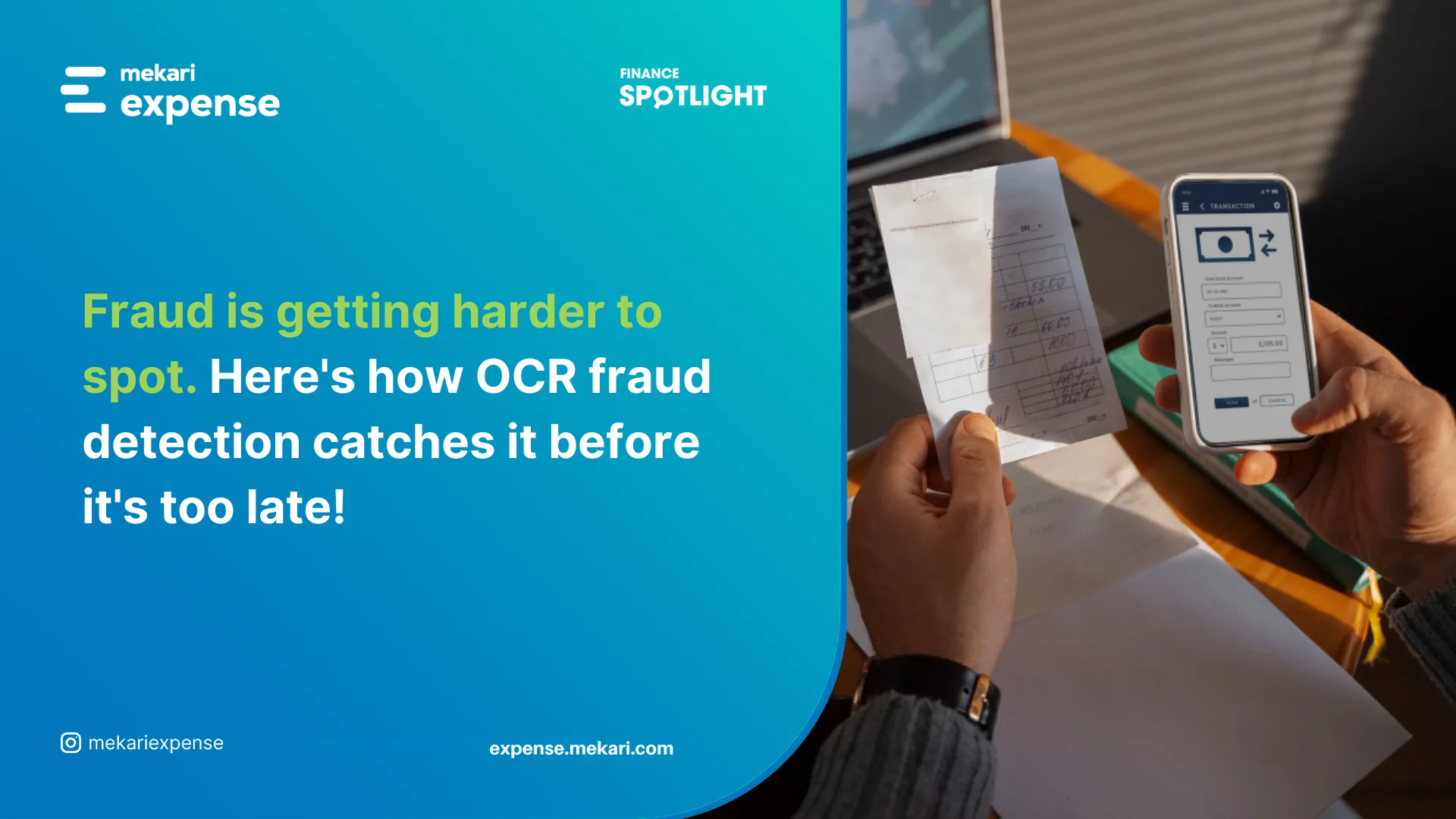
The process starts by capturing the document using a scanner, high-resolution camera, or mobile device. Image quality is critical at this stage. Clear, well-lit images with minimal distortion enable more accurate processing in later stages.
Enterprise systems often integrate with dedicated scanning hardware, while modern solutions also support real-time mobile capture for invoices, contracts, and handwritten forms.
2. Preprocessing
Before text recognition begins, the captured image is refined. This includes deskewing to correct tilted images, despeckling to remove noise such as dust or ink artifacts, and binarization to convert the image into high-contrast black and white.
These steps are especially important for low-quality scans or aging documents, where small imperfections can significantly affect accuracy.
3. Text Recognition
Once the image is prepared, the system analyzes the text using two main approaches. Pattern matching compares characters against predefined templates and works well for structured documents such as invoices or tax forms.
Feature extraction identifies shapes like lines, curves, and intersections to interpret irregular fonts or handwriting. Modern OCR systems enhance both methods with machine learning, allowing them to adapt to various document types.
4. Postprocessing
In the final stage, the extracted text is structured into usable formats such as searchable PDFs, spreadsheets, or JSON fields. Contextual corrections are applied to resolve ambiguities, for example distinguishing between the number “5” and the letter “S” based on surrounding content.
In fraud detection contexts, this stage is where validation logic is applied. This includes format checks, field consistency rules, duplicate detection, and reconciliation processes that flag suspicious documents for further review.
It also integrates with security measures such as encryption or redaction of sensitive data before storage or transmission.
Read More: How to Detect Accounts Payable Fraud Before $125K Losses
Types of OCR technology

Not all OCR implementations carry the same capability and understanding the differences matters when evaluating fraud detection solutions.
Standard OCR
This is the most commonly used type of OCR technology. It converts printed text in scanned documents into editable and searchable formats, making it effective for routine digitization tasks such as data entry automation. However, its accuracy largely depends on document quality and layout complexity. Unstructured formats or poor-quality scans can significantly reduce its reliability.
Optical Word Recognition (OWR)
This type is capable of recognizing entire words rather than individual characters, which improves processing speed for high-volume documents. It is effective for standard documents, but may struggle when dealing with unusual fonts or inconsistent handwriting.
Optical Mark Recognition (OMR)
This type is designed specifically to detect predefined marks or symbols, such as multiple-choice bubbles on exams, checkboxes in surveys, or voting forms. Its speed and accuracy in structured environments make it widely used for exam scoring and data tabulation, although its application is limited to mark-based formats.
Intelligent Character Recognition (ICR)
This is the most advanced type. By leveraging AI and machine learning, ICR can interpret complex handwritten text and continuously improve its accuracy over time. In fraud detection contexts within financial processes ICR and AI-powered OCR have become essential capabilities. Standard OCR alone is insufficient to handle the document variability and validation complexity required for effective fraud prevention.
Read More: Top 9 OCR Invoice Scanning Software: Cut Costs by 78%
Key applications of OCR technology
OCR plays an important role in digital transformation by converting unstructured documents into usable data across various industries, including:
- Financial services & compliance: Used for KYC, AML, invoice processing, automated reconciliation, and loan analysis. OCR helps speed up onboarding processes while reducing the risk of errors and fraud.
- Healthcare: Digitizes medical records, prescriptions, and insurance claims into EHR systems to improve data accuracy and patient safety.
- Retail & logistics: Supports receipt scanning, barcode reading, and shipping label processing to improve transaction accuracy, purchase order tracking, and supply chain efficiency.
- Legal & insurance: Speeds up contract analysis and claims processing while reducing the risk of fraud from documents that may not be detected manually.
Read More: Top 9 Logistics OCR Software to Cut 15% Document Processing Cost
Benefits of using OCR technology for fraud detection
Here are some of the key benefits of OCR in fraud detection workflows
1. Efficiency and speed
OCR can process documents within seconds, tasks that would otherwise take hours if done manually. In addition to improving operational efficiency, this also serves as a fraud risk control, as shorter review times reduce the likelihood of fraudulent documents circulating without detection.
2. Cost reduction
Manual data entry is not only expensive in terms of labor but also in error correction costs. By automating data extraction, OCR enables organizations to reallocate resources to higher-value tasks such as fraud investigation, compliance analysis, and customer support. These savings become even more significant in high-volume operations.
3. Accuracy and error reduction
OCR improves consistency by extracting and validating data against predefined formats. AI-based OCR systems are even more advanced, as they can understand context and distinguish similar characters such as 1 and I, or 0 and O. This contextual understanding also helps detect manipulated documents, where values that do not match expected patterns are automatically flagged for review.
4. Improved customer experience
OCR reduces friction in verification processes, which are often a major cause of user drop-off. By automating data extraction and validation, onboarding becomes faster and does not require repetitive data entry. AI-powered OCR also reduces false rejections compared to rule-based systems, thereby improving trust and overall user experience.
Detect fraud easily with OCR technology from Mekari Expense
As document volumes grow and fraud methods become more sophisticated, manual verification alone is no longer enough. Companies need a system that can process documents accurately, validate data in real-time, and flag suspicious activity before payments are made.
As an AI-native spend management software, Mekari Expense is built with OCR technology to delivers efficiency on the input side, where data from receipts and invoices is extracted automatically without manual entry.
The Fraud AI Checker delivers control on the output side, where every transaction is analyzed in real-time and anomalies are identified before they pass through the approval process.
These two capabilities create a complete layer of protection from the moment a document enters the system to the point of payment execution.
Key advantages of OCR in Mekari Expense:
- Time efficiency and productivity: Automated invoice input helps finance teams process more documents in less time, freeing up capacity for higher-value tasks like fraud investigation and compliance review.
- Financial data accuracy: AI-powered OCR ensures every number and field is read correctly, maintaining the integrity of financial reports and reducing the risk of undetected data manipulation.
- Cash flow optimization: Faster approval and payment processes help maintain liquidity and support healthier cash planning across the organization.
- Direct integration: Data from vendor emails is automatically synced to the Purchase Invoice and claims modules, creating a seamless and traceable workflow from document receipt to payment execution.
- Reduced operational workload: Automated input eliminates repetitive data entry, lowering administrative costs and allowing finance teams to focus on strategic oversight.
- Real-time insight: Financial data can be monitored instantly through the Mekari Expense dashboard, giving teams full visibility over pending documents and flagged transactions at any time.
Prevent fraud before it happens with the OCR and Fraud AI Checker features from Mekari Expense!
References and methodology
Methodology
Methodology
Articles published by Mekari Expense are developed using trusted sources, including official data, company reports, academic research, and insights from industry practitioners. Whenever possible, we refer directly to primary sources before drawing conclusions. Our editorial team reviews and verifies the information to ensure accuracy and relevance. All references are listed so readers can trace each piece of information back to its original source.
Our editorial standards
Our editorial standards
- Primary source first: We consult official product documentation and pricing pages directly, not secondhand summaries or aggregator sites.
- Fact-checking: All product features, pricing, and claims are cross-verified against each platform’s official website at the time of writing.
- No paid placement: Tools are selected based on relevance and fit for Indonesian businesses, not commercial arrangements. Mekari Expense is included as a first-party product and is transparently labeled as such.
- Regular review: Articles are periodically updated to reflect product changes or shifts in market relevance.
References
References
Shufti. “Top OCR Use Cases in 2025: Compliance, Automation & Customer Experience”
FAQ
What is OCR fraud detection?
What is OCR fraud detection?
OCR fraud detection is a process that combines automated text extraction with intelligent validation to detect signs of document manipulation. Extracted data is not only read, but also validated for internal consistency, format compliance, and anomalies that may indicate fraud, enabling companies to process large document volumes accurately while identifying suspicious documents at an earlier stage.
How is OCR fraud detection different from standard OCR?
How is OCR fraud detection different from standard OCR?
Standard OCR simply converts printed text into machine-readable formats for digitization purposes. OCR fraud detection goes further by applying validation logic such as format checks, field consistency rules, duplicate detection, and reconciliation processes that automatically flag suspicious documents for further review—making it an active layer of defense rather than just a data entry tool.
What types of documents can OCR fraud detection process?
What types of documents can OCR fraud detection process?
OCR fraud detection can process a wide range of documents including invoices, identity documents, contracts, tax forms, prescriptions, insurance claims, and shipping labels. It supports scanned PDFs, ID photos, printed documents, and even handwritten forms captured via mobile devices.
How does Mekari Expense use OCR to help prevent fraud?
How does Mekari Expense use OCR to help prevent fraud?
Mekari Expense uses AI-powered OCR to automatically extract invoice data, eliminating manual input and reducing the risk of data manipulation. Combined with the Fraud AI Checker, every transaction is analyzed in real-time to detect potential fraud risks. Data from vendor emails is also automatically synced to the Purchase Invoice and claims modules, ensuring a complete and traceable audit trail from document intake to payment. Learn how Mekari Expense strengthens your fraud detection process.