





How Purchase Invoice Fraud Works And How to Stop It


Mekari Insight
- Purchase invoice fraud often hides within legitimate procurement processes, making it essential to understand where vulnerabilities exist across the purchase-to-pay cycle.
- High transaction volumes, siloed data, and weak approval controls make fraud difficult to detect, allowing many schemes to continue for months before discovery.
- Mekari Expense Fraud AI Checker helps prevent fraud before payment by automatically detecting unusual amounts, suspicious vendors, and duplicate transactions across all spend workflows.
Purchase invoice fraud often doesn’t come from external hackers—it happens within the procurement and payment processes businesses rely on every day. According to Precoro’s 2024 survey, 44% of companies experience invoice fraud annually, with many cases going undetected because they appear to be legitimate transactions.
Since fraudulent invoices move through the same approval workflow as genuine ones, they can be difficult to identify without the right controls.
This article explains how purchase invoice fraud works, common schemes to watch for, and how AI-powered tools can help stop fraud before payments are made.

What is purchase invoice fraud?
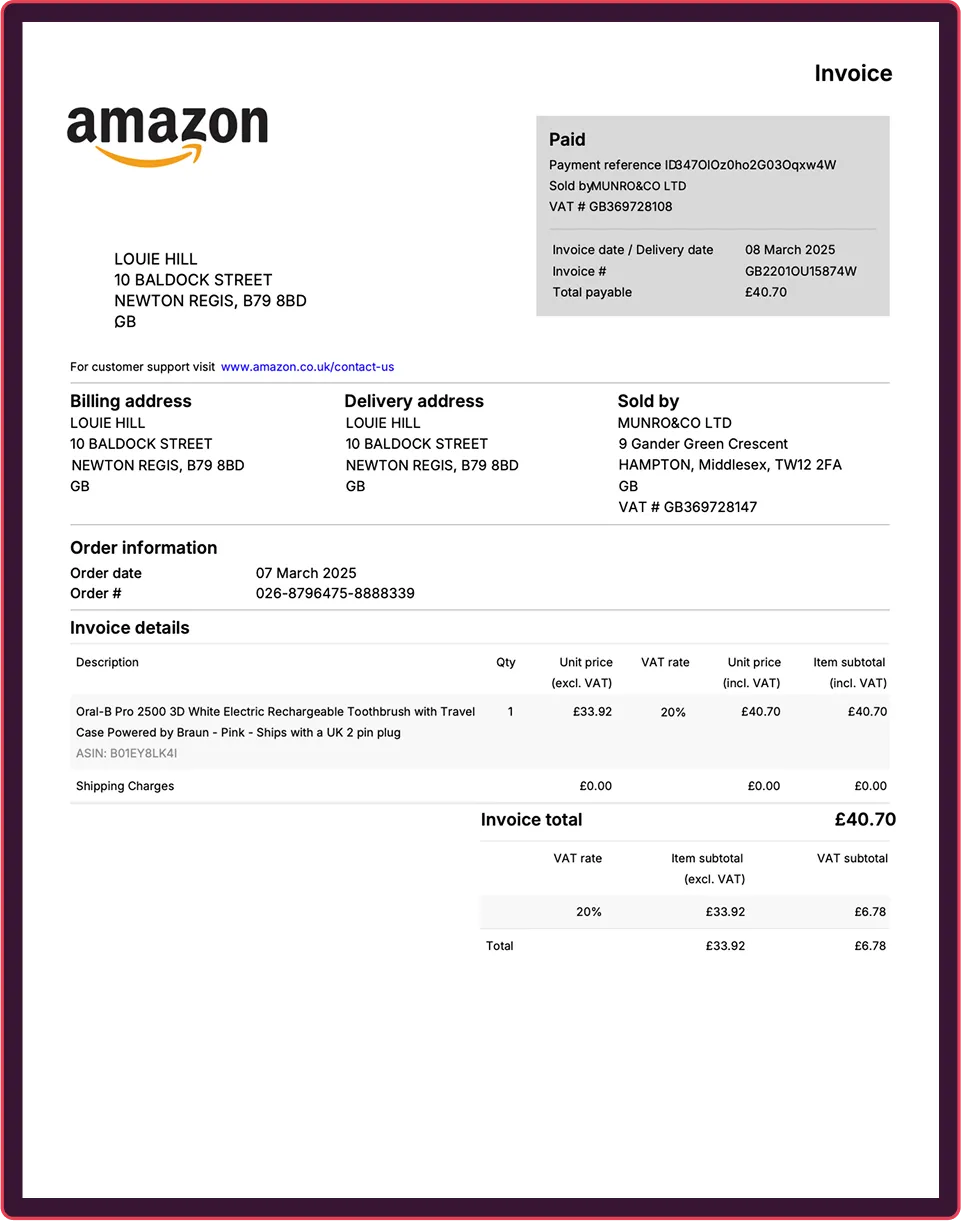
Purchase invoice fraud is the intentional manipulation of the purchasing or invoice process to obtain payments a company never authorized or for goods and services that were never actually delivered.
Unlike a simple billing mistake, invoice fraud involves deliberate deception designed to move company funds through seemingly legitimate transactions.
As a subset of procurement fraud and Accounts Payable (AP) fraud, it can occur at multiple stages of the purchase cycle—from purchase requests and vendor onboarding to invoice submission and payment approval. Common forms include:
- Fake vendors created to receive unauthorized payments
- Inflated invoices with exaggerated quantities or prices
- Duplicate invoices submitted multiple times for payment
- Unauthorized approvals by employees abusing their access
- Payments for goods or services that were never delivered
Important
The impact can be significant. According to ACFE’s 2024 Report to the Nations, organizations lose an estimated 5% of annual revenue to fraud each year, often through transactions that appear completely normal on the surface.
How fraud enters the procurement process: stage by stage
Purchase invoice fraud rarely starts at the payment stage. Instead, it can enter the purchase-to-pay (P2P) process at multiple points, exploiting routine workflows that employees trust every day.
Stage 1: Vendor onboarding — where ghost vendors are created
Fraud often begins when a fictitious vendor or a supplier with a name similar to a legitimate vendor is added to the system. Once approved, the vendor can receive payments like any other supplier.
Red flags:
- New vendors with no transaction history
- Unverified bank accounts
- Vendor names that closely resemble existing suppliers
Read more: 7 Vendor Fraud Schemes: How to Identify and Prevent It
Stage 2: Purchase requisition — where unauthorized spending begins
An employee submits a purchase request for unnecessary goods or services, or inflates quantities and prices. Weak approval controls make these requests easier to pass.
Red flags:
- Requests just below approval thresholds
- Vague or non-specific descriptions
- Unusual quantities or pricing
Stage 3: PO issuance — where terms are manipulated
Fraud can occur when purchase orders are issued to fraudulent vendors or modified after approval through price increases or quantity changes.
Red flags:
- PO prices higher than original quotations
- Frequent PO amendments
- Repeated purchases from the same vendor
Stage 4: Invoice submission — where fake invoices are injected
This is often the highest-risk stage. Fraudsters may submit duplicate invoices, fake invoices for undelivered goods, or invoices with inflated amounts. As invoice volumes grow, these irregularities become harder to spot manually.
Red flags:
- Duplicate invoice amounts
- Pricing that differs from the PO
- Missing delivery evidence
Read more: How to Detect Invoice Fraud and Prevent Losses up to £1M
Stage 5: Approval workflow — where controls are bypassed
Fraud succeeds when approval controls are weak or overridden. Common tactics include splitting invoices to avoid additional review, collusion between employees and vendors, or changing payment details through phishing and impersonation schemes.
Red flags:
- Invoices consistently below approval limits
- Manual approval overrides
- Sudden vendor bank account changes
Stage 6: Payment — the point of no return
Once payment is made, recovering funds can be difficult or impossible. This is why detecting fraud before approval is far more effective than trying to recover losses afterward.
Red flags:
- Large payments to newly onboarded vendors
- Multiple payments for the same invoice
- Unusual payment requests or timing
Because fraud can enter at every stage of the procurement cycle, businesses need controls and visibility across the entire process—not just at the payment stage.
Read more: Payment Fraud Detection to Stop Revenue Leak
Who commits purchase invoice fraud: internal vs external
Purchase invoice fraud is not always committed by outsiders. It can originate from employees inside the organization or from external parties posing as legitimate vendors. Understanding the source helps businesses apply the right controls and detection methods.
| Internal fraud | External fraud |
| Who | Employees with access to procurement, AP, vendor onboarding, or invoice approvals |
| How | Ghost vendors, unauthorized approvals, collusion with suppliers, approval threshold manipulation |
| Why it’s hard to catch | Fraudsters understand internal processes and design schemes to blend into normal workflows |
Internal fraud is particularly difficult to detect because it often involves employees who already understand approval processes and control weaknesses. Meanwhile, external fraud relies on deception, making fraudulent transactions appear legitimate enough to pass routine reviews.
Why purchase invoice fraud is so hard to catch without automation
Most invoice fraud succeeds because of process gaps rather than individual mistakes. As organizations grow, manual reviews become less effective at identifying subtle anomalies across thousands of transactions.
Some of the most common challenges include:
- High transaction volume: Finance teams often process hundreds or thousands of invoices each month, making detailed manual verification impractical.
- Siloed systems: When procurement, AP, and expense data are stored separately, duplicate or suspicious transactions can go unnoticed.
- Lack of historical visibility: Reviewers typically assess invoices individually, making unusual vendor behavior harder to detect.
- Vendor trust bias: Long-term suppliers often receive less scrutiny, creating opportunities for fraud or impersonation.
- Weak segregation of duties: When one person can create vendors, submit invoices, and approve payments, there is no independent oversight.
- Reactive detection: Many fraud cases are discovered only after someone reports suspicious activity rather than through proactive monitoring.
Automation helps address these gaps by continuously analyzing transaction patterns, vendor behavior, approval activity, and invoice data at scale.
Red flags of purchase invoice fraud in your company’s workflow
While every fraud scheme is different, many share similar warning signs throughout the procurement cycle.
At vendor onboarding
- Vendor name closely resembles an existing supplier
- Bank account details change shortly after onboarding
- Missing business registration, tax details, or operating history
- Same employee creates the vendor and later approves invoices
At invoice submission
- Invoice references an invalid or fully paid PO
- Repeated invoices submitted just below approval thresholds
- Duplicate invoice numbers or highly similar invoice details
- Missing itemized descriptions, quantities, or unit prices
- Payment information differs from vendor records
At approval
- One approver consistently approves all invoices from a specific vendor
- Invoices are submitted near period-end or during staff absences
- Potential personal relationships between approvers and vendors
- Urgent payment requests that bypass normal approval workflows
Individually, these signals may not confirm fraud. However, when multiple red flags appear together, they often indicate a higher-risk transaction that deserves additional review.
Read more: Top 9 Fraud Detection Software to Reduce 50% Fraud Losses
How Mekari Expense detects purchase invoice fraud before payment
Mekari Expense helps businesses detect suspicious transactions before they reach the payment stage.
Powered by Mekari Airene AI, Fraud AI Checker automatically analyzes transactions across reimbursements, business travel, and purchasing workflows without requiring manual review.
Key detection layers
- Unusual amount detection – Flags transactions that deviate from normal vendor or spending patterns, helping identify inflated invoices.
- Unusual vendor detection – Detects suspicious vendors, unverified bank accounts, and potential impersonation attempts.
- Duplicate transaction detection – Identifies duplicate or near-identical invoice submissions, even when details have been slightly modified.
Built for smarter approvals
Each flagged transaction receives a risk score and AI-generated explanation, allowing approvers to investigate issues before payments are processed. This helps finance teams reduce manual checks, strengthen controls, and prevent fraud before losses occur.
Ready to strengthen your fraud prevention process? Explore how Mekari Expense can help detect and stop suspicious purchase invoices before payment.
FAQ
1. What is the difference between fraud purchase and a billing error?
1. What is the difference between fraud purchase and a billing error?
A billing error is unintentional — a vendor types the wrong amount, or an employee submits the wrong receipt. Both can be caught and corrected. Purchase invoice fraud is deliberate: someone has structured a transaction to extract money the company did not authorize. The financial outcome may look similar at first, but the source is different, and the response is different — fraud requires investigation, documentation, and often legal or HR action, not just a correction.
2. How do fraudsters exploit the purchase approval workflow?
2. How do fraudsters exploit the purchase approval workflow?
The most common method is threshold manipulation — keeping invoice amounts just below the level that triggers additional approvers. An employee who knows that invoices above IDR 10 million require a second sign-off will submit IDR 9.8 million repeatedly. Another common approach is approver collusion, where the person processing the invoice is also connected to the fraudulent vendor. A third is timing: invoices submitted before period-end or when key approvers are absent receive less scrutiny. All three exploit process rules that are designed for efficiency, not security.
3. Which stage of the procurement cycle is most vulnerable to fraud?
3. Which stage of the procurement cycle is most vulnerable to fraud?
Invoice submission is typically the highest-risk stage because it is where volume is highest and review time per transaction is lowest. However, the fraud is often set up earlier — at vendor onboarding (creating a ghost vendor) or at PO issuance (manipulating terms). This is why end-to-end detection matters: a system that only checks invoice amounts misses fraud that was designed at the vendor setup stage, before any invoice was submitted.
4. How does AI help detect purchase invoice fraud that manual review misses?
4. How does AI help detect purchase invoice fraud that manual review misses?
Manual review assesses each invoice in isolation — a reviewer checks whether the invoice looks reasonable based on current information. AI evaluates every transaction against historical patterns: it knows what a specific vendor normally charges, how often they submit invoices, and whether the current submission deviates statistically from their profile. It also cross-checks across 7-day windows for near-duplicate submissions and validates vendor legitimacy against registered records. This is pattern recognition at a scale and speed that human reviewers cannot replicate.
5. How does Mekari Expense Fraud AI Checker detect fraud across different spend types?
5. How does Mekari Expense Fraud AI Checker detect fraud across different spend types?
Mekari Expense Fraud AI Checker is active across all spend modules: Claims (Reimbursement and Cash Advance), Trips (Business Travel), and Purchases (Purchase Quotation, Purchase Order, Purchase Invoice). Every submission regardless of type is processed by the AI engine, which applies the same three detection layers — Unusual Amount Detection, Unusual Vendor Detection, and Duplicate Transaction Detection. This cross-module coverage means a fraudster cannot avoid detection by shifting the same fraudulent transaction from a purchase invoice to a reimbursement claim. The system sees across the entire spend lifecycle.