





Invoice Tracker: Free Template & Automate Tracker Alternative


Mekari Insight
- Manual invoice tracking is slow, costly, and vulnerable to errors and fraud. By contrast, automated invoice tracking speeds up processing, reduces manual work, and strengthens financial controls.
- As invoice fraud continues to rise, businesses need proactive safeguards such as AI fraud detection and automated three-way matching to prevent duplicate payments and suspicious transactions.
- With Mekari Expense, businesses can automate invoice capture, approvals, fraud checks, and accounting reconciliation in one platform. Explore how to automate invoice tracker workflows and gain greater control over AP operations.
Manual invoice processing is both slow and risky, taking an average of 9.2 days per invoice (Ardent Partners, 2025), while invoice fraud has surged from 14% in 2023 to 24% in 2024 (AFP). Beyond delays, businesses face hidden losses from duplicate payments, human error, and increasingly sophisticated fraud schemes.
An invoice tracker helps address these challenges by centralizing and automating the invoice lifecycle—from OCR capture to three-way matching and payment—while adding AI-driven payment fraud detection to reduce risk and manual workload.
This article breaks down how invoice trackers work, key features to look for, how they compare to manual processes, and how to choose and implement the right solution for your business.

What is an invoice tracker?
An invoice tracker is a tool used to record, monitor, and manage invoices from receipt to payment. It can be as simple as a spreadsheet or as advanced as dedicated accounts payable (AP) software that automates invoice processing and financial controls.
Modern invoice trackers typically help businesses in three key areas:
- Accurate data capture: Extract invoice information automatically using OCR and AI, reducing manual data entry errors.
- Workflow automation: Route invoices for approval, perform matching checks, and sync data with accounting or ERP systems.
- Financial control: Improve visibility into invoice status, prevent duplicate payments, and detect potential fraud risks.
As businesses grow, invoice tracking often evolves from spreadsheets to AP automation tools and eventually to unified spend management platforms that manage procurement, invoices, approvals, and payments in one system.
Invoice tracker template
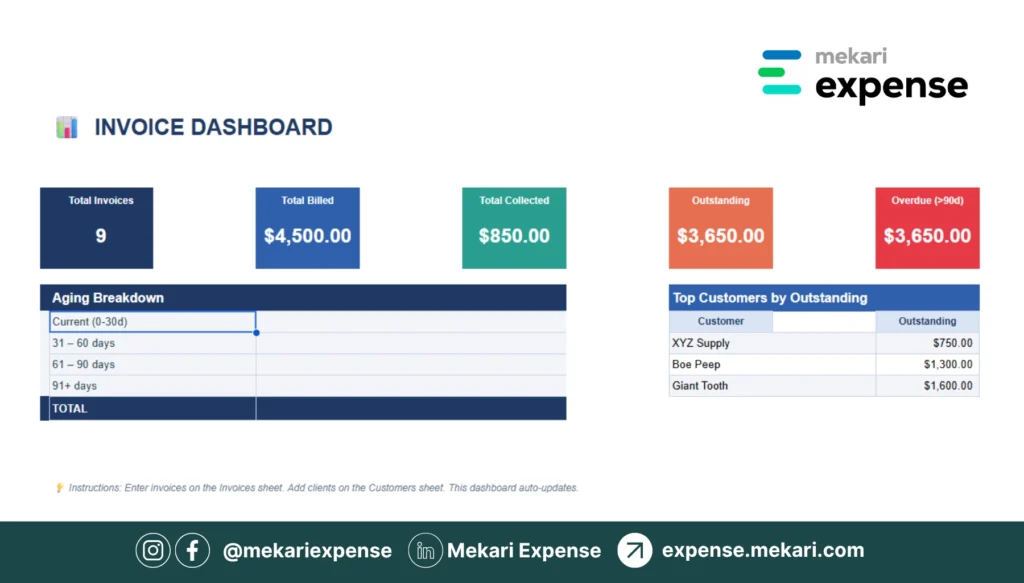
Download our invoice tracker template to efficiently manage invoices, monitor payment due dates, reduce overdue accounts, and improve cash flow visibility.
How does an automated invoice tracker work?
An automated invoice tracker streamlines the entire invoice lifecycle, replacing manual data entry, approval follow-ups, and payment checks with automated workflows. The process typically follows these stages:
1. Invoice capture
Invoices are received through email, scanned documents, EDI connections, or vendor portals. OCR and AI extraction technology automatically capture key information such as:
- Vendor name
- Invoice number
- Invoice date
- Amount due
- Line items
- Purchase order (PO) reference
This eliminates manual data entry while improving speed and accuracy.
Read more: Top 9 OCR Invoice Scanning Software: Cut Costs by 78%
2. Automated validation
Once invoice data is extracted, the system validates it against existing business records and policies, including:
- Purchase orders
- Approved vendor databases
- Budget limits
- Spending policies
Any discrepancies—such as duplicate invoice numbers, mismatched PO values, or unauthorized vendors—are automatically flagged for review.
3. AI fraud detection
Modern invoice trackers add an AI-powered anomaly detection layer that identifies suspicious transactions before they enter the approval workflow. The system can detect:
- Duplicate invoices with modified reference numbers
- Unusually large invoices from first-time vendors
- Sudden changes to vendor bank details
- Pricing that deviates from historical patterns
High-risk invoices are automatically escalated for investigation.
Read more: How AI for Fraud Detection Help Company Saved $60 Million
4. Approval routing
Invoices that pass validation are routed to the appropriate approvers based on predefined rules such as:
- Invoice amount
- Department
- Cost center
- Project
- Expense category
Approvers receive notifications and can review or approve invoices from desktop or mobile devices without relying on email chains.
5. Three-way matching
Before payment is released, the system automatically performs three-way matching by comparing:
- Purchase order (PO)
- Vendor invoice
- Goods receipt confirmation
If all three records match, the invoice moves forward. Any discrepancy triggers an exception workflow and places the invoice on hold until resolved.
6. ERP and accounting sync
After approval, invoice data is synchronized directly with accounting and ERP systems. Information such as GL accounts, tax codes, cost centers, and vendor records is transferred automatically, eliminating duplicate data entry and batch uploads.
7. Payment disbursement
Once all checks and approvals are completed, payment can be initiated automatically according to payment schedules and vendor terms. Every step—from invoice receipt to payment confirmation—is recorded in a complete audit trail.
Key technologies behind invoice automation
Several technologies work together to automate invoice tracking:
- OCR (optical character recognition) captures invoice data from documents and PDFs.
- RPA (robotic process automation) automates repetitive workflows such as routing, validation, and notifications.
- Machine learning (ML) detects anomalies and potential fraud patterns that may be missed by manual reviews.
- ERP integrations ensure invoice data stays synchronized across procurement, accounting, and finance systems.
Together, these technologies transform invoice tracking from a manual administrative task into a faster, more accurate, and more secure financial process.
Manual vs. automated invoice tracker: side-by-side comparison
While spreadsheets and manual processes may work for businesses with low invoice volumes, they often become difficult to manage as transaction volume grows.
Automated invoice trackers help reduce processing time, lower costs, improve visibility, and strengthen fraud controls across the accounts payable process.
| Aspect | Manual Tracking | Automated Invoice Tracker |
| Data Entry | Manual keying from paper or email; prone to typos, duplicates | OCR auto-extracts vendor, amount, date, PO number on receipt |
| Processing Time | 9.2 days average per invoice (Ardent Partners, 2025) | 1.2 minutes with AI-native automation (90% reduction) |
| Processing Cost | $12.88–$19.83 per invoice (manual benchmark, 2025) | $2.36–$5 per invoice with AP automation |
| Fraud Detection | Relies on human review; duplicate invoices often slip through | AI flags duplicates, inflated amounts, and anomalous vendors in real-time |
| Approval Routing | Email chains; no visibility; bottlenecks when approvers unavailable | Automatic routing by rules; one-click mobile approvals |
| Three-Way Matching | Tedious and error-prone; done manually across documents | Automated PO + invoice + goods receipt match before payment |
| Visibility | Scattered across spreadsheets; month-end only | Real-time dashboards; status tracking at all times |
| Compliance & Audit | Incomplete trails; hard to reconstruct for audit | Full digital log; every action timestamped and audit-ready |
| Scalability | Headcount grows linearly with invoice volume | Handles volume increases without adding FTEs |
For growing businesses, the difference extends beyond efficiency. Automated invoice trackers provide stronger controls, better visibility, and greater scalability, allowing finance teams to process more invoices without increasing administrative workload.
AI fraud detection in invoice tracking — how it works
Fraud protection is one of the biggest advantages of modern invoice tracking platforms. While traditional trackers focus on monitoring invoice status, AI-powered systems actively analyze transactions and identify suspicious activity before payments are approved.
The scale of the problem
Invoice fraud continues to be a significant financial risk for organizations worldwide. In 2024, 44% of companies reported experiencing invoice fraud, while incidents increased from 14% in 2023 to 24% in 2024. Businesses lose an estimated 5% of annual revenue to fraud, with median losses reaching $120,000 per case. Even after detection, only a small percentage of organizations recover most of the stolen funds.
Common invoice fraud schemes
Fraudsters often exploit weaknesses in manual approval and verification processes through tactics such as:
- Duplicate invoice submissions with modified invoice numbers.
- Ghost vendors created to receive unauthorized payments.
- Inflated pricing or altered line items.
- Unauthorized changes to vendor banking details.
- Phishing emails impersonating executives or suppliers to request urgent payments.
Because many of these invoices appear legitimate at first glance, manual reviews may fail to identify them before payment is made.
What AI detects that humans often miss
AI models continuously analyze historical transaction patterns and vendor behavior to identify anomalies that would be difficult to spot manually. These include:
- Duplicate invoices with slightly altered reference numbers.
- Invoice amounts that differ significantly from historical averages.
- Large first-time payments to newly created vendors.
- Unusual payment timing or approval activity.
- Sudden changes to supplier banking information.
Rather than waiting for a human reviewer to discover these issues, the system flags them automatically before the approval process begins.
Three-way matching as a fraud control
One of the most effective fraud prevention mechanisms is automated three-way matching. The system compares:
- Purchase order (PO)
- Vendor invoice
- Goods receipt confirmation
If any of these records do not align, the invoice is automatically placed on hold for investigation. This helps prevent payments for products or services that were never ordered, delivered, or approved.
Vendor verification workflow
Advanced invoice tracking platforms also strengthen vendor onboarding and maintenance processes. Before invoices can be processed, the system can:
- Verify bank account information.
- Validate tax identification details.
- Detect duplicate vendor records.
- Flag newly created vendors for additional review.
By combining AI anomaly detection, vendor verification, and automated three-way matching, businesses can create multiple layers of protection against invoice fraud while reducing the burden on finance teams.
Read more: How Purchase Invoice Fraud Works And How to Stop It
How Mekari Expense automates invoice tracking with AI fraud protection
As invoice volumes grow, businesses need more than a simple tracking tool—they need a system that automates processing, strengthens controls, and reduces fraud risk.
Built for businesses operating in Indonesia and those expanding into the market, Mekari Expense provides end-to-end invoice automation within a unified spend management platform.
Key capabilities include:
- AI-powered OCR invoice capture to automatically extract vendor details, invoice amounts, dates, PO references, and line items from incoming invoices.
- Automated three-way matching that reconciles purchase orders, invoices, and goods receipts before payments are approved.
- AI fraud detection and anomaly alerts that identify duplicate invoices, unusual vendor activity, and pricing irregularities in real time.
- Multi-level approval workflows that route invoices automatically based on amount, department, cost center, or vendor type.
- Verified vendor management that helps control supplier onboarding and prevents unauthorized vendors from entering the payment workflow.
- Real-time spend visibility through live dashboards that track invoice status, vendor spending, budget utilization, and exceptions.
- International payment support with real-time exchange rates for accurate cross-border invoice payments.
- Seamless integration with Mekari Jurnal for accounting synchronization, eliminating manual journal entries and improving financial accuracy.
By combining invoice capture, fraud detection, approval automation, vendor controls, and accounting integration in a single platform, Mekari Expense helps finance teams process invoices faster while maintaining stronger financial controls and audit readiness.
Ready to eliminate manual invoice tracking and protect your business from invoice fraud? Explore how to automate invoice tracker workflows with Mekari Expense.