





Top 9 Logistics OCR Software to Cut 15% Document Processing Cost


Mekari Insight
Not all logistics OCR software solves the same problem. Here is a quick guide to matching the right tool to your use case:
- Mekari Expense: Best for logistics finance and AP teams automating freight invoice capture and employee expense claims with built-in OCR, approval routing, and Fraud AI Checker.
- Nanonets: Best for logistics teams that need trainable extraction models with continuous accuracy improvement and end-to-end workflow automation.
- Doxis AI.dp: Best for logistics and customs operators that need compliant, multi-document-type automation with built-in fraud detection and GDPR-compliant data handling.
- ABBYY Vantage: Best for large enterprises processing diverse, high-volume document types with strong RPA integration and flexible deployment options.
- Extend.ai: Best for carriers and freight forwarders processing printed BOLs and freight invoices from a stable carrier set without template configuration.
- Tungsten TotalAgility: Best for enterprises combining intelligent document capture with full workflow automation across departments and hybrid infrastructure.
- Lido: Best for carriers, brokers, and 3PLs needing flexible extraction from varied shipping documents including handwritten BOLs at an accessible price point.
- Descartes: Best for freight forwarders and customs brokers that need document processing embedded inside a full trade compliance and logistics platform.
- Google Document AI: Best for engineering teams building custom logistics document pipelines on Google Cloud infrastructure.
Logistics operations move fast, but the documents behind every shipment still move at the speed of paper.
According to McKinsey, a single shipment can require up to 50 sheets of paper exchanged with as many as 30 different stakeholders, turning document handling into one of the most persistent bottlenecks in global trade.
Logistics OCR software addresses this directly by automatically extracting structured data from shipping documents, eliminating the manual entry that slows down freight, customs, and AP workflows.
Rather than replacing human judgment, these automatic data extraction tools convert unstructured documents into ready-to-use data that feeds directly into transportation, warehouse, and financial systems.
This article compares the top logistics OCR software available in 2026 and what to consider when choosing the right one for your operations.

What is Logistics OCR Software
Logistics OCR software is an AI-powered tool that automatically extracts structured data from the documents that keep supply chains moving.
Unlike general-purpose OCR tools that struggle with variable layouts, handwritten fields, and multi-language content, logistics OCR is built specifically for the document complexity and processing volumes that logistics operations demand.
The document types these extraction tools commonly handle include:
- Bill of lading (BOL): Shipper, consignee, commodity, and cargo tracking data.
- Freight invoices and vendor bills: Line items, vendor details, amounts, and payment terms.
- Customs declarations: Duty and tax data, HS codes, and certificate of origin details.
- Packing lists and delivery notes: Itemized cargo contents matched against purchase orders.
- Proof of delivery (POD): Signed receipts and handwritten confirmations tied to order status.
- Shipping labels: Tracking numbers, carrier codes, addresses, and barcodes.
- Operational receipts: Fuel, toll, parking, and other field expense documents submitted for reimbursement.
Once a document is captured via scan, photo, email attachment, or PDF upload, the logistics OCR software extracts key fields, validates the data, and pushes it directly into downstream systems such as a TMS, WMS, ERP, or AP platform.
These tools do this not by reading characters alone, but by using machine learning to understand document structure and context. This makes the OCR that is specified for logistics capable of handling the layout variation and format inconsistency that traditional OCR cannot.
Read More: 10 Best Inventory Invoice Software to Manage Stock and Billing
Top 9 Logistics OCR Software in 2026
Not all logistics OCR tools are built for the same problem. Some are purpose-built for shipping operations documents like bills of lading and customs declarations, while others focus on the finance and AP side of logistics, automating freight invoice capture and employee expense processing.
The nine platforms below are selected based on document type coverage, logistics-specific capabilities, integration options, and fit across different operation types and team sizes and ordered based on its rating on G2 platform.
| Logistics OCR Software | Key Features | Best For | Rating on G2 |
|---|---|---|---|
| Lido | Template-free OCR extraction, handwritten BOL support, configurable business rules, ERP and TMS integration | Carriers, brokers, and 3PLs needing flexible extraction from varied shipping documents at an accessible price point | 4.8/5 |
| Mekari Expense | OCR for invoices and receipts, Fraud AI Checker, multi-level approval routing, integration with Mekari unified software ecosystem | Logistics finance and AP teams automating freight invoice capture and employee expense claims | 4.7/5 |
| Nanonets | Pre-trained logistics models, multi-channel document input, workflow automation, human-in-the-loop review | Logistics teams needing trainable extraction with end-to-end workflow automation | 4.7/5 |
| Descartes | Trade compliance and export control, document digitization and extraction, ERP and supply chain integration, customs and regulatory filing | Freight forwarders and customs brokers needing document processing within a full trade compliance and logistics platform | 4.6/5 |
| Doxis AI.dp (Formerly Klippa DocHorizon) | 15+ logistics document types, fraud detection and verification, GDPR-compliant data anonymization, flexible output via API or SDK | Logistics and customs operators needing compliant, multi-document-type automation with built-in fraud detection | 4.5/5 |
| Tungsten TotalAgility | AI-powered document capture and OCR, end-to-end workflow orchestration, flexible cloud and on-premises deployment, built-in compliance and governance | Enterprises combining intelligent document capture with full workflow automation across departments and hybrid infrastructure | 4.3/5 |
| Google Document AI | Enterprise OCR and layout parsing, configurable extraction models, Gemini-powered processing, Google Cloud ecosystem integration | Engineering teams building custom logistics document pipelines on Google Cloud infrastructure | 4.2/5 |
| ABBYY Vantage | 150+ pre-trained document skills, multi-format and multilingual support, RPA integrations, cloud and on-premises deployment | Large logistics enterprises processing diverse, high-volume document types with strong RPA integration and flexible deployment options | 4.2/5 |
1. Lido
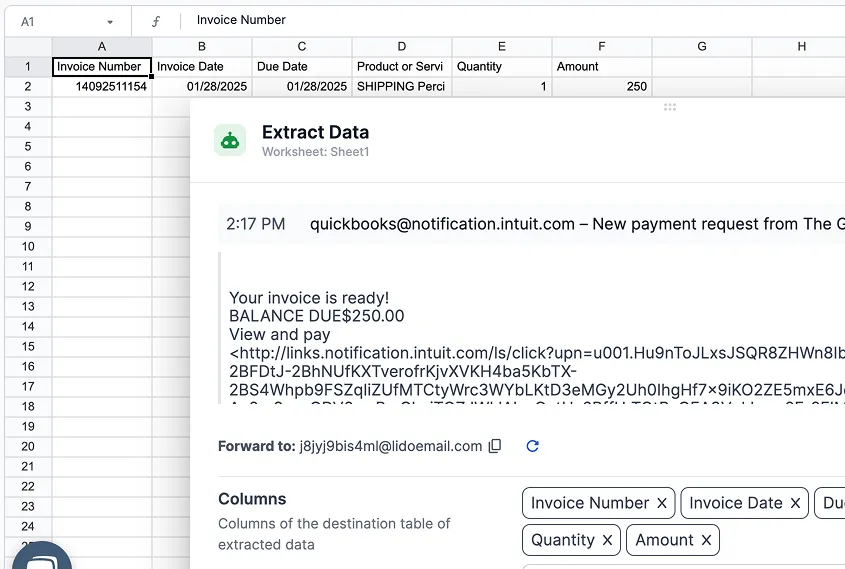
Lido is an AI-powered document extraction platform that combines vision models, OCR, and large language models to process logistics documents.
Key features:
- Template-free OCR extraction: Processes BOLs, freight invoices, packing lists, customs declarations, and driver documents across any carrier format without per-document-type configuration.
- Handwritten document support: Handles handwritten BOLs and operational receipts with 99.9% accuracy.
- Configurable business rules: Users can set field-level extraction rules and data transformation logic without code.
- ERP and TMS integration: Pushes structured data directly into ERP, TMS, EDI, and accounting systems via API.
Rating: 4.8/5 on G2
Best for: Carriers, brokers, and 3PLs that need flexible, template-free extraction from varied shipping documents at an accessible price point without enterprise-level implementation timelines.
Pricing: Starts at $29/month. Higher-tier plans available. Check the Lido website for current pricing.
Read More: 10 Best Document Management Systems for File Management
2. Mekari Expense
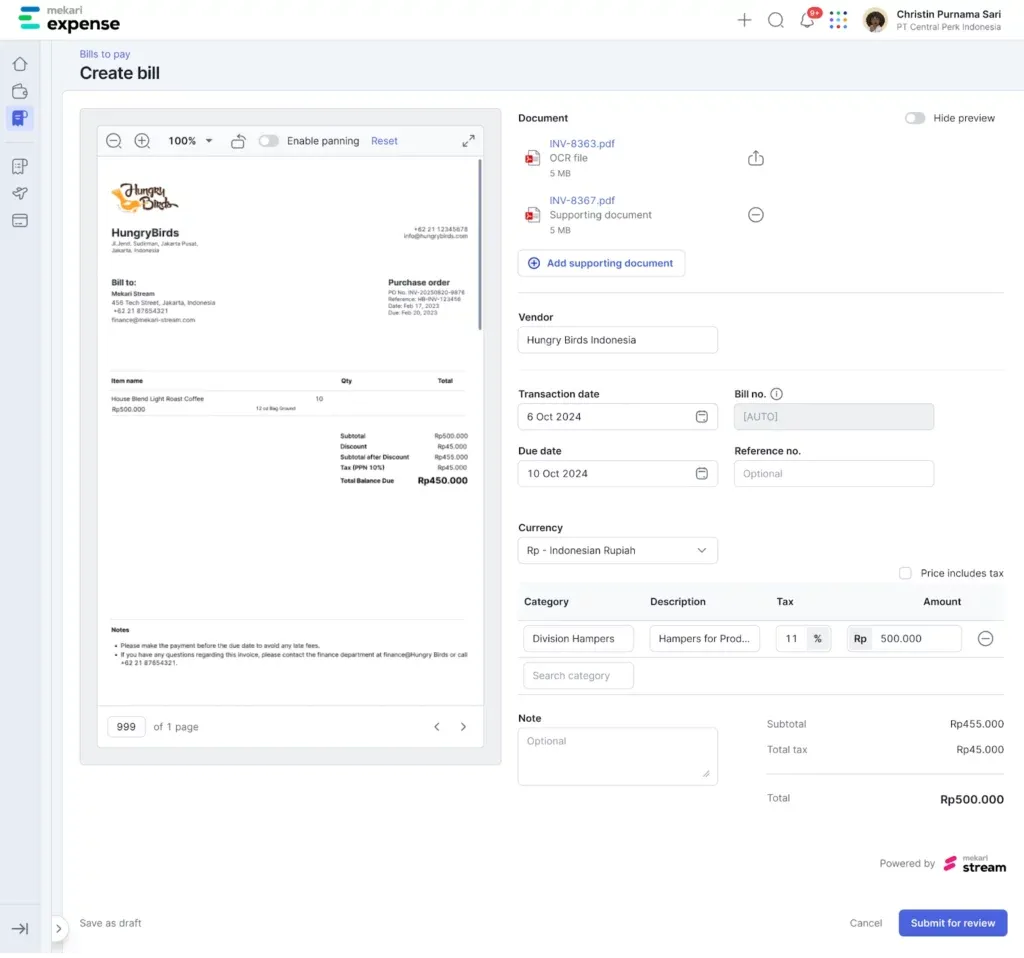
Mekari Expense is a spend management system with AI-native OCR built for finance and AP teams, including those at logistics companies managing high volumes of vendor invoices, freight bills, and employee expense claims.
Mekari Expense’s logistics OCR software capability works at two key points in the expense workflow:
- Purchase Invoice: Captures vendor invoices and freight bills automatically, extracting vendor name, invoice number, amount, and tax details including VAT and WHT, then syncing data directly into the purchase invoice record without manual entry.
- My Claims: Allows field staff and drivers to upload operational receipts in PDF, PNG, or JPG format, with the system extracting transaction date, amount, vendor, and description automatically so employees verify and submit rather than type.
Beyond document capture, Mekari Expense connects OCR into a broader AP and expense management workflow, including:
- Multi-level approval routing: Automatically routes submitted invoices and expense claims through structured approval workflows based on company policies.
- Purchase invoice management: Manage the full vendor invoice lifecycle from creation and verification to payment scheduling, with a complete audit trail for every action.
- OCR Fraud AI Detection: Automatically analyzes every expense submission across Claims, Trips, and Purchases for unusual amounts, unusual vendors, and duplicate transactions, then delivers a real-time risk score with AI-generated reasoning so approvers can take action before approving.
- International remittance: Send cross-border vendor payments directly from the platform with real-time exchange rates for accurate, transparent transactions.
- Integration with Mekari unified software ecosystem: Connects with Mekari’s integrated platform including Mekari Jurnal for automatic accounting reconciliation without double entry.
- ISO 27001-certified data security: Company and financial data is protected with encryption, role-based access, and a complete audit trail at all times.
Rating: 4.7 on G2
Best for: Logistics companies where both finance teams and field operations staff deal with high document volumes, including AP teams processing vendor invoices and freight bills, and drivers or field employees submitting frequent operational expense claims.
Pricing: Check the website for current pricing details.
3. Nanonets
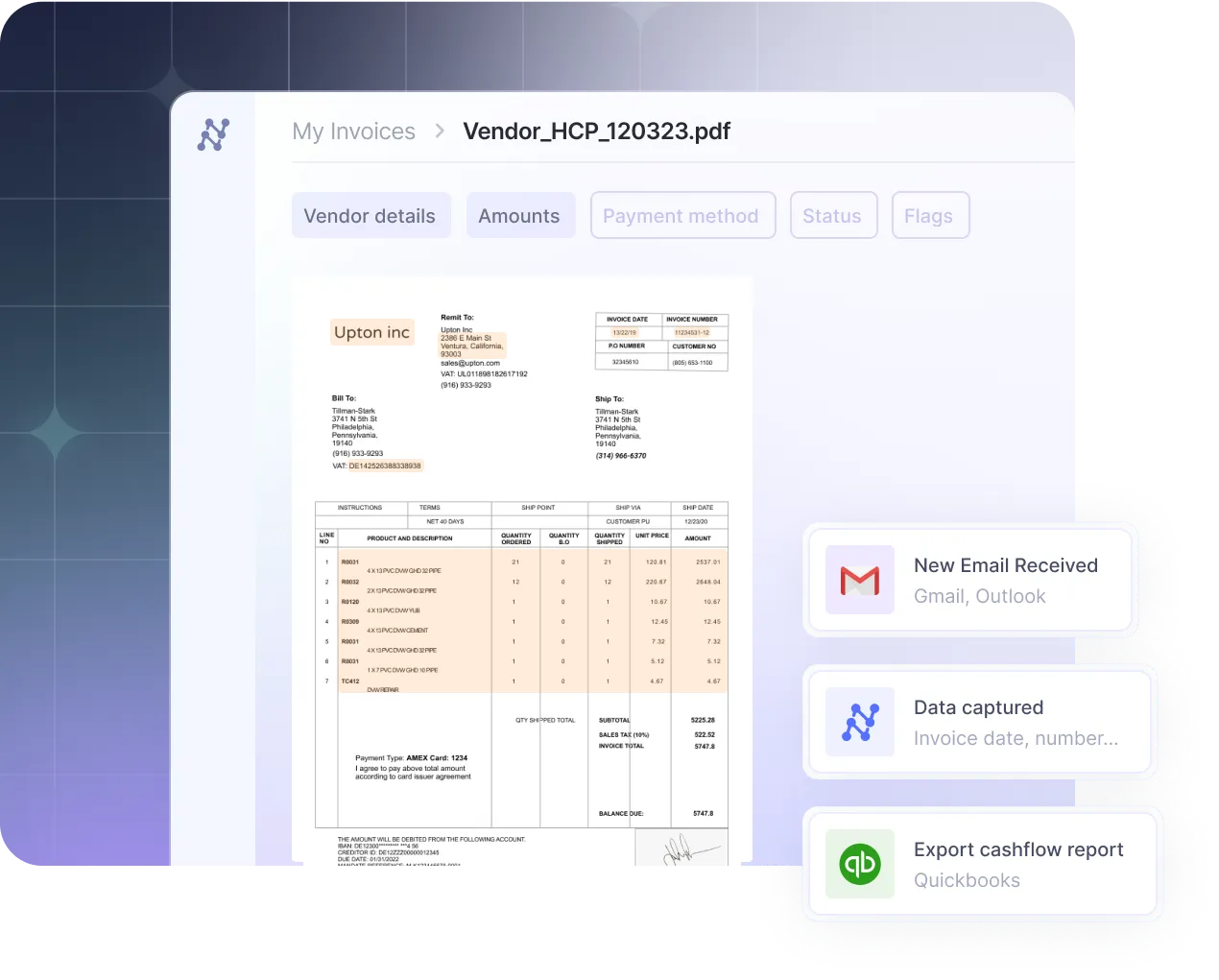
Nanonets is an AI-powered document automation platform with pre-trained OCR models for logistics documents and a self-learning extraction engine that improves accuracy over time without manual template configuration.
Key features:
- Pre-trained logistics models: Ready-to-use extraction models for bills of lading, customs declarations, freight invoices, packing lists, and proof of delivery, with field-level selection and custom field support.
- Multi-channel document input: Accepts documents via email, upload, mobile capture, cloud storage, or API, making it flexible for varied logistics intake workflows.
- Workflow automation: Builds end-to-end automated pipelines covering data validation, approval routing, and direct export to TMS, WMS, ERP, and accounting systems.
- Human-in-the-loop review: Flags low-confidence extractions for manual verification before data is committed downstream, with the system learning from each correction.
Rating: 4.7/5 on G2
Best for: Logistics teams that need pre-trained extraction models with workflow automation and continuous accuracy improvement across varied carrier formats.
Pricing: Paid plans are usage-based. Check the Nanonets website for current pricing.
4. Descartes
Descartes is a logistics-native SaaS platform where document digitization and OCR-based data extraction are built into a broader suite covering trade compliance, customs filing, and supply chain visibility.
Key features:
- Trade compliance and export control: Automates export licensing, denied party screening, and customs declaration filing with real-time regulatory updates.
- Document digitization and extraction: Converts shipping documents and trade certificates into structured data for downstream logistics workflows.
- ERP and supply chain integration: Real-time and batch integration with SAP, Oracle, and other enterprise systems via the Descartes Global Logistics Network.
- Customs and regulatory filing: Supports import and export filings and multimodal shipment documentation across multiple jurisdictions.
Rating: 4.6/5 on G2
Best for: Freight forwarders, customs brokers, and global shippers that need document processing embedded within a full trade compliance and logistics platform.
Pricing: Platform pricing based on modules and volume. Check the Descartes website for a quote.
5. Doxis AI dp (Formerly Klippa DocHorizon)
Doxis AI.dp is an AI-powered intelligent document processing platform with dedicated support for 15+ logistics document types, covering the full range of shipping operations documents without requiring template setup.
Key features:
- Logistics document coverage: Bill of lading, CMR waybill, customs declarations, packing lists, delivery notes, shipping labels, and proof of delivery.
- Fraud detection and verification: Identifies tampered documents and validates extracted data against external APIs including VAT databases and Chamber of Commerce registries.
- GDPR-compliant data anonymization: Automatically masks sensitive logistics data before processing or storage.
- Flexible output and integration: Delivers structured data in JSON, XML, or CSV via API or SDK.
Rating: 4.5/5 on G2
Best for: Logistics and customs operators with high document volumes that need compliant, multi-document-type automation with built-in fraud detection.
Pricing: Pay-per-use and monthly license options available. Check the website for a quote.
6. Tungsten TotalAgility
Tungsten TotalAgility is an AI-powered intelligent document processing and workflow automation platform from Tungsten Automation.
Key features:
- AI-powered document capture and OCR: Ingests, classifies, and extracts data from structured and unstructured logistics documents with intelligent recognition.
- End-to-end workflow orchestration: Automates multi-step business processes across systems and teams, coordinating approvals, routing, and system integrations.
- Flexible deployment: Available as cloud SaaS or on-premises, compatible with enterprises that have strict data residency or infrastructure requirements.
- Built-in compliance and governance: Audit trails, security controls, and validation rules for regulated industries and high-stakes document workflows.
Best for: Large enterprises that need to combine intelligent document capture with full workflow automation across departments within the Tungsten ecosystem.
Rating: 4.3/5 on G2
Pricing: Custom pricing based on deployment type and document volume. Check the Tungsten Automation website for a quote.
7. Google Cloud Document AI
Google Cloud Document AI is a cloud-based document intelligence API that uses Gemini-powered OCR and configurable extraction models to convert logistics and business documents into structured, machine-readable data.
Key features:
- Enterprise OCR and layout parsing: Detects and extracts text, tables, and layout information from scanned documents, PDFs, and images.
- Configurable extraction models: Teams can train custom processors on their own document types, including logistics-specific formats.
- Gemini-powered processing: Latest processor versions are powered by Gemini LLMs, enabling document-level contextual understanding for improved extraction accuracy on complex layouts.
- Google Cloud ecosystem integration: Outputs structured data directly into BigQuery, Cloud Storage, and other Google Cloud services.
Best for: Engineering teams building custom logistics document pipelines on Google Cloud infrastructure that need a scalable, programmable extraction API without vendor lock-in.
Pricing: Pay-per-page. Check the Google Cloud Document AI pricing page for current rates.
8. ABBYY Vantage
ABBYY Vantage is an enterprise IDP platform with over 30 years of OCR and document processing experience, purpose-built for large organizations handling complex, high-volume document workflows including shipping and logistics.
Key features:
- Pre-trained document skills: Ready-to-use AI skills covering logistics documents including bills of lading, freight forwarding orders, customs clearance documents, invoices, and purchase orders.
- Multi-format and multilingual support: Processes structured, semi-structured, and unstructured documents across different languages.
- Cloud and on-premises deployment: Available as cloud SaaS or on-premises in a private cloud, with auto-scaling and Kubernetes-based orchestration for enterprise-grade reliability.
Rating: 4.2/5 on G2
Best for: Large logistics enterprises processing diverse, high-volume document types that need proven IDP with strong RPA integration and flexible deployment options.
Pricing: Subscription-based with volume tiers. Check the ABBYY website for a quote.
Read more: OCR Purchase Order: Cut Invoice Errors by 99%
What to Look for in Logistics OCR Software
Choosing the right logistics OCR software comes down to more than extraction accuracy. These are the key criteria worth evaluating before committing to a platform.
- Accuracy on varied input: The tool should handle handwritten fields, low-resolution scans, damaged documents, and multi-carrier format variations without requiring manual correction on every edge case.
- Document type coverage: Confirm the platform supports the specific document mix your operations generate, whether that is BOLs, customs forms, freight invoices, PODs, or operational receipts.
- Integration capability: Look for native connectors or API access to the systems your teams already use, including TMS, WMS, ERP, and AP platforms, so extracted data flows downstream without manual re-entry.
- Scalability and throughput: Evaluate how the tool performs at peak volume. Some platforms process documents in real time while others run in batch mode, and the right fit depends on how your document load is distributed across the day.
- Validation and exception handling: A reliable tool assigns confidence scores per extracted field and provides a human-in-the-loop review interface for low-confidence results, so errors are caught before data enters downstream systems.
- Compliance and security: For operations involving customs and cross-border documents, look for audit trails, role-based access controls, and data handling standards that meet regulatory requirements in your operating regions.
- Pricing model: Platforms typically charge per page, per subscription tier, or via enterprise contract. Evaluate total cost at both your current document volume and your projected growth to avoid pricing surprises at scale.
Why Logistics Companies Are Automating Document Processing
Logistics operations run on documents, and the volume is staggering. A single international shipment can require up to 50 sheets of paper exchanged with as many as 30 different parties. Finance teams add to that volume with freight invoices, operational receipts, and vendor bills processed separately on the back end.
Automating this document layer delivers measurable impact across both operations and finance. Key benefits logistics companies gain from OCR-based document automation:
- Faster document turnaround: Automated extraction eliminates manual re-keying, reducing the time between document receipt and data availability in downstream systems from hours to seconds.
- Lower processing costs: Removing manual steps from document workflows cuts labor overhead and reduces the cost per document significantly across high-volume operations.
- Fewer data errors: Human error in manual data entry introduces discrepancies that cascade into customs delays, billing disputes, and reconciliation rework — automated extraction applies consistent field-level validation at every submission.
- Real-time data availability: Structured data flows directly into TMS, WMS, ERP, and AP systems without manual handoffs, giving operations and finance teams visibility they can act on immediately.
- Better compliance and audit readiness: Every extracted document is timestamped, validated, and traceable, creating a reliable audit trail for customs, regulatory, and financial review.
- Scalability without headcount growth: Document automation allows logistics companies to process higher volumes without adding manual processing staff.
The numbers reflect how significant this shift can be:
- Organizations implementing intelligent document processing have saved more than 20,000 employee hours in a single year, with some teams doubling processing speed at half the manual effort within four weeks of deployment. (McKinsey)
- Early adopters of AI-enabled supply chain management report a 15% reduction in logistics costs and a 65% improvement in service levels compared to slower-moving competitors. (McKinsey)
- Digitalizing the bill of lading alone could unlock $6.5 billion in direct cost savings and enable between $30 and $40 billion in new global trade volume. (McKinsey)
Read More: AI Spend Analysis: Strategies to Reduce Costs by 40%
Stop Manually Processing Logistics Finance Documents
Logistics finance teams face a document load that never stops: freight bills, vendor invoices, fuel receipts, and expense claims that still rely on manual entry, creating bottlenecks and data accuracy risks at every stage of the approval cycle.
Mekari Expense is an AI-native spend management software that is capable of acting as a logistics OCR software to automate document capture at the point of submission and embedding intelligence across the full expense workflow.
Why finance teams in logistics companies should choose Mekari Expense:
- Automated document capture: Eliminates manual data entry at the point of submission for both vendor invoices and employee expense claims.
- Fraud AI Checker: Catches unusual amounts, vendor mismatches, and duplicate submissions before they reach approval, reducing fraud risk without adding manual review burden.
- Faster approval cycles: Structured multi-level routing ensures every submission moves through the right approvers without manual follow-up.
- End-to-end payment visibility: From invoice capture to vendor payment and accounting reconciliation, every transaction is traceable in one platform.
- Scales with transaction volume: Handles growing document loads across Claims, Trips, and Purchases without adding headcount or manual processing steps.
Automate logistics invoice capture and eliminate manual data entry in your company with Mekari Expense OCR!
References and methodology
Methodology
Methodology
Articles published by Mekari Expense are developed using trusted sources, including official data, company reports, academic research, and insights from industry practitioners. Whenever possible, we refer directly to primary sources before drawing conclusions. Our editorial team reviews and verifies the information to ensure accuracy and relevance. All references are listed so readers can trace each piece of information back to its original source.
Our editorial standards
Our editorial standards
- Primary source first: We consult official product documentation and pricing pages directly, not secondhand summaries or aggregator sites.
- Fact-checking: All product features, pricing, and claims are cross-verified against each platform’s official website at the time of writing.
- No paid placement: Tools are selected based on relevance and fit for Indonesian businesses, not commercial arrangements. Mekari Expense is included as a first-party product and is transparently labeled as such.
- Regular review: Articles are periodically updated to reflect product changes or shifts in market relevance.
References
References
McKinsey. “Succeeding in the AI supply-chain revolution”
McKinsey. “Fueling digital operations with analog data”
Lido. “Best OCR for Logistics in 2026”
FAQ
1. What is logistics OCR software?
1. What is logistics OCR software?
Logistics OCR software is an AI-powered tool that automatically extracts structured data from shipping and finance documents — such as bills of lading, freight invoices, customs declarations, and operational receipts — and feeds that data directly into downstream systems like TMS, WMS, ERP, or AP platforms without manual entry.
2. How does logistics OCR software benefit finance teams specifically?
2. How does logistics OCR software benefit finance teams specifically?
Finance and AP teams at logistics companies process a separate but high-volume document load — freight bills, vendor invoices, and employee expense claims — that traditionally relies on manual data entry. OCR eliminates that entry at the point of submission, reduces data errors, and accelerates the approval and payment cycle.
3. How does Mekari Expense support logistics finance teams with OCR?
3. How does Mekari Expense support logistics finance teams with OCR?
Mekari Expense provides AI-powered OCR at two points in the expense workflow: the Purchase Invoice module for freight invoices and vendor bills, and the My Claims module for field staff and driver receipts. Both automatically extract key fields including vendor name, amount, date, and tax details, eliminating manual entry and feeding data directly into approval workflows and accounting reconciliation. Learn how Mekari Expense simplifies logistics invoice processing and expense management for your finance team.