





Spend Performance Management: Guide to Stop 40% Savings Leak


Mekari Insight
- Spend performance management ensures that every expense is not only tracked but also delivers measurable business value through data-driven evaluation.
- Key challenges include fragmented data, lack of real-time visibility, and the gap between planned and realized savings.
- Mekari Expense helps companies close this gap through its spend control module, ensuring spending control, comprehensive visibility, and the ability to measure financial impact in real time.
Most finance and procurement teams already know where company money is being spent through available reports and dashboards. However, knowing where expenses are allocated is not the same as ensuring that every cost truly delivers value to the business.
This is where spend performance management becomes important. Without the right approach, companies risk losing efficiency opportunities due to off-policy purchases, contract non-compliance, and savings that are not actually realized.
This guide will discuss what spend performance management is, why it matters, and how companies can manage it more effectively.

What is spend performance management?

Spend performance management (SPM) is an approach focused on tracking where company money is spent, measuring, analyzing, and improving the effectiveness of spending to generate business impact.
SPM is different from spend management. Spend management focuses on control to ensure purchases are made according to vendors, budgets, and established procedures. Meanwhile, spend performance management goes further by tracking and evaluating whether those controls actually generate the expected efficiency and value.
This distinction is important because most value in procurement is often still potential. Contracts may already be negotiated with certain savings, but realization depends on compliance with vendor usage, pricing alignment, and execution in practice.
Research from Suplari shows that around 40–60% of procurement savings are never actually realized due to contract non-compliance, off-policy purchases, and delays in implementation.
To address this issue, spend performance management serves as the solution. More than just a tool, spend performance management is a continuous framework where spending data is collected, analyzed, and acted upon continuously to ensure that every expense tied to business activities can be proven to impact the company’s financial performance.
Why companies need spend performance management tools
Spend performance management is a critical foundation for addressing various challenges that hinder visibility, control, and value optimization from every expense.
1. Data silos
Procurement data is often scattered across multiple disconnected systems, from ERP and P2P systems to contract and vendor data. Without proper integration, companies struggle to gain a comprehensive view of spending performance, leading to suboptimal decision-making.
2. Lack of standardized spending categories
Differences in how spending is categorized across departments lead to inconsistent analysis. This makes it difficult for companies to measure efficiency, identify savings opportunities, or consolidate vendors accurately.
3. Gap between savings and realization
Many companies claim savings from procurement processes, but not all are reflected in financial reports. Without systems that connect procurement activities to financial outcomes, expected value may be lost.
4. Decentralized purchasing and maverick spend
Spending outside official channels, such as department cards or direct purchases without approval, weakens spending control. This reduces bargaining power with vendors and results in incomplete, hard-to-measure spending data.
5. Non-scalable manual processes
Using spreadsheets and manual processes for tracking savings, monitoring compliance, or evaluating vendors is no longer sufficient as businesses grow. These approaches are time-consuming, error-prone, and unable to provide real-time insights.
Read more: Spend Data Management Guide: Reduce Manual Work by 60%
Benefit of using spend performance management

After understanding the concept of spend performance management, the next step is to see how its implementation through software can create real impact for businesses.
1. Competitive advantage
Companies that effectively implement spend performance management gain stronger competitive advantages. With better control and visibility over spending, they can move faster and more efficiently than competitors.
2. Real-time performance tracking
Software enables real-time performance tracking across the supply chain. Companies can monitor contract compliance, measure vendor performance, and ensure every expense aligns with strategic goals.
3. Data-driven insights
With a data-driven approach, companies can identify gaps in the supply chain, detect potential risks, and capture efficiency opportunities. Spend analytics also consolidates spending data from multiple systems into a single, easy-to-analyze view.
4. Synchronized manufacturing signaling
For manufacturing companies, data integration enables synchronization between demand and suppliers. Approaches like lean manufacturing and Kanban help ensure the right inventory is available at the right time at optimal cost.
5. Real-time supply chain data
Access to real-time supply chain data helps companies make faster and more accurate decisions, especially in dynamic and competitive global environments.
6. Control strategic spending
By monitoring critical success factors (CSFs) and overall spending performance, companies can better control strategic spending. This ensures that sourcing decisions align with business objectives.
7. Consolidated view of spending
A robust spend performance management system provides full visibility over all expenses, regardless of data sources. This centralized view helps companies identify inefficiencies, optimize vendors, and reduce company spending without compromising service quality.
8. Advanced analytics-driven cost savings
Leveraging advanced analytics enables management to make smarter, more strategic decisions. As a result, companies can achieve significant cost savings and reallocate funds to drive business growth.
Read more: Top 8 Spend Management Software for Better Cost Control
5 Core components of spend performance management
Spend performance management is not a single function but a system consisting of five interconnected components.
1. Spend analysis
Spend analysis is the foundation of SPM. This process includes collecting, cleansing, normalizing, and classifying spending data from various sources such as ERP systems, expense platforms, and vendor invoices into a centralized view.
The quality of this analysis determines the accuracy of insights generated. With strong visibility, companies can more quickly identify efficiency opportunities and strengthen their position in vendor negotiations.
Read more: Vendor Negotiation Strategy: Get Better Deals & Cut Cost 10%
2. Spend under management (SUM)
Spend under management measures how much of a company’s spending is controlled by procurement, such as through approved vendors or negotiated contracts.
The higher the percentage, the greater the control. Organizations with high SUM are typically better at reducing maverick spend and optimizing negotiation leverage.
3. Savings tracking
Savings tracking focuses on monitoring actual realized savings, not just estimates. This ensures that procurement initiatives are directly linked to real financial impact. Savings are typically categorized into hard savings, cost avoidance, and operational efficiencies such as managing subscription costs.
4. Supplier performance monitoring
This component evaluates vendor performance based on agreed KPIs such as delivery timeliness, product quality, and pricing compliance.
By linking vendor performance data with spending data, companies can ensure that selected vendors truly deliver expected value.
5. Compliance monitoring
Compliance monitoring ensures all purchasing activities follow established policies and contracts. It helps detect maverick spend, pricing discrepancies, authorization violations, and potential duplicate invoices. With structured monitoring, companies can prevent value leakage before it impacts financial reports.
These five components work together to ensure that every expense is not only recorded but also controlled, measured, and contributing to business performance.
Read more: Tail Spend Management: Cut 10% Costs with Tail Spend Automation
Best practices for spend performance management

To ensure implementation delivers real impact, companies must adopt a structured and continuous approach.
1. Start with data unification
A common mistake is building dashboards without ensuring data quality. Accurate insights can only come from integrated data. The first step is consolidating all procurement data into a consistent and continuously updated source.
2. Measure realized savings
Identified savings do not always translate into real financial impact. Companies need to track savings from initiation to actual realization and validation by finance teams to reduce the gap between estimates and outcomes.
3. Continuously monitor contract performance
Periodic contract evaluations often detect issues too late. Continuous monitoring allows companies to identify pricing discrepancies or contract violations early, minimizing potential losses.
4. Link spending metrics to business outcomes
Metrics such as number of vendors or purchase orders are less relevant to management. What matters is how spending impacts cash flow, margins, and operational efficiency. Linking metrics to outcomes increases procurement’s strategic value.
5. Automate monitoring processes
Manual processes like reporting and transaction checks are time-consuming and difficult to scale. Automation allows procurement teams to focus more on strategic analysis and decision-making.
6. Maintain consistent evaluation
Spend performance management requires structured and regular evaluation. Daily monitoring helps detect issues early, monthly reviews keep progress on track, and quarterly or annual evaluations ensure alignment with long-term business goals.
How to optimize spend performance management with Mekari Expense?
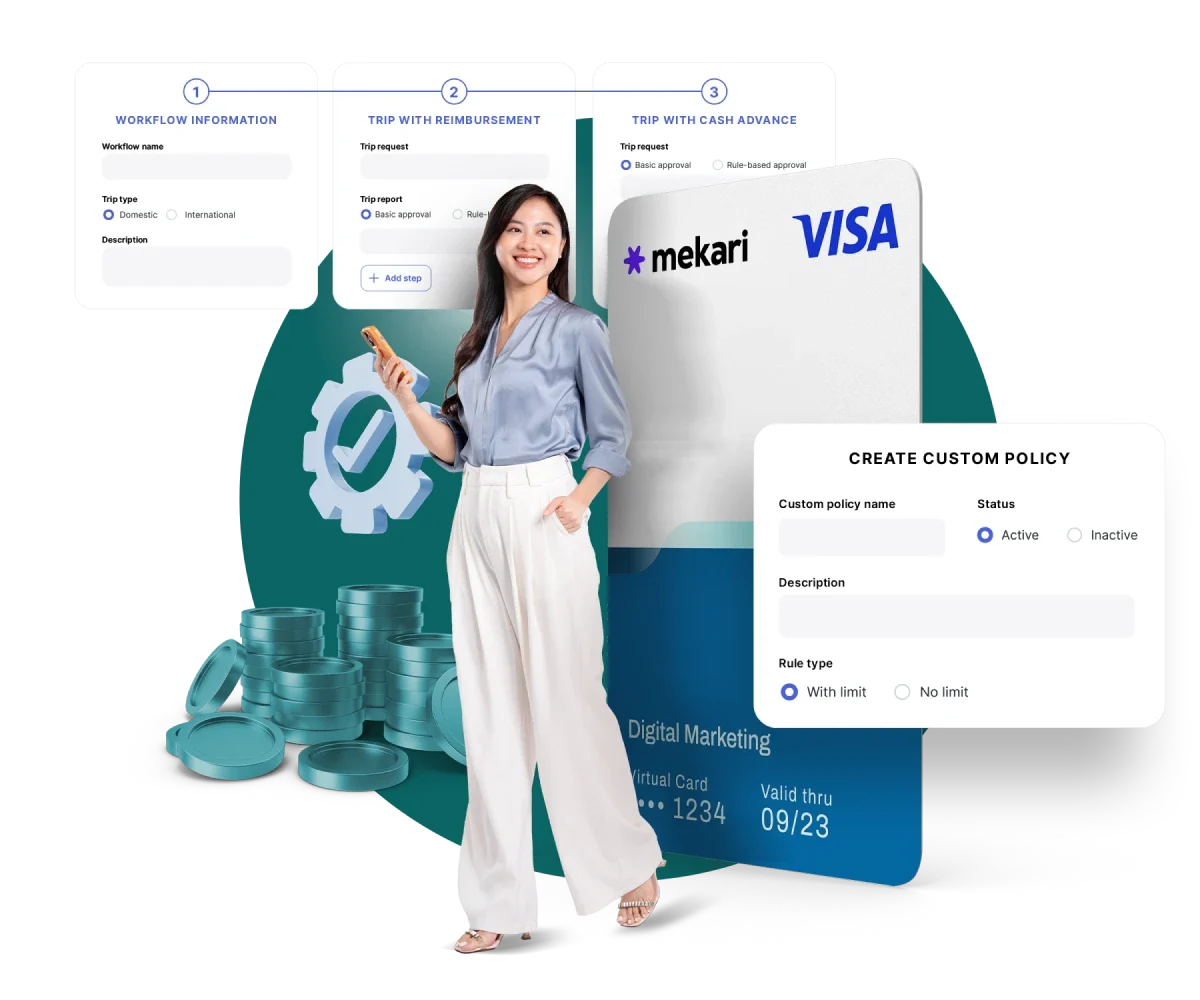
Effective spend performance management requires more than just reporting dashboards. Companies must be able to control spending before transactions occur, ensure policy compliance automatically, and monitor every expense against budgets in real time.
Mekari Expense, as a spend management platform, provides a solution for local businesses in Indonesia to measure spending effectiveness and drive meaningful business impact.
Through its Spend Control module, companies can address core spend performance management needs, including real-time visibility, pre- and post-transaction control, policy compliance, and cross-system data integration.
Key advantages of Mekari Expense:
- Ready-to-use physical and virtual corporate cards: Instantly create physical and virtual cards for teams or projects within minutes directly through the app.
- Automated and flexible policy settings: Configure spending limits, categories, and business travel rules according to business needs.
- Efficient dynamic approvals: Multi-level approval workflows that adapt to transaction types and amounts without slowing operations.
- Centralized budget visibility: Manage all budgets in a single dashboard with more transparent and integrated control.
- Integration with Mekari ecosystem: Seamlessly connects with Mekari Jurnal for accounting and Mekari Talenta for HR, enabling faster reconciliation and reporting.
- International-standard data security: Supported by ISO 27001 certification to ensure the security of financial and employee data.
Ensure every expense drives real impact with spend performance management from Mekari Expense.
References
Suplari. ”Spend Performance Management: Key Components, Best Practices, and How AI Changes Everything”
SAP. “8 Secrets to SAP Enabled Spend Performance Management”
FAQ
What is employee business expense?
What is employee business expense?
Employee business expense refers to costs incurred by employees for work-related purposes that are reimbursed or managed by the company based on its policies.
What is the difference between reimbursable and non-reimbursable expenses?
What is the difference between reimbursable and non-reimbursable expenses?
Reimbursable expenses are paid using employees’ personal funds and later reimbursed, while non-reimbursable expenses are paid directly using company funds or facilities.
What are examples of employee business expenses?
What are examples of employee business expenses?
Examples include business travel, accommodation, client meals, mileage, and work-related software subscriptions.
How does Mekari Expense help with reimbursement processes?
How does Mekari Expense help with reimbursement processes?
Mekari Expense simplifies reimbursement through an integrated feature that covers expense submission, automated approval workflows, real-time tracking, and faster, more accurate payouts.