





Corporate Travel Management Strategy: How to Build an Effective Travel Program


Mekari Insight
- Corporate travel management covers the full journey of a business trip, from planning and approval to payment, expense reporting, and reconciliation.
- An effective travel strategy needs clear policies, travel budgets, approval rules, booking requirements, and procedures for handling exceptions before employees start spending.
- Travel spending becomes easier to control when Finance can connect approved trip budgets with actual expenses and review them by department, project, category, or trip.
- As travel volume grows, manual processes across email, spreadsheets, cash advances, reimbursements, and company cards can make it harder to maintain financial visibility and close expenses on time.
- With Business Trips in Mekari Expense, companies can manage trip requests, approvals, cash advances, reimbursements, and post-trip reporting in a connected travel expense workflow.
Business travel can become harder to manage as a company grows. More employees may travel for client meetings, sales visits, conferences, training, or supplier visits, while spending gets spread across departments, projects, and payment methods.
Finance also needs to know whether each trip was approved, how much it should cost, who is paying, and whether the final expenses stayed within budget. Without a clear process, employees can complete their trips while Finance is left piecing together the financial record afterward.
A corporate travel management strategy connects travel policy, approval, payment, expense reporting, and financial review into one process. Deloitte’s 2025 Corporate Travel Study reflects the pressure to manage travel spending, with 74% of surveyed travel managers planning to increase travel budgets and 54% citing cost as a top factor restricting travel.

What Is Corporate Travel Management?
Corporate travel management is the process of planning, controlling, and reviewing business travel across an organization. It covers travel policies, approvals, booking rules, payment, expense reporting, and post-trip reconciliation.
A typical process looks like this: Plan → Approve → Book → Travel → Report → Review
Employees manage their trips, managers approve them, and Finance monitors budgets, payments, and final expenses. A company may use a travel management company (TMC) for booking and traveler services while using travel and expense software for approvals, spending, and expense reporting.
Build a Corporate Travel Management Strategy Around Three Things
Set Clear Travel Policies
A travel policy should answer the decisions employees actually face: who can travel, which trips require approval, where they should book, how much they can spend, and what happens when an exception is needed.
For example, instead of asking employees to choose a “reasonable” hotel, a company might define a maximum hotel allowance by city or trip type. The same principle can apply to airfare, ground transportation, meals, and other common expenses.
For companies with different rules by department, employee type, or expense category, custom expense policies can make those requirements more consistent. The policy should also define an exception process for situations such as last-minute travel or limited accommodation options.
For international or higher-risk trips, the policy can also include duty-of-care requirements such as emergency contacts, travel insurance, or procedures for unexpected incidents.
Set Travel Budgets and Approval Rules
A travel policy defines what is allowed. Approval rules determine when a trip can happen.
A trip request can include its business purpose, destination, dates, estimated cost, department, and project. Managers can then assess the request against the relevant budget before the company commits money.
Approval levels can vary by trip. A routine domestic client visit may only need manager approval, while a high-cost international trip may also require a budget owner or Finance. The exact thresholds depend on the company, but the approval path should be clear before employees submit requests.
Decide How Travel Will Be Paid and Tracked
Payment method affects how easily a company can track travel spending. Common approaches include corporate cards, virtual cards, cash advances, employee reimbursement, or a combination of these methods.
Each creates a different workflow. A cash advance requires Finance to reconcile the advance with actual expenses and settle any unused balance, while reimbursement requires employees to submit eligible expenses and supporting receipts. A clear cash advance settlement process and employee expense reporting process can keep these steps organized.
Corporate cards keep more spending within company-controlled payment channels and give Finance earlier visibility into transactions. The payment method should therefore match the company’s travel policy and control requirements.
Design the Travel Process From Request to Reconciliation
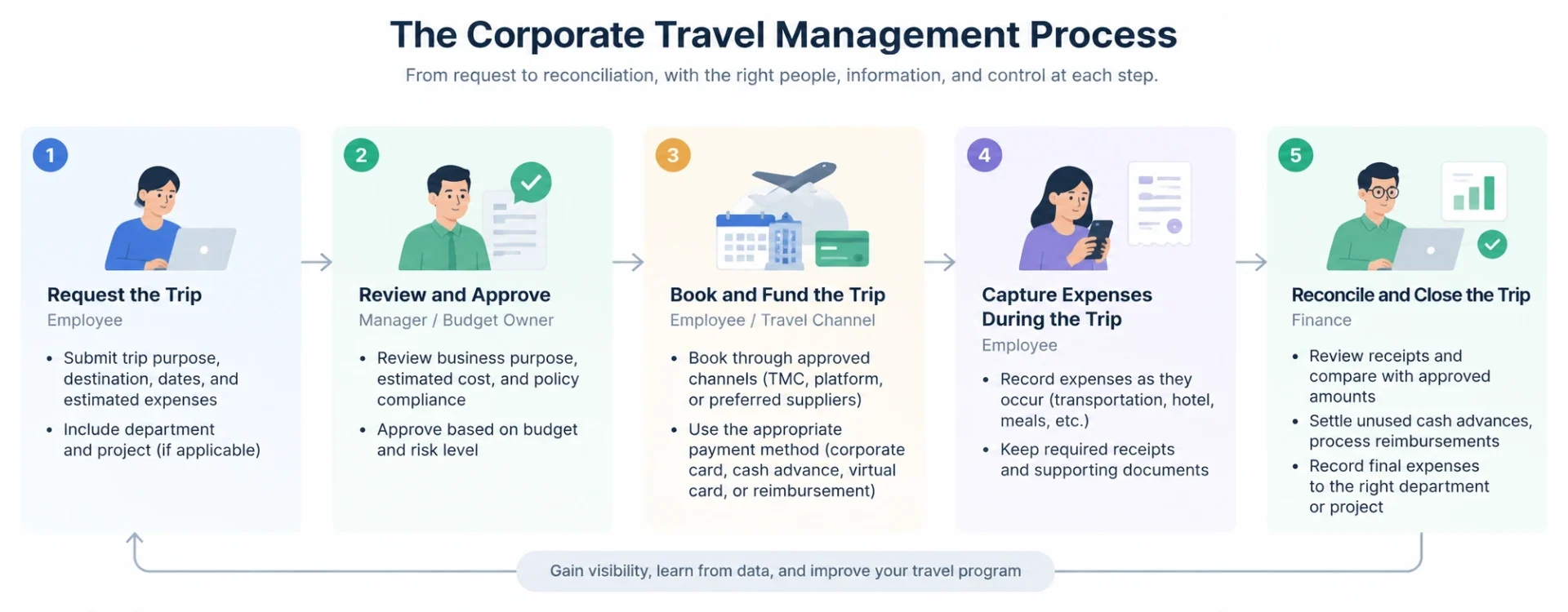
1. Request the Trip
Employees should submit a trip request before making travel-related commitments. The request can capture the destination, travel dates, business purpose, estimated cost, department, and project so the company has a clear basis for review.
2. Review and Approve
Managers or budget owners review the request against business needs, policy, and available budget. A defined approval workflow helps prevent employees from committing company funds before the trip has been authorized.
3. Book and Fund the Trip
Once approved, employees can book through the company’s designated channel, whether that means a travel management company, booking platform, or another approved method. The policy should make clear which booking channels are allowed and when employees can make exceptions.
Booking compliance is easier when the approved process is practical. Deloitte’s 2025 study found that 60% of surveyed travel managers said their companies were increasing compliance with their prescribed booking process, while 49% of business travelers said they always use corporate booking tools.
The company can then fund the trip using the appropriate payment method. Depending on the policy, this may involve a corporate card, cash advance, virtual card, or employee payment followed by reimbursement.
4. Capture Expenses During the Trip
Employees should record expenses as they occur and keep the required receipts or supporting documents. A consistent employee business expense process reduces the amount of information employees need to reconstruct after returning from a trip.
Finance can also define which expenses require additional documentation or approval, particularly for out-of-policy spending. This makes exceptions visible instead of leaving Finance to discover them during reconciliation.
5. Reconcile and Close the Trip
After the trip, actual expenses should be compared with the approved request, budget, and any cash advance or company-funded transactions. Any unused advance, reimbursement, refund, or outstanding documentation can then be settled before the trip is closed.
This final step gives Finance a complete record of what was planned, what was spent, and where the difference came from.
Control Travel Spending Without Slowing Employees Down
Enforce Policies Before Spending Happens
The strongest travel controls happen before money is spent. Approval limits, eligible expense categories, booking requirements, and spending limits can reduce the number of transactions that need to be reviewed manually later.
Controls also make unusual spending easier to identify. A defined business trip fraud prevention process can help Finance review suspicious claims, duplicate expenses, or spending that does not match the approved trip.
Give Employees Access to Controlled Company Funds
Employees need a practical way to pay for approved travel expenses without relying entirely on personal funds. The right approach depends on the company’s policy, but controlled company payment methods can reduce reimbursement volume and keep spending within approved limits.
For companies using corporate cards, Mekari Limitless Card provides company-controlled spending with transaction monitoring through Mekari Expense.
Keep Finance Visibility in Real Time
Travel spending is easier to manage when Finance can see transactions while the program is running rather than waiting until every trip has been completed. This helps the team compare actual spending with budgets and identify unusual increases earlier.
Strong spend visibility also makes it easier to understand which departments, projects, or expense categories are driving travel costs. Over time, consistent spend data management gives Finance a stronger basis for adjusting policies and budgets.
Measure and Improve the Travel Program
A travel program should be reviewed using both financial and operational metrics. The goal is to understand not only how much the company spends, but also where the process creates delays, exceptions, or unnecessary work.
| KPI | What It Shows |
|---|---|
| Average spend per trip | Typical cost of business travel and changes over time. |
| Spend vs. budget | Whether travel spending is staying within approved budgets. |
| Policy compliance | How often employees follow defined travel and expense rules. |
| Booking compliance | Whether employees use approved booking channels. |
| Approval turnaround | How long it takes for a trip request to receive approval. |
| Reimbursement turnaround | How quickly employees receive eligible reimbursements after submission. |
| Out-of-policy spending | How much travel spending falls outside approved rules. |
| Spend by department or project | Which parts of the organization are driving travel costs. |
| Cash advance settlement time | How quickly advances are reconciled and closed after a trip. |
These metrics can reveal different problems even when total travel spending looks acceptable. For example, stable spending with slow reimbursement or high out-of-policy rates may point to a process problem rather than a budget problem.
When Should You Use Corporate Travel Management Software?
A manual travel process can work when only a few employees travel occasionally. The need for a more connected system becomes clearer as trip volume, approval, payment, and reporting requirements increase.
Requests may come through different channels, managers may approve trips through email or chat, Finance may consolidate budgets manually, and cash advances or receipts may become harder to reconcile.
Another warning sign is when Finance cannot easily compare planned and actual spending. The company may know how much it spent on travel, but not which departments or projects drove the increase or how much of the budget has already been committed.
Corporate travel management software can connect these stages. Depending on the company’s needs, the setup may include a booking tool or TMC alongside expense management, corporate cards, approval workflows, or other financial systems.
For businesses that need to connect trip requests, approvals, cash advances, reimbursements, and post-trip reporting, Business Trips in Mekari Expense brings these activities into one workflow.
Build a Corporate Travel Program That Can Scale
A corporate travel program works when employees know what to do before, during, and after a trip, while Finance can see the financial result without rebuilding the story from receipts and spreadsheets.
Start with clear policy and approval rules, choose payment methods that fit the company’s control requirements, and connect them to expense reporting and reconciliation. As travel volume grows, use the resulting data to refine the program and keep the process manageable for both employees and Finance.