





Airwallex Alternatives in Indonesia: Which Option Fits Your Finance Team?

Mekari Insight
- Airwallex alternatives cover different Finance needs, from international payments and FX to employee expenses, procurement, Accounts Payable, and spend control.
- Airwallex itself now covers cards, expenses, bills, and purchase orders, so the right alternative depends on the workflows your Finance team needs to manage.
- Wise Business and Payoneer are relevant when international money movement is the main requirement, while Aspire and Volopay combine payments with broader spend management features.
- The biggest difference between these platforms appears when you look at the full Finance process, from purchasing and approval to invoice processing and payment.
- Mekari Expense connects Travel & Expense, Accounts Payable, Procurement, and Spend Control in one spend management platform.
Businesses searching for an Airwallex alternative may start with international payments and then find that their Finance requirements extend into employee expenses, purchasing, vendor invoices, approvals, and budget control.
Those needs can lead to very different software choices. A company that mainly pays overseas suppliers may prioritize international transfers and FX, while another Finance team may need to manage spending from a purchase request through approval, invoicing, and payment.
This guide compares Airwallex with five alternatives based on their main Finance capabilities and the workflows they support for businesses operating in Indonesia.

Airwallex Alternatives at a Glance
The table below gives a quick view of each platform’s main focus and key features. Use it to narrow down the options before looking at the detailed review of each platform.
| Platform | Best for | Key features |
|---|---|---|
| Airwallex | Global spend and financial operations | Corporate cards Expense management Bills and Accounts Payable Purchase Orders Global payments and FX |
| Mekari Expense | Integrated spend management in Indonesia | Travel & Expense Accounts Payable Procurement Spend Control International Remittance |
| Aspire | Regional business finance and spend management | Budgets Claims Bills and invoices Transfer approvals Virtual cards |
| Volopay | Corporate cards and spending controls | Corporate cards Expense management Reimbursements Accounts Payable Vendor payments Approval workflows |
| Wise Business | International transfers and FX | International transfers Multi-currency Receiving money Business payments International spending |
| Payoneer | International client, supplier, and marketplace payments | Global receiving accounts Multi-currency operations Supplier payments Contractor payments Marketplace payments |
What Should You Consider When Choosing an Airwallex Alternative?
Start with the Finance process your team needs to improve. A product can offer a corporate card or international transfer without solving the approval, purchasing, invoice, and reconciliation work that happens around the transaction.
A useful comparison should therefore cover the entire spending process. Finance teams can use a spend management framework to review where money is requested, approved, spent, recorded, and reconciled.
| Finance need | What to evaluate |
|---|---|
| International payments | Payments to overseas suppliers, contractors, partners, and other business recipients |
| FX and multi-currency | Currency conversion, balances, and cross-border transactions |
| Expense management | Employee claims, receipts, reimbursements, and expense reporting |
| Corporate cards | Controlled spending for employees, departments, subscriptions, or projects |
| Procurement | Purchase requests, approvals, quotations, purchase orders, and vendor management |
| Accounts Payable | Invoice capture, review, approval, payment scheduling, and reconciliation |
| Spend control | Budgets, policies, spending limits, approval rules, and transaction visibility |
| Indonesia fit | Business availability, local workflows, currency, accounting setup, and payment requirements |
Cross-border payments are also becoming more connected in the region. Bank Indonesia announced in February 2026 that Indonesia would join Project Nexus to strengthen cross-border payment connectivity with other participating countries.
For Finance teams, international payment capability is one part of the evaluation. The wider question is what happens before and after the payment, including purchasing, employee spending, vendor invoices, approvals, and budget tracking.
What Are the Best Airwallex Alternatives in Indonesia?
Each platform below addresses a different set of Finance requirements. The strongest option depends on which workflows your business needs to run in the same environment.
1. Mekari Expense
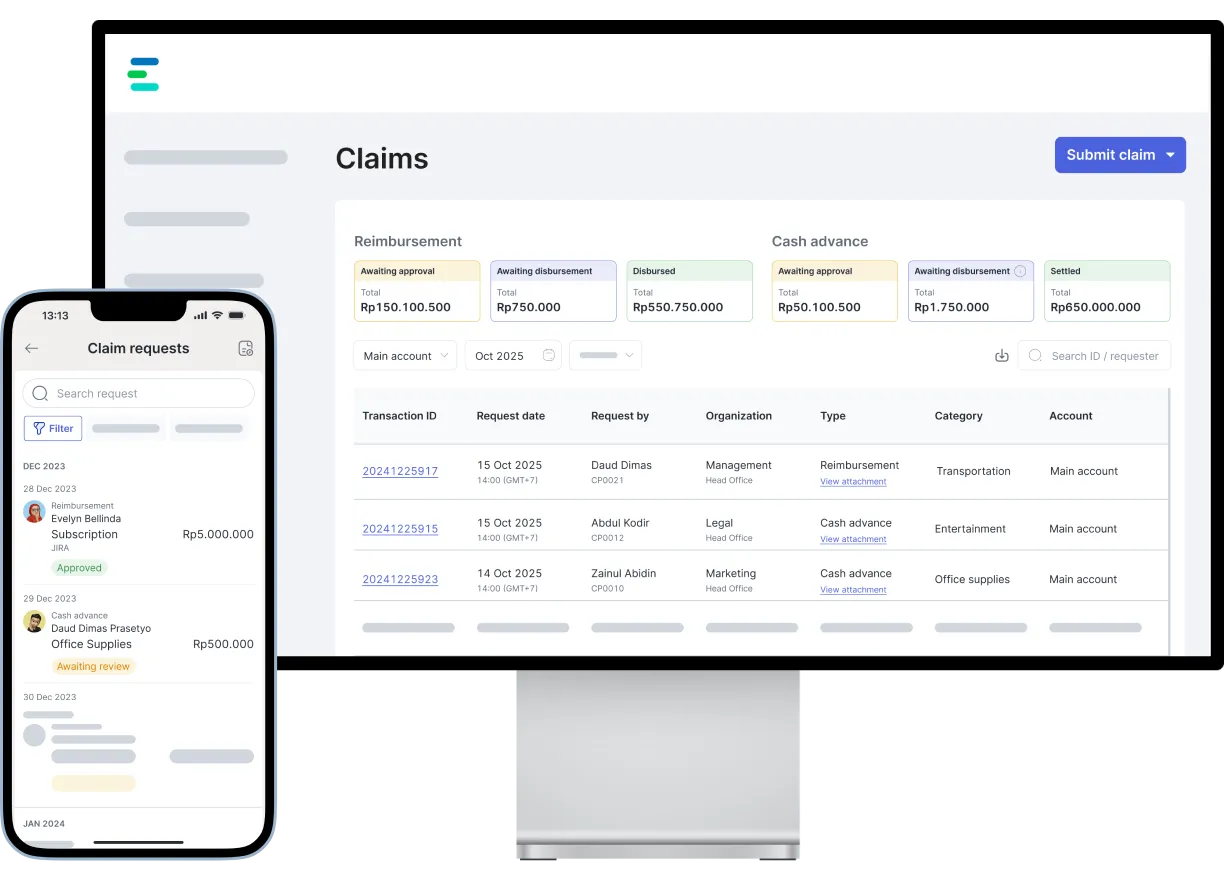
Best for: Finance teams that need integrated spend management across procurement, Accounts Payable, expenses, and spend control.
Mekari Expense brings Travel & Expense, Accounts Payable, Procurement, and Spend Control into one platform. Its product structure is designed around visibility and control across different types of company spending.
Key features:
- Travel & Expense: Employee expense claims, travel booking, receipt scanning, and policy enforcement.
- Accounts Payable: Invoice management, payment scheduling, and international remittance.
- Procurement: Purchase Request, Purchase Order, purchasing management, and vendor invoice capture.
- Spend Control: Budget allocation, approval workflows, and policy-based spending limits.
- Cards: Corporate spending through Mekari card products.
The purchasing workflow can start with a Purchase Request and continue through approval, quotation, Purchase Order, and Purchase Invoice. In the Help Center, employees, approvers, and Procurement users have different access across these steps.
This approach can be useful when Procurement and Finance need the same purchasing record throughout the process. The resulting Purchase Order management workflow can help Finance keep committed spending visible between approval and payment.
A good fit when: your Finance team wants procurement, AP, employee expenses, approvals, and spend controls to work together in one system.
2. Aspire
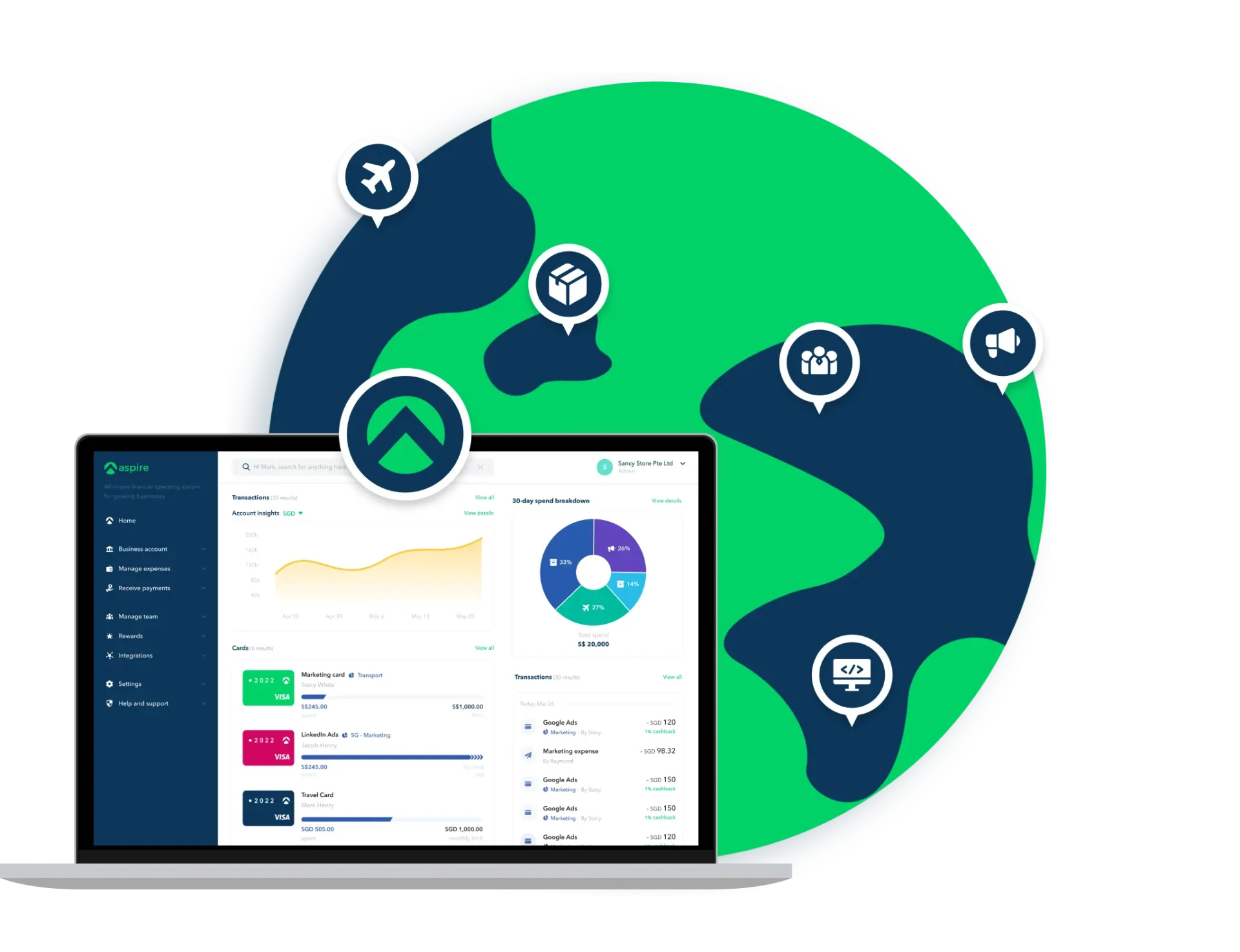
Best for: Businesses looking for regional business finance and spend management capabilities.
Aspire provides spend management features for Indonesia-incorporated businesses, including budgets, claims, bills, invoices, and payment approval policies. Its current eligibility documentation lists virtual cards and Advance Cards for Indonesia-incorporated businesses, while physical cards are unavailable for those entities.
Key features:
- Budgets: Set and manage spending budgets.
- Claims: Manage employee expense claims.
- Bills and invoices: Manage business bills and invoices.
- Payment approvals: Apply approval policies to transfers and claims.
- Virtual cards: Available for eligible Indonesia-incorporated businesses.
Country-specific availability should be checked before implementation because card and payment features can differ by business incorporation country.
A good fit when: your business wants regional spend management and payment capabilities and the available features match the requirements of your Indonesian entity.
3. Volopay
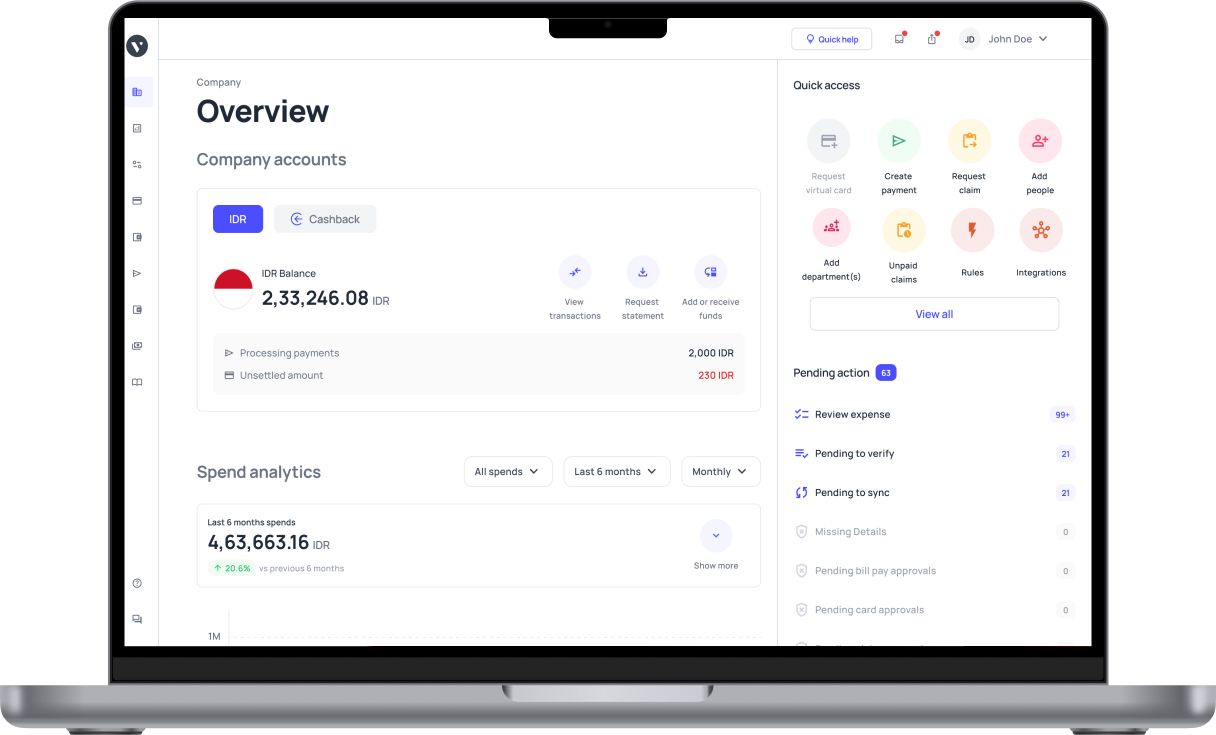
Best for: Companies prioritizing corporate cards, expense controls, AP, and business payments.
Volopay combines cards, expenses, reimbursements, Accounts Payable, vendor payments, and approval workflows. Its Indonesia offering also includes virtual cards and spending controls.
Key features:
- Corporate cards: Physical and virtual cards with spending controls.
- Expense management: Expense tracking and receipt collection.
- Reimbursements: Employee claims for out-of-pocket expenses.
- Accounts Payable: Vendor management, invoice approvals, and payment workflows.
- Approval workflows: Multi-level approval rules for payments and employee spending.
- International transfers: Domestic and cross-border business payments.
For teams using cards for subscriptions and recurring purchases, a purchasing card framework can also help when comparing how different platforms control delegated spending.
A good fit when: corporate cards and spending controls are central to your Finance operations alongside expenses, AP, and payments.
4. Wise
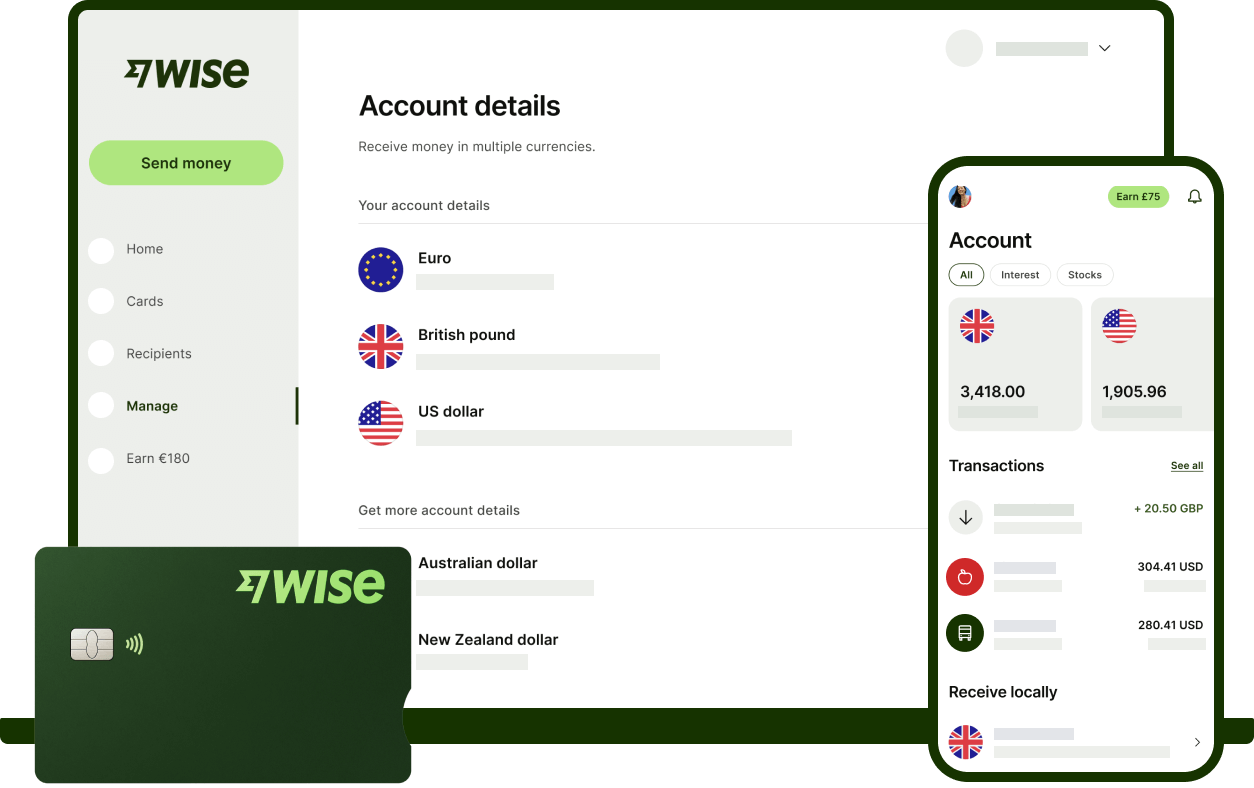
Best for: Businesses that primarily need international transfers and multi-currency capabilities.
Wise Business focuses on international money movement. For Indonesia, Wise currently supports international transfers and states that its services in the country are licensed by Bank Indonesia.
Key features:
- International transfers: Send business funds across countries.
- Multi-currency: Manage funds in different currencies.
- Receiving money: Receive payments from supported international sources.
- Business payments: Pay business expenses and international recipients.
- International spending: Spend in supported markets and currencies.
Wise makes more sense when international money movement is the starting point for the Finance requirement. Businesses with procurement, invoice approval, or broader spend management requirements should evaluate those workflows separately.
A good fit when: international transfers and FX are the main requirements for your Finance team.
5. Payoneer
Best for: Businesses with significant international client, supplier, contractor, or marketplace payments.
Payoneer focuses on cross-border business payments. Its current business platform supports international receiving, multi-currency balances, supplier payments, and contractor payments across 190+ countries and territories.
Key features:
- Global receiving accounts: Receive international business payments in supported currencies.
- Multi-currency operations: Hold and manage funds in multiple currencies.
- Supplier payments: Pay suppliers in their local currencies.
- Contractor payments: Send payments to contractors across international markets.
- Marketplace payments: Receive payouts from supported online marketplaces.
Payoneer is useful for businesses that regularly work with international clients, suppliers, contractors, or marketplaces. Companies that need more control before a payment is made should also evaluate their procurement and AP workflows.
A good fit when: cross-border receiving and payments are central to the business.
Which Airwallex Alternative Fits Each Finance Need?
The first table helps identify what each platform offers. This comparison looks at the other side of the decision: which option deserves a closer look based on the Finance problem your team is solving.
| Finance priority | Platforms worth evaluating | What to consider |
|---|---|---|
| Global payments and FX | Airwallex, Wise | International transfers and multi-currency requirements |
| International marketplace payments | Payoneer | Receiving marketplace payouts and paying overseas recipients |
| Corporate cards and delegated spending | Airwallex, Volopay, Aspire | Card controls, employee spending, and approval policies |
| Employee expense management | Mekari Expense, Airwallex, Aspire, Volopay | Claims, receipts, reimbursements, and approvals |
| Procurement workflow | Mekari Expense, Airwallex | Requests, approvals, POs, vendor information, and downstream invoices |
| Accounts Payable | Mekari Expense, Airwallex, Aspire, Volopay | Invoice processing, approvals, payment, and reconciliation |
| Procurement to AP to payment | Mekari Expense, Airwallex | Whether purchasing and downstream Finance processes stay connected |
| Indonesia-oriented spend management | Mekari Expense | Local operating requirements and connected spend workflows |
The difference becomes clearer when the comparison follows the full Finance process. Airwallex and Mekari Expense both cover multiple spend workflows, while Wise and Payoneer are more closely associated with international money movement.
For businesses with several departments, budgets also need to remain connected to actual spending. A corporate budgeting approach can help Finance define how spending should be planned and monitored before transactions take place.
The same principle applies to spend controls. Finance teams can review how policies and approval rules work in practice through a spend policy framework rather than judging a platform only by whether it offers a card or approval button.
What Should Finance Teams Check Before Switching Platforms?
A platform comparison is only useful when the product works for the transactions your team handles every day. Before choosing an Airwallex alternative, test the workflows that create the most manual work or approval delays today.
- Map the current process. Document how purchase requests, approvals, purchase orders, invoices, employee expenses, and payments move between people and systems.
- Separate core requirements from supporting features. A company processing many vendor invoices may prioritize AP, while another business may put more weight on international payments or cards.
- Check country and entity eligibility. Feature availability can differ by incorporation country, especially for business cards and payment services.
- Review accounting requirements. Check how transactions, tax information, cost centres, accounts, and reconciliation data move into your accounting system.
- Test real transactions. Use representative purchase requests, vendor invoices, employee expenses, recurring payments, and international transactions instead of relying only on a product demonstration.
Invoice handling deserves its own test because approval and payment often depend on the information captured at this stage. Teams can compare how a platform handles Accounts Payable OCR, invoice fields, approvals, and downstream accounting data.
The evaluation should also reflect how your business operates across locations. Finance teams supporting several branches may have different approval structures and spending patterns, which is why expense management for multi-location businesses can require additional controls.
When Should You Consider Mekari Expense Over Airwallex?
Mekari Expense can be a closer fit when the Finance requirement starts before the payment and continues across several spending workflows.
Procurement is part of the Finance process
A purchase may begin with an employee request, move through approval, and continue into a purchase order, invoice, and payment. Mekari Expense supports this workflow through structured purchasing steps and role-based access for requesters, approvers, and Procurement users.
Teams looking at the broader purchasing lifecycle can also refer to the Procurement guide when defining where approvals, suppliers, and business spend should connect.
AP needs to connect with purchasing and expenses
Finance may need visibility into vendor invoices alongside employee spending and other company expenses. Mekari Expense places Accounts Payable within the same product structure as Procurement, Travel & Expense, and Spend Control.
Its product coverage includes invoice management, payment scheduling, and international remittance. For teams reviewing the payment stage, the cross-border remittance guide provides additional context on solutions businesses can use for international payments.
International payments are part of a broader spending workflow
A company can have overseas supplier or contractor payments while still managing purchasing, approvals, invoices, and employee expenses in Indonesia. In that case, international remittance is one part of the Finance process rather than the entire workflow.
Mekari Expense includes International Remittance alongside Procurement, Accounts Payable, Travel & Expense, and Spend Control.
Finance needs tighter control over company spending
Finance teams may need to set spending rules before transactions happen, monitor available budgets, and route selected expenses through the right approval path. Mekari Expense’s product structure includes budget allocation, multi-level approvals, and policy-based spending limits.
When reviewing the source of overspending, Finance can also use a spending leakage framework to identify duplicated, off-policy, or poorly controlled expenses.
Business travel is a meaningful part of company spend
Travel expenses can involve booking, employee spending, receipts, reimbursement, and policy checks. Companies with frequent business trips should therefore compare how each platform handles the travel workflow rather than reviewing general expense claims alone.
The business travel expenses guide provides a useful reference for mapping those costs before selecting a platform.
The better choice depends on your Finance team’s priorities. Airwallex may make more sense for businesses where global financial operations and multi-currency activity are central. Mekari Expense may be a closer fit when Finance needs to manage purchasing, AP, employee expenses, and spend controls as one connected process.
Frequently Asked Questions About Choosing an Airwallex Alternative
Can a company use more than one finance platform?
Can a company use more than one finance platform?
Yes. A company may use one platform for international payments and another for procurement, expenses, or accounting. Before doing so, define which system owns each transaction record and how data moves between the systems.
What data should Finance prepare before evaluating an Airwallex alternative?
What data should Finance prepare before evaluating an Airwallex alternative?
Prepare representative transactions from the workflows you want to test. These can include vendor invoices, purchase orders, employee expenses, recurring card payments, and international transfers. A transaction sample makes it easier to compare approval steps, accounting fields, reporting, and payment requirements using actual business scenarios.
How should Finance compare the cost of two finance platforms?
How should Finance compare the cost of two finance platforms?
Look beyond the subscription price. Include implementation, transaction fees, FX costs, card charges, integrations, user costs, limits, and the internal work needed to operate each platform. The total cost can change significantly once transaction volume and workflow requirements are included.
What should a Finance team prepare for a platform migration?
What should a Finance team prepare for a platform migration?
Decide which historical transactions, active vendors, unpaid invoices, approval records, and recurring payments need to move to the new system. The team should also determine where older records will remain accessible and how outstanding transactions will be handled during the transition.
What should Finance test during a product trial?
What should Finance test during a product trial?
Test the workflows that create the most work for the team today. A useful pilot can include one purchase request, one approval chain, one purchase order, one vendor invoice, one employee expense, and one payment. Ask the people responsible for each step to complete the workflow and record where manual work remains.
How often should Finance review its spend management setup?
How often should Finance review its spend management setup?
Review the setup when the company’s spending structure changes materially, such as entering a new market, adding departments, changing approval authority, or introducing new payment methods. Finance can also review recurring spending patterns to check whether budgets, policies, and approval rules still match how the business operates.
Choosing an Airwallex alternative works best when the evaluation starts with the Finance team’s actual process. Compare each platform against the work your team performs every week, then choose the option that fits those requirements most closely.